Anhydrite, Calcite and Chalcedony
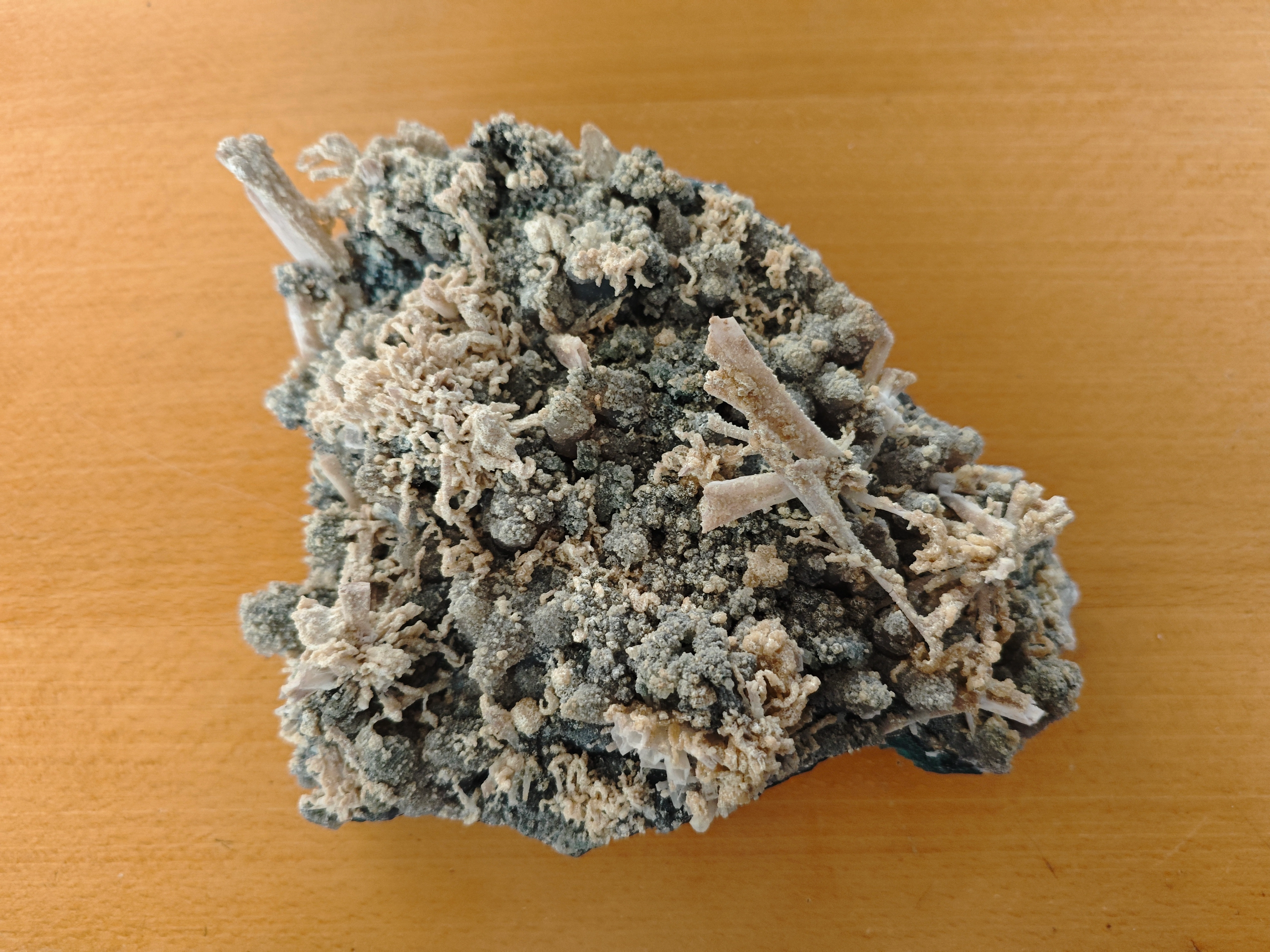
| ID | 650 | |
|---|---|---|
| Mineral |
Anhydrite
Calcite Chalcedony |
|
| Location | Iraí - Rio Grande Do Sul - Brazil | |
| Fluorescence | LW-UV: close SW-UV: close |
|
| Mindat.org |
View Anhydrite information at mindat.org View Calcite information at mindat.org View Chalcedony information at mindat.org |
|
Mindat data
| ID | 234 |
|---|---|
| Long ID | 1:1:234:1 |
| Formula |
CaS6+O4
|
| IMA Status |
APPROVED GRANDFATHERED |
| Description | Isostructural with Ferruccite; isostructural and isomorphous with α-BaSO4 and α-SrSO4. Readily alters to gypsum. |
| Other Occurrences | Sedimentary evaporite deposits, cap rock of salt domes. |
| Discovery Year | 1804 |
| Diapheny | Transparent,Translucent |
| Cleavage | On {010} perfect; on {100} nearly perfect; on {001} good to imperfect. |
| Tenacity | brittle |
| Colour | Colourless, bluish, blue-grey, violet, burgundy-red, white, rose-pink, brownish, reddish, grey, dark grey; colourless in transmitted light |
| Hardness (min) | 3.0 |
| Hardness (max) | 3.5 |
| Lustre | Vitreous, greasy |
| About the name |
Named in 1804 by Abraham Gottlob Werner from the Greek άνυδρος ("anhydros") meaning "without water", in allusion to the lack of water in its composition, in contrast to |
| Streak | White, off-white, greyish |
| Crystal System | Orthorhombic |
| Cleavage Type | Perfect |
| Fracture type | Irregular/Uneven,Splintery |
| Morphology | Crystals equant, or nearly so, with large pinacoidal faces. Also thick tabular on {010}, {100}, or {001}; commonly elongated on [100], [010] or [001]. Massive. Fine granular to scaly; fibrous (either parallel, radiated or plumose) and frequently curved. Contorted concretionary forms (bowel stone). |
| Twinning | 1.) On {011} as contact twins and polysynthetic lamellae (may be produced by heating or pressure); 2.) On {120} as contact twins, rare. |
| UV | Can show fluorescence under LW and/or SW. For example: bluish white response to SW: https://www.mindat.org/photo-1254482.html |
| Thermal Behaviour | Inverts to α-CaSO4 at 1193°C. Melting Point = ~ 1450°C. Before the blowpipe, fuses at 3, coloring the flame reddish yellow, giving an enamel-like bead which reacts alkaline. |
| Comment Luster | Pearly on {010} |
| shortcode_ima | Anh |
| ID | 859 |
|---|---|
| Long ID | 1:1:859:4 |
| Formula |
CaCO3
|
| IMA Status |
APPROVED GRANDFATHERED |
| Description | Calcite Group. Calcite-Rhodochrosite Series. A very common and widespread mineral with highly variable forms and colours. Calcite is best recognized by its relatively low Mohs hardness (3) and its high reactivity with even weak acids, such as vinega... |
| Other Occurrences | Found in most geologic settings and as a later forming replacement mineral in most other environments in one form or another, it is most common as massive material in limestones and marbles. It forms as chemical sedimentary deposits as limestone, can be regionally or contact metamorphosed into marbles and rarely forms igneous rocks (carbonatites). Also is a common gangue mineral in hydrothermal deposits. |
| Industrial | Mined extensively for a wide variety of uses ranging from lime (cement) to limestone and marble building stones and aggregates, agricultural supplements and optical calcite. |
| Diapheny | Transparent,Translucent |
| Cleavage |
Perfect on |
| Tenacity | brittle |
| Colour | White, Yellow, Red, Orange, Blue, Green, Brown, Gray etc. |
| Hardness (min) | 3.0 |
| Hardness (max) | 3.0 |
| Luminescence | Fluorescent |
| Lustre | Vitreous |
| About the name | Ancient name. Named as a mineral by Gaius Plinius Secundus (Pliny the elder) in 79 from Calx, Latin for Lime. |
| Streak | White |
| Crystal System | Trigonal |
| Cleavage Type | Perfect |
| Fracture type | Conchoidal |
| Morphology | Over 800 different forms have been described. Most commonly as acute rhombohedrons or prismatic with scalenohedral terminations, or combinations of the two. |
| Twinning |
At least four twin laws have been described, the most common being when the twin plane and the composition plane are |
| UV | May be fluorescent under LW UV, mid-range UV or SW UV as well as under X-rays, cathode rays and even sunlight, in a number of colors and shades, commonly an intense red under SW with Mn as an activator (such as at Franklin, New Jersey, USA, and Långban in Sweden. The yellow series exhibits blue–white fluorescence, together with a short-lived green phosphorescent afterglow after removal of the excitation source, whereas the pink series shows stable orange–red fluorescence with much weaker afterglow behavior. [[1]] |
| Comment Luster | Pearly on cleavage and {0001}. Can be dull or earthy in chalk variety. |
| shortcode_ima | Cal |
| ID | 960 |
|---|---|
| Long ID | 1:1:960:9 |
| Variety of | 3337 |
| Entry type | 2 |
| Other Occurrences | Very common. As nodules, vein fillings, crusts in volcanic rocks. As sinter-like crusts in low- to medium temperature hydrothermal veins. Main constituent in silica-rich marine sedimentary rocks. As nodular concretions and layers in limestones and marls. As a metasomatic replacement in limestones and marls ("replacement chert"). As cement in sandstones. Replacing other minerals in pseudomorphoses. As a fossilizing material (petrified wood, coral agate). |
| Diapheny | Translucent |
| Tenacity | brittle |
| Colour | colorless, white, gray, blue, any color due to embedded minerals, multicolored specimen not uncommon. |
| Hardness (min) | 6.5 |
| Hardness (max) | 7.0 |
| About the name | Mentioned by Agricola (1546) of a stone named for the town of Chalcedon, now called Kadıköy, and is a district within the city of Istanbul, Turkey. |
| Streak | White |
| Cleavage Type | None Observed |
| Fracture type | Conchoidal,Sub-Conchoidal |
| Twinning | Quartz crystallites in the chalcedony fibers are polysynthetically twinned by the Brazil law (left- and right-handed domains). |
| UV | None in a pure specimen, however, green fluorescence in short-wave UV light is very common at many localities. |
| Comment Luster | vitreous when polished, fractured surfaces have a dull or waxy luster |
Details
Price: € 110
Dimensions: None mm x None mm x None mm
Weight: Not registered
Visibile in overview:
Notes:
None
| Symbol | Element | |
|---|---|---|
| C | Carbon | |
| Ca | Calcium | |
| O | Oxygen | |
| S | Sulfur | |
| Si | Silicium |