Lizardite, Hematite and Hydrotalcite
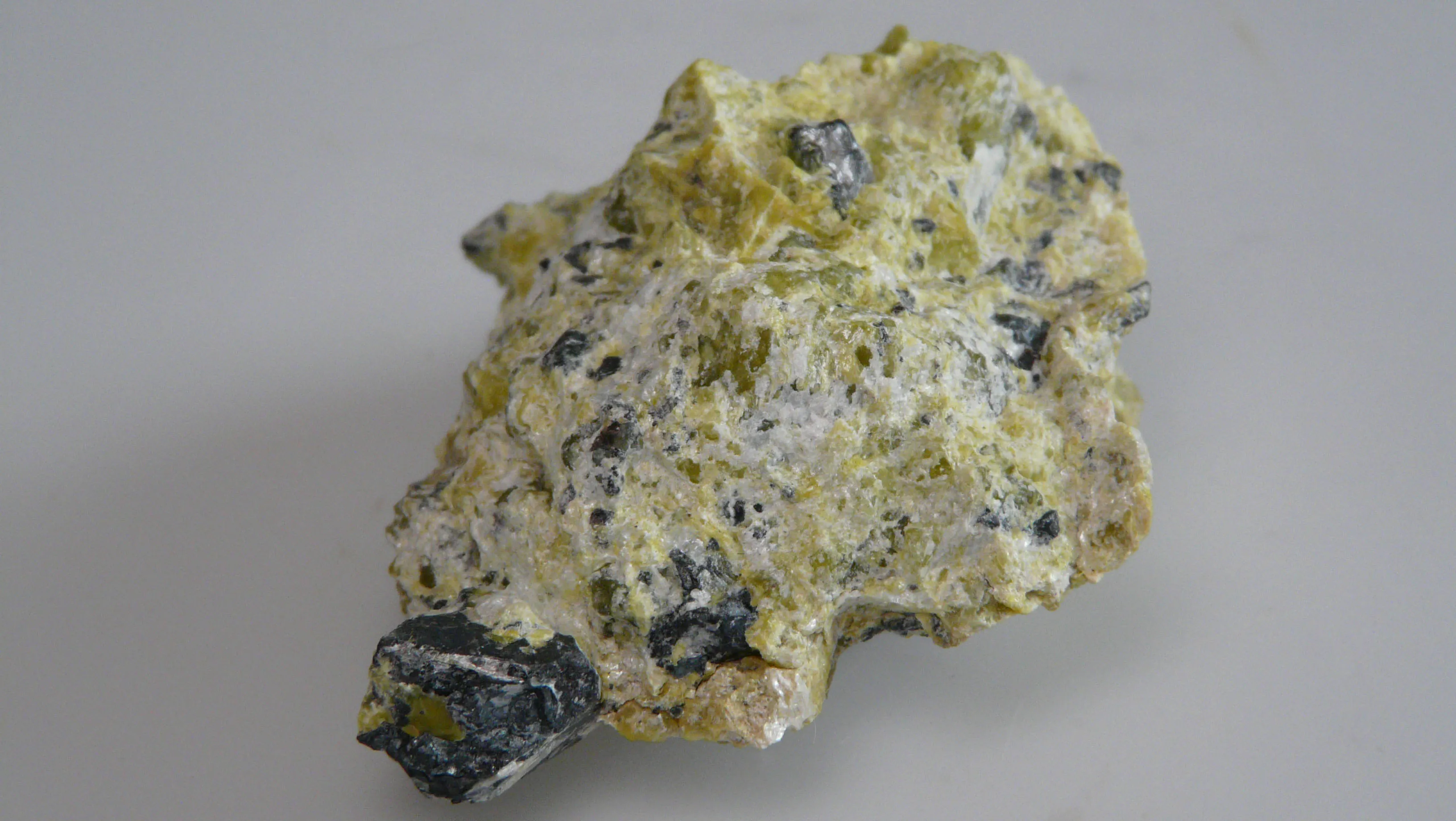
| ID | 610 | |
|---|---|---|
| Mineral |
Lizardite
Hematite Hydrotalcite |
|
| Location | Dypingdal serpentine-magnesite deposit - Snarum - Buskerud - Norway | |
| Fluorescence | LW-UV: close SW-UV: close |
|
| Mindat.org |
View Lizardite information at mindat.org View Hematite information at mindat.org View Hydrotalcite information at mindat.org |
|
Mindat data
| ID | 2425 |
|---|---|
| Long ID | 1:1:2425:5 |
| Formula |
Mg3Si2O5(OH)4
|
| IMA Status |
0 1 |
| Description | Lizardite is volumetrically the most common serpentine subgroup species. It is typically a product of retrograde metamorphism, replacing olivine and orthopyroxene (enstatite) in ultramafic igneous rocks and some magnesian skarns. Can contain nickel ... |
| Other Occurrences |
It is typically a product of retrograde metamorphism, replacing |
| Diapheny | Translucent |
| Cleavage | Rarely observed |
| Tenacity | flexible |
| Colour | green, brown, light yellow to white |
| Hardness (min) | 2.5 |
| Hardness (max) | 2.5 |
| About the name | Named in 1955 by Eric James William Whittaker and Jack Zussman for the type location which lies within the area of Cornwall known as the Lizard peninsula. The locality itself being at Eastern Cliff, Kennack, Ruan - Grade, Lizard Peninsula, Cornwall, England, UK. |
| Streak | white |
| Crystal System | Trigonal |
| Fracture type | Irregular/Uneven,Conchoidal,Sub-Conchoidal |
| Morphology | Trigonal plates to truncated trigonal pyramids. |
| UV | Not known to be fluorescent in UV |
| shortcode_ima | Lz |
| Group | Serpentine Subgroup |
| ID | 1856 |
|---|---|
| Long ID | 1:1:1856:8 |
| Formula |
Fe2O3
|
| IMA Status |
0 1 |
| Description | Hematite Group. The iron analogue of Corundum, Eskolaite, and Karelianite. Hematite is rather variable in its appearance - it can be in reddish brown, ocherous masses, dark silvery-grey scaled masses, silvery-grey to black crystals, and dark-grey ma... |
| Other Occurrences | Large ore bodies of hematite are usually of sedimentary origin; also found in high-grade ore bodies in metamorphic rocks due to contact metasomatism, and occasionally as a sublimate on igneous extrusive rocks ("lavas") as a result of volcanic activity. It is also usually the cause of red soils all over the planet. |
| Industrial | A major ore of iron. |
| Diapheny | Opaque |
| Tenacity | brittle |
| Colour | Steel-grey to black in crystals and massively crystalline ores, dull to bright "rust-red" in earthy, compact, fine-grained material. |
| Hardness (min) | 5.0 |
| Hardness (max) | 6.0 |
| Luminescence | None |
| Lustre | Metallic |
| About the name | Originally named about 300-325 BCE by Theophrastus from the Greek, "αιματίτις λίθος" ("aematitis lithos") for "blood stone". It is possibly the first mineral ever named ending with a "-ite" suffix. Translated in 79 by Pliny the Elder to haematites, "bloodlike", in allusion to the vivid red colour of the powder. The modern form evolved by authors frequently simplifying the spelling by excluding the "a", somewhat in parallel with other words originally utilising the root "haeme". |
| Streak | Reddish brown ("rust-red"); blackish when Ti-bearing |
| Crystal System | Trigonal |
| Cleavage Type | None Observed |
| Fracture type | Irregular/Uneven,Sub-Conchoidal |
| Morphology |
|
| Twinning |
|
| UV | None. |
| shortcode_ima | Hem |
| Group | Hematite Group |
| ID | 1987 |
|---|---|
| Long ID | 1:1:1987:9 |
| Formula |
Mg6Al2CO3(OH)16(H2O)4
|
| IMA Status |
0 1 |
| Description | Is a member of the hydrotalcite group and hydrotalcite supergroup. May be confused with meixnerite. Compare also quintinite. "Manasseite" was discredited because it was recognised as a hexagonal polytype of hydrotalcite, Hydrotalcite-2H, by Mills... |
| General Appearance | As contorted, lamellar-to-fibrous white masses of waxy or pearly lustre. |
| Occurrence | A serpentine-magnesite body |
| Discovery Year | 1842 |
| Diapheny | Transparent |
| Cleavage | {0001} |
| Colour | White, brownish |
| Hardness (min) | 2.0 |
| Hardness (max) | 2.0 |
| Lustre | Pearly |
| About the name | First found by Prof. K. J. A. Theodor Scheerer (1813-1875) at Snarum, Buskerud, Norway. Named in 1842 by Carl Christian Hochstetter in allusion its high water content ('Hydro-') and to its resemblance to talc. |
| Streak | White |
| Crystal System | Trigonal |
| Cleavage Type | Perfect |
| Morphology | Massive, with a foliated or contorted lamellar structure on {0001}. Indistinct plates; lamellar-fibrous. |
| Publication Year | 1842 |
| shortcode_ima | Htc |
| Group | Hydrotalcite Group |
Details
Price: € 8
Dimensions: Not registered
Weight: Not registered
Visibile in overview:
Notes:
| Symbol | Element | |
|---|---|---|
| Al | Aluminium | |
| C | Carbon | |
| Fe | Iron | |
| H | Hydrogen | |
| Mg | Magnesium | |
| O | Oxygen | |
| Si | Silicium |