Tennantite-(Fe), Calcite and Malachite
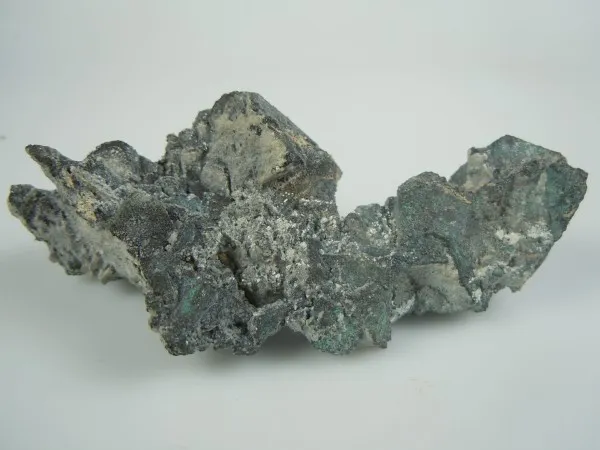
| ID | 354 | |
|---|---|---|
| Mineral |
Tennantite-(Fe)
Calcite Malachite |
|
| Location | Tsumeb Mine - Tsumeb - Oshikoto - Namibia | |
| Fluorescence | LW-UV: close SW-UV: close |
|
| Mindat.org |
View Tennantite-(Fe) information at mindat.org View Calcite information at mindat.org View Malachite information at mindat.org |
|
Mindat data
| ID | 3911 |
|---|---|
| Long ID | 1:1:3911:2 |
| Formula |
Cu6[Cu4(Fe,Zn)2]As4S13
|
| IMA Status |
0 |
| Entry type | 5 |
| Description | Biagioni et al. (2020) delineate the series of Ag-poor tennantites, where Ag < 3 apfu, belong to the tennantite series. Although considered a series as there were formerly just two IMA-recognized end-members (tennantite-(Fe) and tennantite-(Zn)), th... |
| Other Occurrences | Hydrothermal veins and contact metamorphic deposits. |
| Industrial | Copper ore |
| Discovery Year | 1819 |
| Diapheny | Opaque |
| Tenacity | brittle |
| Colour | Grey-black, steel-gray, iron-gray, black |
| Hardness (min) | 3.0 |
| Hardness (max) | 4.5 |
| Lustre | Metallic |
| About the name | Originally called "gray sulphuret of copper in dodecahedral crystals" in 1817 by James Sowerby. Renamed in 1819 by William Phillips in honor of Smithson Tennant [November 30, 1761, Selby, Yorkshire, England, United Kingdom - February 22, 1815, Boulogne-sur-Mer, France], English chemist of independent means. Tennant established the beneficial nature of using limestone to reduce soil acidity. He and William Hyde Wollaston, who was then his chemical assistant, analyzed graphite and diamond and found that graphite and diamond were both carbon. He analyzed meteorites and found nickel in them, as well as finding iodine in sea water. Tennant's fame, however, is firmly based on his discovery of the elements iridium and osmium. |
| Streak | Reddish grey, black, red-brown |
| Crystal System | Isometric |
| Fracture type | Sub-Conchoidal |
| Morphology | Tetrahedral to rounded crystals to 20 cm. |
| Twinning | Twin axis [111], twin plane {111} |
| key_elements |
0 1 |
| Group | Tetrahedrite Group |
| ID | 859 |
|---|---|
| Long ID | 1:1:859:4 |
| Formula |
Ca(CO3)
|
| IMA Status |
0 1 |
| Other Occurrences | Found in most geologic settings and as a later forming replacement mineral in most other environments in one form or another, it is most common as massive material in limestones and marbles. It forms as chemical sedimentary deposits as limestone, can be regionally or contact metamorphosed into marbles and rarely forms igneous rocks (carbonatites). Also is a common gangue mineral in hydrothermal deposits. |
| Industrial | Mined extensively for a wide variety of uses ranging from lime (cement) to limestone and marble building stones and aggregates, agricultural supplements and optical calcite. |
| Diapheny | Transparent,Translucent |
| Cleavage |
Perfect on |
| Tenacity | brittle |
| Colour | White, Yellow, Red, Orange, Blue, Green, Brown, Gray etc. |
| Hardness (min) | 3.0 |
| Hardness (max) | 3.0 |
| Luminescence | Fluorescent |
| Lustre | Vitreous |
| About the name | Ancient name. Named as a mineral by Gaius Plinius Secundus (Pliny the elder) in 79 from Calx, Latin for Lime. |
| Streak | White |
| Crystal System | Trigonal |
| Cleavage Type | Perfect |
| Fracture type | Conchoidal |
| Morphology | Over 800 different forms have been described. Most commonly as acute rhombohedrons or prismatic with scalenohedral terminations, or combinations of the two. |
| Twinning |
At least four twin laws have been described, the most common being when the twin plane and the composition plane are |
| UV | May be fluorescent under LW UV, mid-range UV or SW UV as well as under X-rays, cathode rays and even sunlight, in a number of colors and shades, commonly an intense red under SW with Mn as an activator (such as at Franklin, New Jersey, USA, and Långban in Sweden. |
| Comment Luster | Pearly on cleavage and {0001}. Can be dull or earthy in chalk variety. |
| shortcode_ima | Cal |
| Group | Calcite Group |
| ID | 2550 |
|---|---|
| Long ID | 1:1:2550:4 |
| Formula |
Cu2(CO3)(OH)2
|
| IMA Status |
0 1 |
| Other Occurrences | It is the most common secondary mineral found in the oxidized zones of copper deposits. |
| Industrial | A minor ore of copper when abundant enough in a copper deposit. |
| Discovery Year | Unno |
| Diapheny | Opaque |
| Cleavage |
Perfect on |
| Tenacity | brittle |
| Colour | Bright green, with crystals deeper shades of green, even very dark to nearly black; green to yellowish green in transmitted light. |
| Hardness (min) | 3.5 |
| Hardness (max) | 4.0 |
| About the name | Named in antiquity (see Pliny the Elder, 79 CE) molochitus after the Greek μαλαχή, "mallows," in allusion to the green color of the leaves. Known in the new spelling, malachites, at least by 1661. |
| Streak | Light green |
| Crystal System | Monoclinic |
| Cleavage Type | Perfect |
| Fracture type | Splintery |
| Morphology | Crystals uncommon, usually short or long prismatic or acicular, parallel to [001]; often grouped in rosettes, sprays, or tufts. Botryoidal to mammillary aggregates of radiating fibrous crystals more common. It may also be massive, compact, and stalactitic. |
| Twinning | Untwinned crystals are extremely rare. Typically twinned on {100}, sometimes as penetration or polysynthetic twinning with the axis parallel to [201]. |
| Thermal Behaviour | Loses water at about 315°, leaving tenorite. |
| key_elements |
0 |
| shortcode_ima | Mlc |
| Group | Rosasite Group |
Details
Price: € 50
Dimensions: Not registered
Weight: 182 g
Visibile in overview:
Notes:
| Symbol | Element | |
|---|---|---|
| As | Arsenic |

|
| C | Carbon | |
| Ca | Calcium | |
| Cu | Copper | |
| H | Hydrogen | |
| O | Oxygen | |
| S | Sulfur |