Biotite and Feldspar
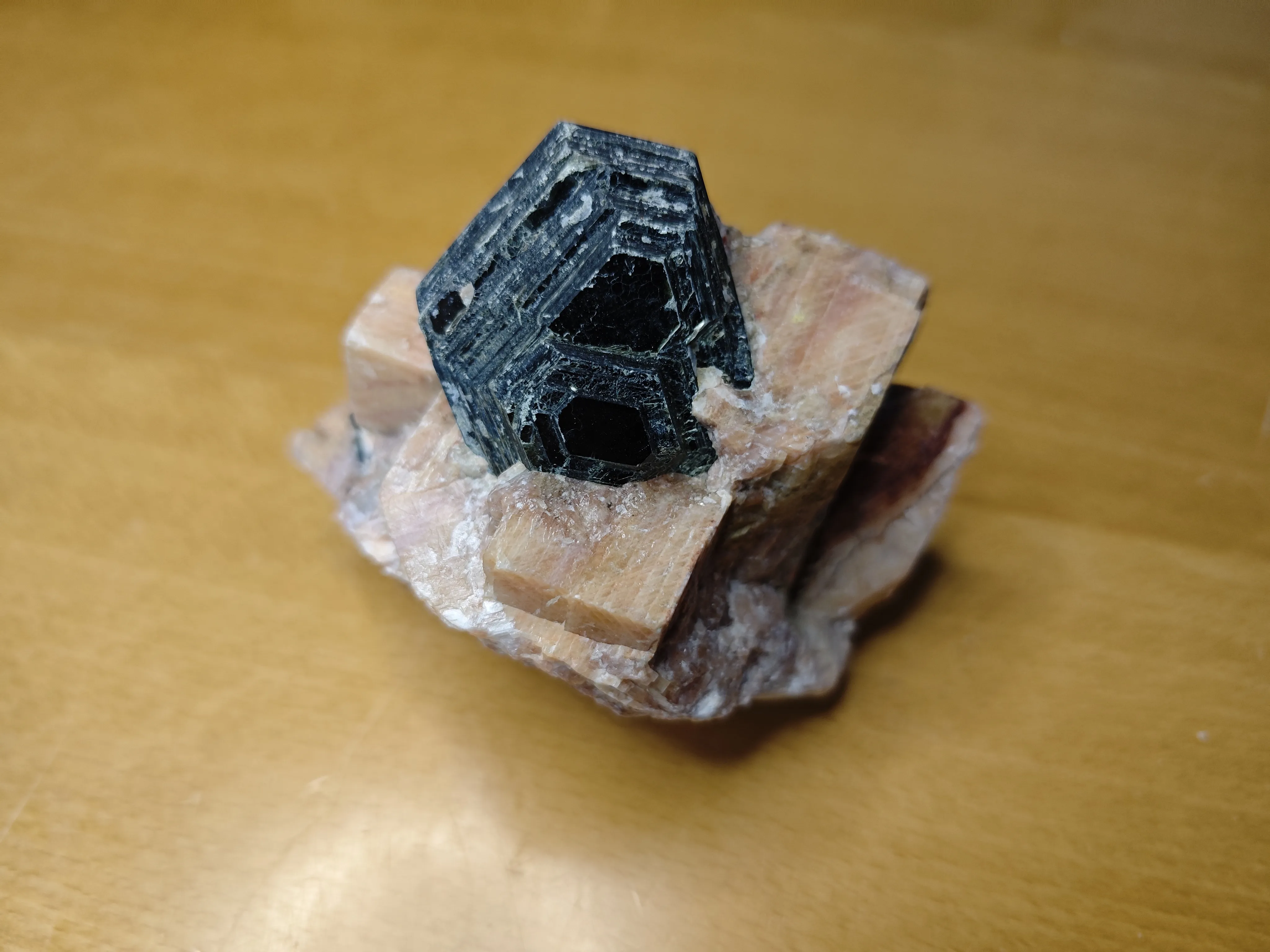
| ID | 645 | |
|---|---|---|
| Mineral |
Biotite
Feldspar |
|
| Location | Namibia | |
| Fluorescence | LW-UV: close SW-UV: close |
|
| Mindat.org |
View Biotite information at mindat.org View Feldspar information at mindat.org |
|
Mindat data
| ID | 677 |
|---|---|
| Long ID | 1:1:677:2 |
| Entry type | 5 |
| Luminescence | None |
| Lustre | Vitreous - Pearly |
| About the name | Named in 1847 by Johann Friedrich Ludwig Hausmann in honour of the French physicist, mathematician, meteoriticist, astronomer, and mineralogist, Jean-Baptiste Biot [April 21, 1774, Paris, France - February 3, 1862, Paris, France], who studied the optical properties of the micas. Biot and his associate, Félix Savart, discovered that an electric current in a wire produced a magnetic field. Biot received many awards in his lifetime in recognition of the value of his scientific researches. |
| key_elements |
Ti |
| shortcode_ima | Bt |
| ID | 1624 |
|---|---|
| Long ID | 1:1:1624:3 |
| Entry type | 5 |
| About the name | The name is derived from the German term 'Feldspat'. For centuries, miners generally referred to minerals and rocks as "Spat" if they had the property of being particularly easy to (completely) split. The perfection of cleavage was often evident from the existing, visible cleavage cracks and from the fact that fine flakes (“Spaten”) detached from the mineral or rock body when struck with a hammer. The term feldspar came into being around the middle of the 18th century when people in mineralogy learned to differentiate between the different types of minerals more precisely. There are various theories about the exact origin of this name. In 1783, for example, Urban Brückmann asked himself whether feldspar could have received its name based on its characteristic way of occurrence in the form of fields or patches in granite and other types of rock (never as entire veins, rocks, or mountains). René-Just Haüy, on the other hand, suggested in his 1804 work "Traité de minéralogie" that the name could have been chosen based on the fact that feldspar fragments were regularly found in the fields. The feldspar would therefore be understood as “spar from the fields” and an indication that feldspar gradually turned into arable soil through weathering. |
| shortcode_ima | Fsp |
Details
Price: € 45
Dimensions: None mm x None mm x None mm
Weight: Not registered
Visibile in overview:
Notes:
None
| Symbol | Element | |
|---|---|---|
| Al | Aluminium | |
| F | Fluorine |

|
| Fe | Iron | |
| H | Hydrogen | |
| K | Potassium | |
| Mg | Magnesium | |
| O | Oxygen | |
| Si | Silicium | |
| Ti | Titanium |