Watermelon Tourmaline, Rock Crystal and Albite
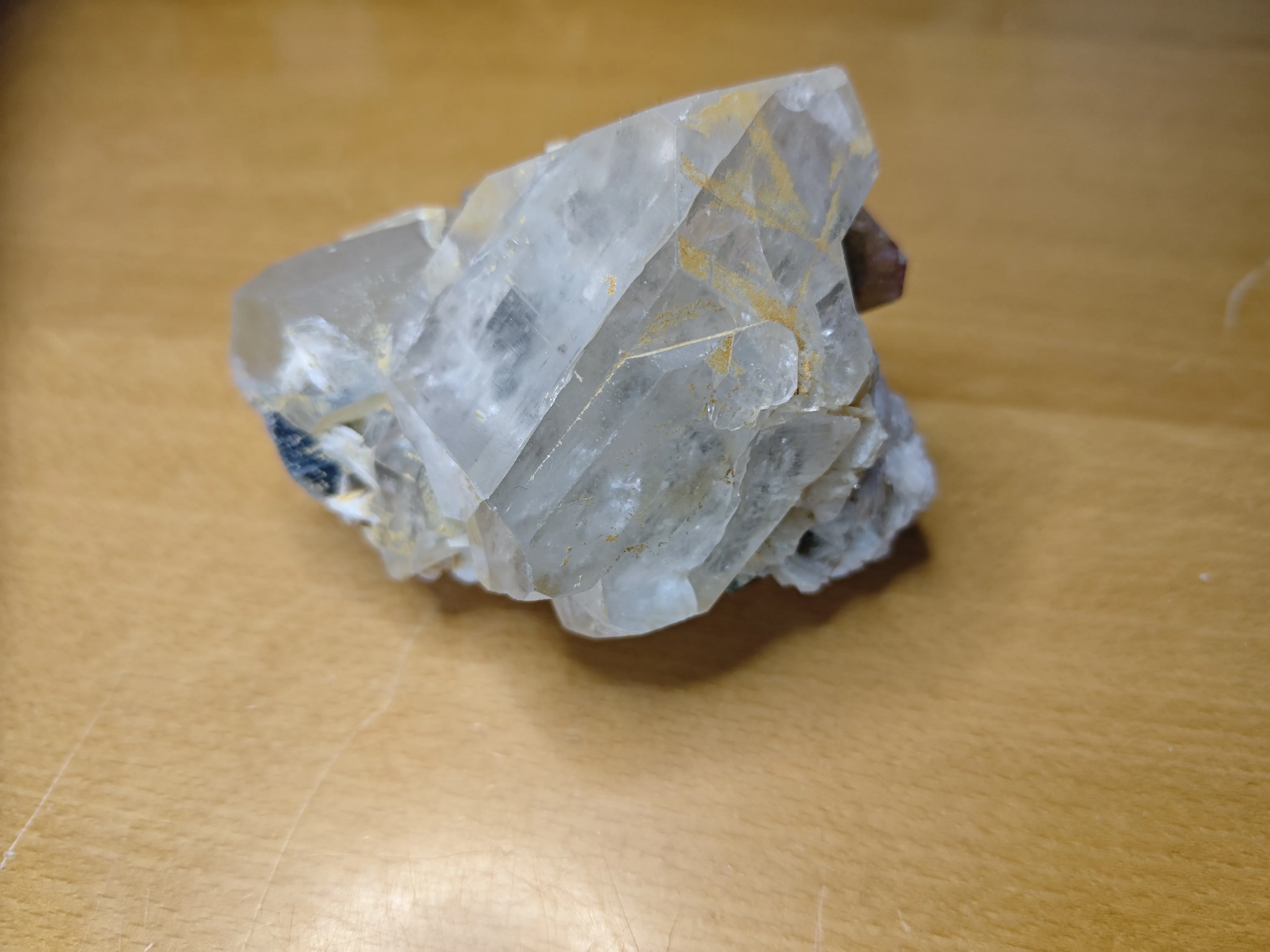
| ID | 644 | |
|---|---|---|
| Mineral |
Watermelon Tourmaline
Rock Crystal Albite |
|
| Location | Gilgit-Baltistan - Pakistan | |
| Fluorescence | LW-UV: close SW-UV: close |
|
| Mindat.org |
View Watermelon Tourmaline information at mindat.org View Rock Crystal information at mindat.org View Albite information at mindat.org |
|
Mindat data
| ID | 10889 |
|---|---|
| Long ID | 1:1:10889:4 |
| Variety of | 4003 |
| Entry type | 2 |
| Occurrence | Granite pegmatite |
| Discovery Year | 1910 |
| Diapheny | Transparent |
| Tenacity | brittle |
| Colour | Green rims on red/pink cores |
| Hardness (min) | 7.0 |
| Hardness (max) | 7.5 |
| About the name | Watermelon tourmaline is a variety of concentrically color-zoned tourmaline with red interiors and green exteriors and is distinct from longitudinal bi-color or polychrome zonation. The name was coined by George Robeley Howe [1860-1950] of Norway, Maine, USA. The name was first used in a Lewiston, Maine newspaper account in 1910 when describing specimens from the Havey Quarry in Poland, Maine, USA. The name was used in an international publication, Mineral Resources of the United States, by Douglas B. Sterrett in 1911. |
| Cleavage Type | None Observed |
| Fracture type | Irregular/Uneven,Conchoidal,Sub-Conchoidal |
| UV | The red/pink cores may fluoresce chalky blue or creamy white in SW UV depending on the activator. Sometimes specimens show both colors in patchy or zonal arrangement. |
| ID | 6128 |
|---|---|
| Long ID | 1:1:6128:1 |
| Variety of | 3337 |
| Entry type | 2 |
| ID | 96 |
|---|---|
| Long ID | 1:1:96:9 |
| Formula |
Na(AlSi3O8)
|
| IMA Status |
APPROVED GRANDFATHERED |
| Description | One of the most common members of the Feldspar group. Low- and high-temperature structural modifications exist ('low albite' and 'high albite'), with ordered and disordered Al-Si distribution, respectively. The Na-rich end member of the Albite-An... |
| Other Occurrences | A major constituent of granites and granite pegmatites, alkalic diorites, basalts, and in hydrothermal and alpine veins. A product of potassium metasomatism and in low-temperature and low-pressure metamorphic facies and in some schists. Detrital and authigenic in sedimentary rocks. |
| Discovery Year | 1815 |
| Diapheny | Transparent,Translucent,Opaque |
| Cleavage | on [001], good on [010], imperfect on {110} |
| Tenacity | brittle |
| Colour | White to gray or colorless, uncommonly blue tinted or rarely green or red tinted, while much included albite may be strongly colored |
| Hardness (min) | 6.0 |
| Hardness (max) | 6.5 |
| Lustre | Vitreous, pearly |
| About the name | Named in 1815 by Johan Gottlieb Gahn and Jöns Jacob Berzelius from Latin "albus", white, alluding to its usual color. |
| Streak | White |
| Crystal System | Triclinic |
| Cleavage Type | Perfect |
| Fracture type | Irregular/Uneven,Conchoidal |
| Morphology |
Crystals commonly tabular parallel |
| Twinning |
Common around |
| Comment Luster | Pearly on cleavages |
| shortcode_ima | Ab |
Details
Price: € 510
Dimensions: None mm x None mm x None mm
Weight: Not registered
Visibile in overview:
Notes:
None
| Symbol | Element | |
|---|---|---|
| Al | Aluminium | |
| Na | Sodium | |
| O | Oxygen | |
| Si | Silicium |