Fluorite
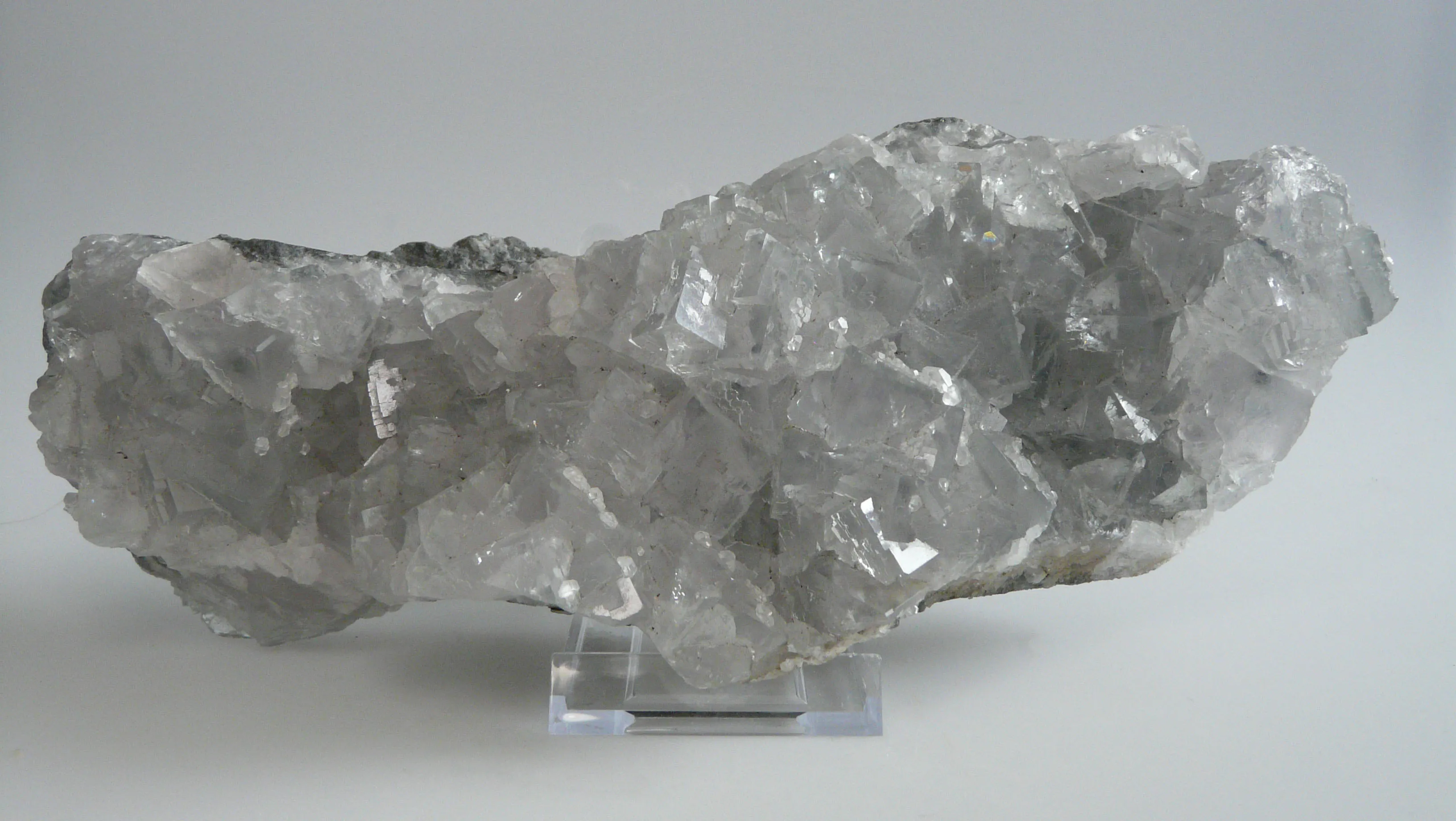
| ID | 629 | |
|---|---|---|
| Mineral | Fluorite | |
| Location | Hunan - China | |
| Fluorescence | LW-UV: close SW-UV: close |
|
| Mindat.org |
View Fluorite information at mindat.org |
|
Mindat data
| ID | 1576 |
|---|---|
| Long ID | 1:1:1576:5 |
| Formula |
CaF2
|
| IMA Status |
APPROVED GRANDFATHERED |
| Description | Fluorite Group. Fluorite is found as a common gangue mineral in hydrothermal veins, especially those containing lead and zinc minerals. It is also found in some greisens, granites, pegmatites and high-temperature veins, and as a component of some ma... |
| Other Occurrences | Hydrothermal veins; cavities in sedimentary rocks; as a cementing material in sandstones; as hot springs deposits. |
| Industrial | Flux in steel making; source of fluorine |
| Discovery Year | 1529 |
| Diapheny | Transparent |
| Cleavage | Perfect on {111}, very easy. |
| Tenacity | brittle |
| Colour | Purple, lilac, golden-yellow, green, colourless, blue, pink, champagne, brown. |
| Hardness (min) | 4.0 |
| Hardness (max) | 4.0 |
| Luminescence | Fluorescent, Short UV=blue, Long UV=blue. |
| Lustre | Vitreous |
| About the name | Named in 1797 by Carlo Antonio Galeani Napione from the Latin, fluere = "to flow" (for its use as a flux). The term fluorescence is derived from fluorite, which will often markedly exhibit this effect. The element fluorine also derives its name from fluorite, a major source of the element. |
| Streak | White |
| Crystal System | Isometric |
| Cleavage Type | Perfect |
| Fracture type | Splintery,Sub-Conchoidal |
| Morphology | Fluorite has seven main crystal forms: the most common Are the cube {100}, octahedron {111} and dodecahedron {110}; these forms having fixed Miller indices); and the tetrahexahedron {hk0}, trapezohedron {h11}, trisoctahedron {hhl} and hexoctahedron {hkl} (less common to quite rare crystal forms, having variable Miller indices). Combinations of two or more of these forms are common. The cuboctahedron (combined cube and octahedron) is less common than the combination of a cube and a docecahedron, the cubododecahedron. The faces of some crystal forms are more easily etched by nature than other faces, although this also depends on other parameters, and so none of the forms will always be smooth. Not all crystal faces will always be present, and sometimes certain faces are more developed than others, even within the same crystal form. Consequently, elongated crystals of fluorite have been observed. Crystals distorted at times by unequal development of faces, as of {013}. Often markedly composite; minute cubes aggregated to form an octahedron at times or as an overgrowth of crystals upon the corners of an earlier formed crystal of differing habit. Massive; compact; earthy, columnar (rare), or in globular aggregates; botryoidal (rare). For the Goldschmidt images we currently show the following habits with the crystallographic forms denoted here: no. 1 : a cube {100} no. 2 : an octahedron {111} no. 3 : a dodecahedron {110} no. 12: a cube {100}, modified by a hexoctahedron {421} no. 45: a cube {100}, highly modified by a dodecahedron {110}, two tetrahexahedrons: {210} and {310}, and a trapezohedron {211} no. 66: an octahedron {111}, modified by a dodecahedron {110} and a trisoctahedron {221} |
| Twinning | On {111}, usually as interpenetrating cubes (e.g., Strzegom, Poland), but also as contact spinel twins (e.g. Naica, Mexico and Chumar Bakhoor, Pakistan). |
| UV | Blue under LW-UV, due to Eu2+; other colors caused by different activators (white & cream - organic matter). Red (Mapimi, Mexico), pink (Doña Ana claims, AZ), white (Sterling Hill, NJ). Green response points to ytterbium (Siddike et al. 2003). May also be phosphorescent. |
| Thermal Behaviour | Melting point 1360°C. |
| Comment Luster | Dull when massive |
| shortcode_ima | Flr |
Details
Price: € 100
Dimensions: Not registered
Weight: Not registered
Visibile in overview:
Notes:
| Symbol | Element | |
|---|---|---|
| Ca | Calcium | |
| F | Fluorine |

|