Vesuvianite, Feldspar and Calciet
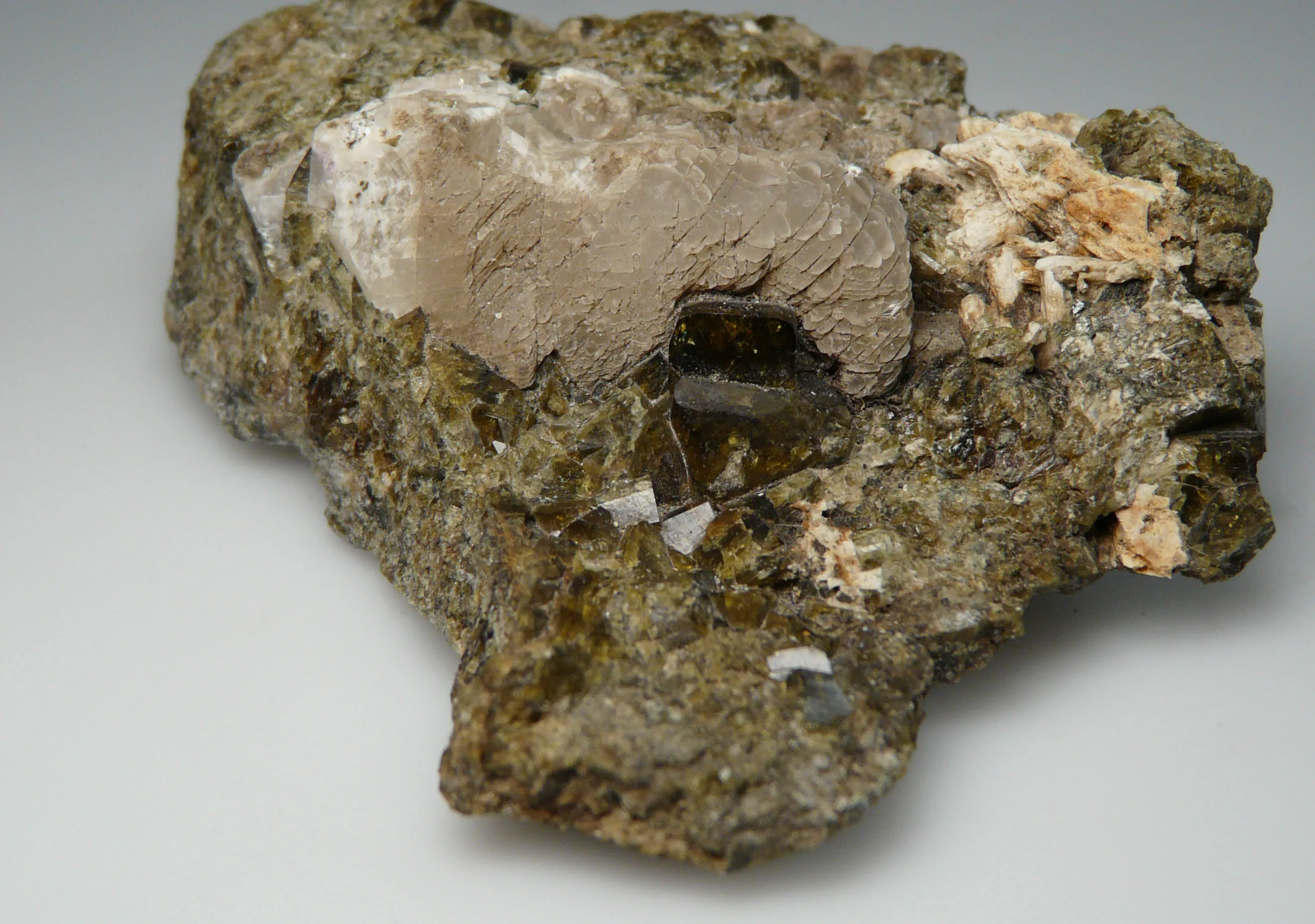
| ID | 619 | |
|---|---|---|
| Mineral |
Vesuvianite
Feldspar Calciet |
|
| Location | Kayes Region - Mali | |
| Fluorescence | LW-UV: close SW-UV: close |
|
| Mindat.org |
View Vesuvianite information at mindat.org View Feldspar information at mindat.org View Calciet information at mindat.org |
|
Mindat data
| ID | 4223 |
|---|---|
| Long ID | 1:1:4223:5 |
| Formula |
(Ca,Na)19(Al,Mg,Fe)13(SiO4)10(Si2O7)4(OH,F,O)10
|
| IMA Status |
0 1 |
| Description | Hydroxyl analogue of Fluorvesuvianite. The Fe3+ (in site Y1; Panikorovskii et al., 2017) analogue of Alumovesuvianite and Manganvesuvianite. |
| Other Occurrences | Skarns or regional metamorphism of limestones. |
| Discovery Year | 1795 |
| Diapheny | Transparent,Translucent |
| Cleavage | Poor on {110} Very poor on {100} {001} |
| Tenacity | brittle |
| Colour | Brown, yellow, brown-black, light green, emerald green, white, red, purple, violet, blue-green to blue |
| Hardness (min) | 6.5 |
| Hardness (max) | 6.5 |
| About the name | Originally named "hyacinthus dictus octodecahedricus" by Moritz Anton Kappeler in 1723. Renamed "hyacinte du Vesuve" by Jean-Baptiste Louis Romé de L'Isle in 1772. This was possibly the inspiration for Abraham Gottlob Werner to rename the species "vesuvian" in 1795, after its discovery locality, Mount Vesuvius, Campania, Italy. In 1799, Rene Just Haüy introduced the name "idocrase", which was formerly a popular name. |
| Streak | White |
| Crystal System | Tetragonal |
| Cleavage Type | Poor/Indistinct |
| Fracture type | Irregular/Uneven,Sub-Conchoidal |
| Morphology | Short pyramidal to long prismatic, columnar, granular, massive. |
| Twinning | Twinned domains observed at very fine scale. |
| shortcode_ima | Ves |
| Group | Vesuvianite Group |
| ID | 1624 |
|---|---|
| Long ID | 1:1:1624:3 |
| Entry type | 5 |
| About the name | The name is derived from the German term 'Feldspat'. For centuries, miners generally referred to minerals and rocks as "Spat" if they had the property of being particularly easy to (completely) split. The perfection of cleavage was often evident from the existing, visible cleavage cracks and from the fact that fine flakes (“Spaten”) detached from the mineral or rock body when struck with a hammer. The term feldspar came into being around the middle of the 18th century when people in mineralogy learned to differentiate between the different types of minerals more precisely. There are various theories about the exact origin of this name. In 1783, for example, Urban Brückmann asked himself whether feldspar could have received its name based on its characteristic way of occurrence in the form of fields or patches in granite and other types of rock (never as entire veins, rocks, or mountains). René-Just Haüy, on the other hand, suggested in his 1804 work "Traité de minéralogie" that the name could have been chosen based on the fact that feldspar fragments were regularly found in the fields. The feldspar would therefore be understood as “spar from the fields” and an indication that feldspar gradually turned into arable soil through weathering. |
| shortcode_ima | Fsp |
| ID | 859 |
|---|---|
| Long ID | 1:1:859:4 |
| Formula |
Ca(CO3)
|
| IMA Status |
0 1 |
| Description | Calcite Group. Calcite-Rhodochrosite Series. A very common and widespread mineral with highly variable forms and colours. Calcite is best recognized by its relatively low Mohs hardness (3) and its high reactivity with even weak acids, such as vinega... |
| Other Occurrences | Found in most geologic settings and as a later forming replacement mineral in most other environments in one form or another, it is most common as massive material in limestones and marbles. It forms as chemical sedimentary deposits as limestone, can be regionally or contact metamorphosed into marbles and rarely forms igneous rocks (carbonatites). Also is a common gangue mineral in hydrothermal deposits. |
| Industrial | Mined extensively for a wide variety of uses ranging from lime (cement) to limestone and marble building stones and aggregates, agricultural supplements and optical calcite. |
| Diapheny | Transparent,Translucent |
| Cleavage |
Perfect on |
| Tenacity | brittle |
| Colour | White, Yellow, Red, Orange, Blue, Green, Brown, Gray etc. |
| Hardness (min) | 3.0 |
| Hardness (max) | 3.0 |
| Luminescence | Fluorescent |
| Lustre | Vitreous |
| About the name | Ancient name. Named as a mineral by Gaius Plinius Secundus (Pliny the elder) in 79 from Calx, Latin for Lime. |
| Streak | White |
| Crystal System | Trigonal |
| Cleavage Type | Perfect |
| Fracture type | Conchoidal |
| Morphology | Over 800 different forms have been described. Most commonly as acute rhombohedrons or prismatic with scalenohedral terminations, or combinations of the two. |
| Twinning |
At least four twin laws have been described, the most common being when the twin plane and the composition plane are |
| UV | May be fluorescent under LW UV, mid-range UV or SW UV as well as under X-rays, cathode rays and even sunlight, in a number of colors and shades, commonly an intense red under SW with Mn as an activator (such as at Franklin, New Jersey, USA, and Långban in Sweden. |
| Comment Luster | Pearly on cleavage and {0001}. Can be dull or earthy in chalk variety. |
| shortcode_ima | Cal |
| Group | Calcite Group |
Details
Price: € 7
Dimensions: Not registered
Weight: Not registered
Visibile in overview:
Notes:
| Symbol | Element | |
|---|---|---|
| Al | Aluminium | |
| C | Carbon | |
| Ca | Calcium | |
| Fe | Iron | |
| H | Hydrogen | |
| Mg | Magnesium | |
| O | Oxygen | |
| Si | Silicium |