Molybdenite and Quartz
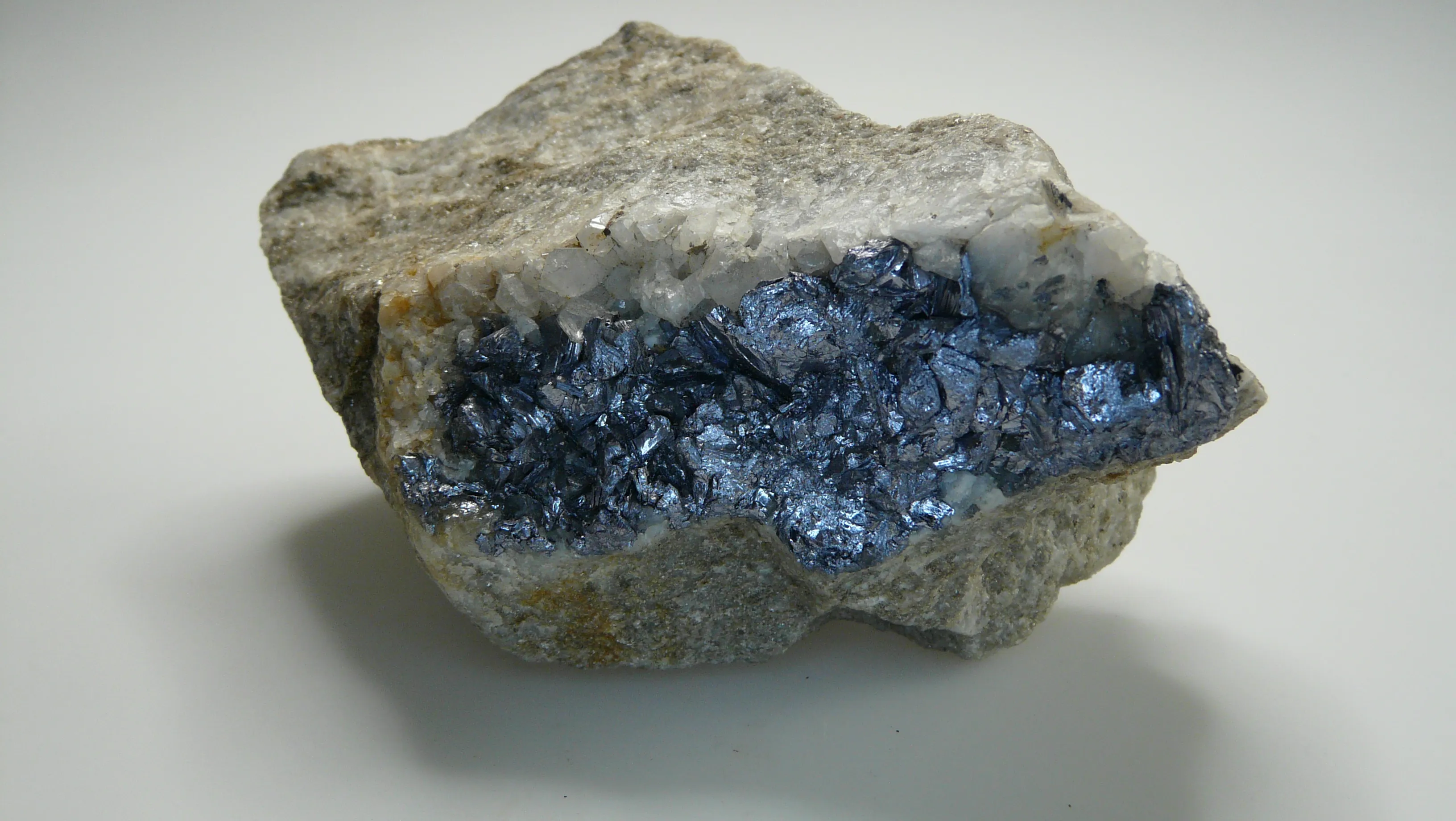
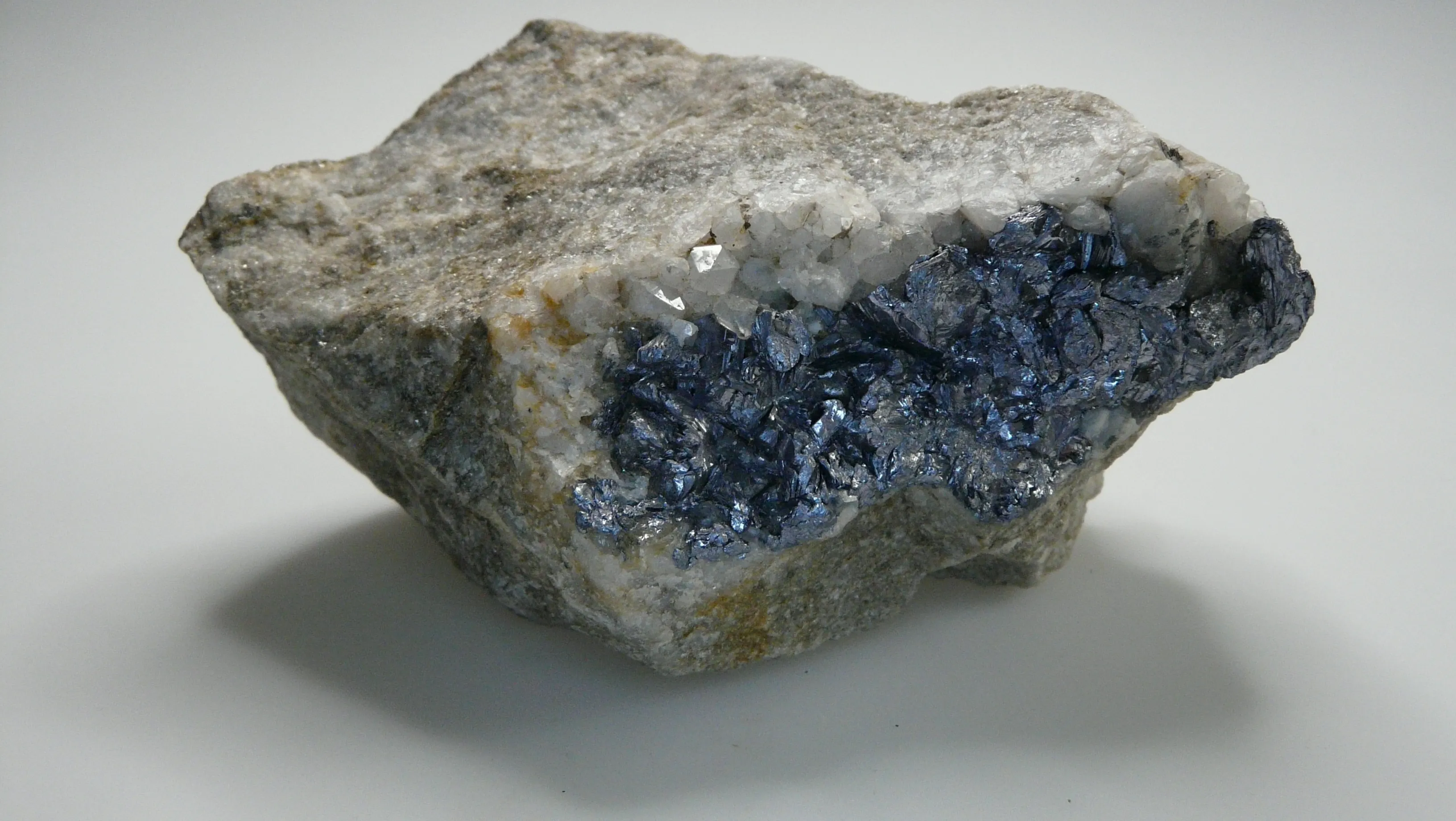
| ID | 561 | |
|---|---|---|
| Mineral |
Molybdenite
Quartz |
|
| Location | Crown Point Mine - Railroad Creek Mining District - Washington - United States of America | |
| Fluorescence | LW-UV: close SW-UV: close |
|
| Mindat.org |
View Molybdenite information at mindat.org View Quartz information at mindat.org |
|
Mindat data
| ID | 2746 |
|---|---|
| Long ID | 1:1:2746:1 |
| Formula |
MoS2
|
| IMA Status |
0 1 |
| Diapheny | Opaque |
| Cleavage | Perfect on {0001} |
| Tenacity | flexible |
| Colour | Black, lead gray, or gray |
| Hardness (min) | 1.0 |
| Hardness (max) | 1.5 |
| Luminescence | None |
| Lustre | Metallic |
| About the name | Variations of the name molybdaena and molybdenite were used for lead ores by Dioscorides (50-70 CE), Pliny the Elder (79 CE), and Agricola (1556), but the modern use of molybdenite did not begin until Johan Gottschalk Wallerius wrote about molybdenite in Mineralogia, eller Mineralriket published in 1747. There was still a multiplicity of minerals receiving the same name, but modern molybdenite and graphite were the most common minerals given this name. The element molybdenum was discovered by Carl Wilhelm Scheele in 1778 and he provided molybdenite to Peter Jacob Hjelm who was able to isolate molybdenum in 1781. Scheele showed that molybdenite, in the modern sense, was soluble in acid, while graphite was not. From the Greek μόλυβδοζ meaning "lead", but a name having a new usage unlike that of former times. |
| Streak | Bluish gray |
| Crystal System | Hexagonal |
| Cleavage Type | Perfect |
| Morphology | Tabular crystals, flakes |
| key_elements |
0 |
| shortcode_ima | Mol |
| Group | Molybdenite Group |
| ID | 3337 |
|---|---|
| Long ID | 1:1:3337:0 |
| Formula |
SiO2
|
| IMA Status |
0 1 |
| Other Occurrences | Most of them... |
| Industrial | Ore for silicon, glassmaking, frequency standards, optical instruments, silica source for concrete setting, filtering agents as sand. A major component of sand. |
| Diapheny | Transparent,Translucent |
| Cleavage |
The rhombohedral cleavage r |
| Tenacity | brittle |
| Colour | Colorless, purple, rose, red, black, yellow, brown, green, blue, orange, etc. |
| Hardness (min) | 7.0 |
| Hardness (max) | 7.0 |
| Luminescence | Triboluminescent |
| Lustre | Vitreous |
| About the name | Quartz has been known and appreciated since pre-historic times. The most ancient name known is recorded by Theophrastus in about 300-325 BCE, κρύσταλλος or kristallos. The varietal names, rock crystal and bergcrystal, preserve the ancient usage. The root words κρύοσ signifying ice cold and στέλλειυ to contract (or solidify) suggest the ancient belief that kristallos was permanently solidified ice. The earliest printed use of "querz" was anonymously published in 1505, but attributed to a physician in Freiberg, Germany, Ulrich Rülein von Kalbe (a.k.a. Rülein von Calw, 1527). Agricola used the spelling "quarzum" (Agricola 1530) as well as "querze", but Agricola also referred to "crystallum", "silicum", "silex", and silice". Tomkeieff (1941) suggested an etymology for quartz: "The Saxon miners called large veins - Gänge, and the small cross veins or stringers - Querklüfte. The name ore (Erz, Ertz) was applied to the metallic minerals, the gangue or to the vein material as a whole. In the Erzgebirge, silver ore is frequently found in small cross veins composed of silica. It may be that this ore was called by the Saxon miners 'Querkluftertz' or the cross-vein-ore. Such a clumsy word as 'Querkluftertz' could easily be condensed to 'Querertz' and then to 'Quertz', and eventually become 'Quarz' in German, 'quarzum' in Latin and 'quartz' in English." Tomkeieff (1941, q.v.) noted that "quarz", in its various spellings, was not used by other noted contemporary authors. "Quarz" was used in later literature referring to the Saxony mining district, but seldom elsewhere. Gradually, there were more references to quartz: E. Brown in 1685 and Johan Gottschalk Wallerius in 1747. In 1669, Nicolaus Steno (Niels Steensen) obliquely formulated the concept of the constancy of interfacial angles in the caption of an illustration of quartz crystals. He referred to them as "cristallus" and "crystallus montium". Tomkeieff (1941) also noted that Erasmus Bartholinus (1669) used the various spellings for "crystal" to signify other species than quartz and that crystal could refer to other "angulata corpora" (bodies with angles): "In any case in the second half of the XVIIIth century quartz became established as a name of a particular mineral and the name crystal became a generic term synonymous with the old term 'corpus angulatum'." |
| Streak | White |
| Crystal System | Trigonal |
| Cleavage Type | Poor/Indistinct |
| Fracture type | Conchoidal |
| Twinning | Dauphiné law. Brazil law. Japan law. Others for beta-quartz... |
| Thermal Behaviour | Transforms to beta-quartz at 573° C and 1 bar (100 kPa) pressure. |
| shortcode_ima | Qz |
Details
Price: € 20
Dimensions: Not registered
Weight: Not registered
Visibile in overview:
Notes:
| Symbol | Element | |
|---|---|---|
| Mo | Molybdenum | |
| O | Oxygen | |
| S | Sulfur | |
| Si | Silicium |