Apophyllite, Stilbite-Ca and Chalcedony
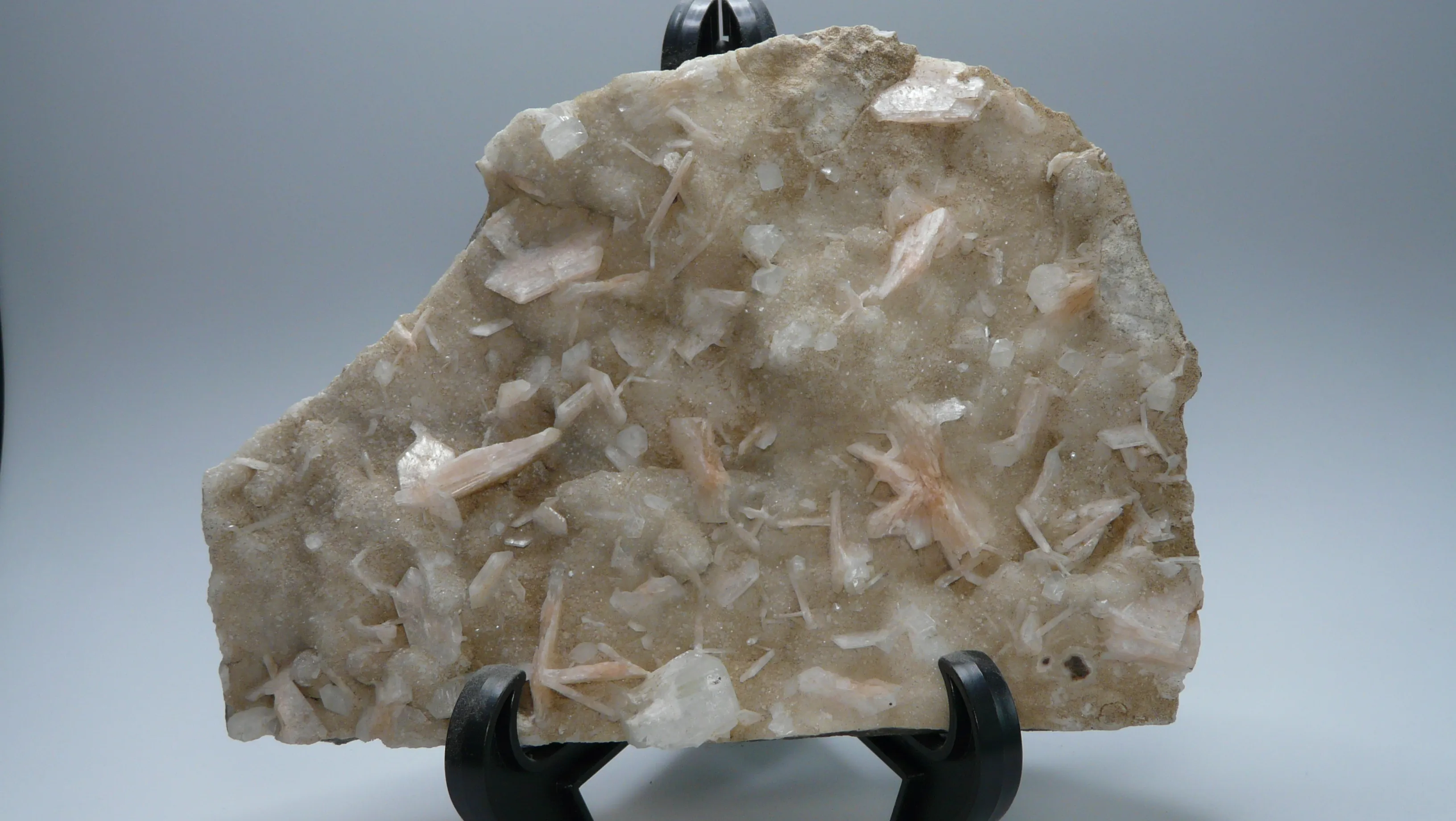
| ID | 532 | |
|---|---|---|
| Mineral |
Apophyllite
Stilbite-Ca Chalcedony |
|
| Location | Nashik District - Maharashtra - India | |
| Fluorescence | LW-UV: close SW-UV: close |
|
| Mindat.org |
View Apophyllite information at mindat.org View Stilbite-Ca information at mindat.org View Chalcedony information at mindat.org |
|
Mindat data
| ID | 1989 |
|---|---|
| Long ID | 1:1:1989:3 |
| Formula |
KCa4Si8O20(OH,F) · 8H2O
|
| IMA Status |
0 |
| Discovery Year | 1978 |
| Diapheny | Transparent,Translucent,Opaque |
| Cleavage | {001} |
| Tenacity | brittle |
| Colour | Colorless to white; may be pink, light green, or light yellow. |
| Hardness (min) | 4.0 |
| Hardness (max) | 5.0 |
| About the name | Apophyllite was named in 1806 by Rene Just Haüy from the Greek for "away from" (ἀπό, apo) and "leaf" (φύλλον, phyllos), in allusion to the way it exfoliates upon heating. Chemical variants were recognized by Pete J. Dunn, Roland C. Rouse, and Julie A. Norberg in 1978. |
| Streak | white |
| Crystal System | Tetragonal |
| Cleavage Type | Perfect |
| Fracture type | Irregular/Uneven |
| Comment Luster | Vitreous on {100} and pearly on {001} |
| shortcode_ima | Hapo-K |
| Group | Apophyllite Group |
| ID | 7313 |
|---|---|
| Long ID | 1:1:7313:0 |
| Formula |
NaCa4(Si27Al9)O72 · 28H2O
|
| IMA Status |
0 1 |
| Other Occurrences | A low temperature hydrothermal mineral, in amygdules and cavities in basalt. |
| Diapheny | Transparent,Translucent |
| Cleavage | on {010} |
| Colour | White, colourless, red, light yellow, light to dark brown, cream, orange, pink |
| Hardness (min) | 3.5 |
| Hardness (max) | 4.0 |
| Lustre | Vitreous , Pearly |
| About the name | Named in 1797 by Jean Claude de la Métherie from Greek στιλβη "stilbein", to glitter or shine, or "stilbe", a mirror, alluding to its pearly or vitreous luster. Originally, but inconsistently called zeolite in 1756 by Axel Cronstedt. Named crystalii ad centrum tendentes in 1758 by Cronstedt. In 1772, Johan Gottschalk Wallerius called this mineral zeolite selenitica lamellaris. Also in 1797, de la Métherie called this mineral zeolite nacrée. Werner (1780) called this mineral strehliger zeolith. Rene Just Haüy (1801) used the term stilbite anamorphique for a mineral now recognized as heulandite. Desmine was introduced in 1818 by Johann Friedrich August Breithaupt. Sphaerostilbite was used in 1832 by François Sulpice Beudant. Additional varietal names and synonyms have been proposed: blättricher zeolit, hypostilbite, puflerite, radiated zeolite, and syhedrite. Chemical suffixes were added by the IMA. |
| Streak | White |
| Crystal System | Monoclinic |
| Cleavage Type | Perfect |
| Fracture type | Irregular/Uneven |
| Morphology | Typically thin tabular, sheaflike or globular clusters. |
| Twinning | Ubiquitous on {001}, cruciform and penetration. |
| UV | May fluoresce pale-yellow or blue-white in shortwave UV. |
| Comment Luster | Pearly on cleavage |
| shortcode_ima | Stb-Ca |
| Group | Stilbite Subgroup |
| ID | 960 |
|---|---|
| Long ID | 1:1:960:9 |
| IMA Status |
0 1 |
| Variety of | 3337 |
| Entry type | 2 |
| Description | Depending on the context, the term "chalcedony" has different meanings. 1. A more general term for all varieties of quartz that are made of microscopic or submicroscopic crystals, the so-called microcrystalline varieties of quartz. Examples are the ... |
| Other Occurrences | Very common. As nodules, vein fillings, crusts in volcanic rocks. As sinter-like crusts in low- to medium temperature hydrothermal veins. Main constituent in silica-rich marine sedimentary rocks. As nodular concretions and layers in limestones and marls. As a metasomatic replacement in limestones and marls ("replacement chert"). As cement in sandstones. Replacing other minerals in pseudomorphoses. As a fossilizing material (petrified wood, coral agate). |
| Diapheny | Translucent |
| Tenacity | brittle |
| Colour | colorless, white, gray, blue, any color due to embedded minerals, multicolored specimen not uncommon. |
| Hardness (min) | 7.0 |
| Hardness (max) | 7.0 |
| Lustre | Vitreous |
| About the name | Mentioned by Agricola (1546) of a stone named for the town of Chalcedon, now called Kadıköy, and is a district within the city of Istanbul, Turkey. |
| Streak | White |
| Crystal System | Trigonal |
| Cleavage Type | None Observed |
| Fracture type | Conchoidal,Sub-Conchoidal |
| Twinning | Quartz crystallites in the chalcedony fibers are polysynthetically twinned by the Brazil law (left- and right-handed domains). |
| UV | None in a pure specimen, however, green fluorescence in short-wave UV light is very common at many localities. |
| Comment Luster | vitreous when polished, fractured surfaces have a dull or waxy luster |
Details
Price: € 25
Dimensions: Not registered
Weight: Not registered
Visibile in overview:
Notes:
| Symbol | Element | |
|---|---|---|
| Al | Aluminium | |
| Ca | Calcium | |
| F | Fluorine |

|
| H | Hydrogen | |
| K | Potassium | |
| Na | Sodium | |
| O | Oxygen | |
| Si | Silicium |