Malachite, Conichalcite and Chabazite-Ca
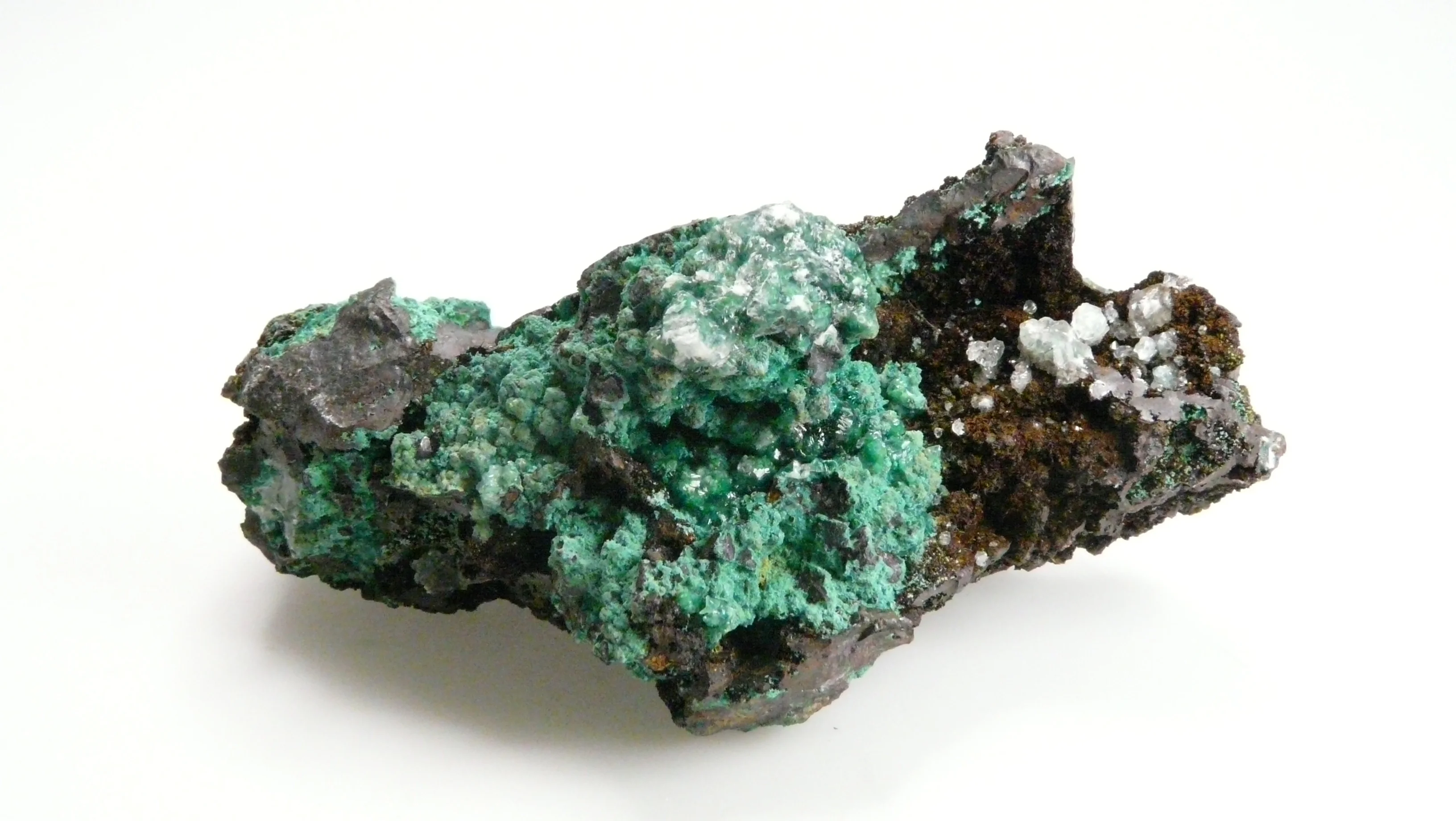
| ID | 497 | |
|---|---|---|
| Mineral |
Malachite
Conichalcite Chabazite-Ca |
|
| Location | Ojuela Mine - Mapimi - Durango - Mexico | |
| Fluorescence | LW-UV: close SW-UV: close |
|
| Mindat.org |
View Malachite information at mindat.org View Conichalcite information at mindat.org View Chabazite-Ca information at mindat.org |
|
Mindat data
| ID | 2550 |
|---|---|
| Long ID | 1:1:2550:4 |
| Formula |
Cu2(CO3)(OH)2
|
| IMA Status |
0 1 |
| Other Occurrences | It is the most common secondary mineral found in the oxidized zones of copper deposits. |
| Industrial | A minor ore of copper when abundant enough in a copper deposit. |
| Discovery Year | Unno |
| Diapheny | Opaque |
| Cleavage |
Perfect on |
| Tenacity | brittle |
| Colour | Bright green, with crystals deeper shades of green, even very dark to nearly black; green to yellowish green in transmitted light. |
| Hardness (min) | 3.5 |
| Hardness (max) | 4.0 |
| About the name | Named in antiquity (see Pliny the Elder, 79 CE) molochitus after the Greek μαλαχή, "mallows," in allusion to the green color of the leaves. Known in the new spelling, malachites, at least by 1661. |
| Streak | Light green |
| Crystal System | Monoclinic |
| Cleavage Type | Perfect |
| Fracture type | Splintery |
| Morphology | Crystals uncommon, usually short or long prismatic or acicular, parallel to [001]; often grouped in rosettes, sprays, or tufts. Botryoidal to mammillary aggregates of radiating fibrous crystals more common. It may also be massive, compact, and stalactitic. |
| Twinning | Untwinned crystals are extremely rare. Typically twinned on {100}, sometimes as penetration or polysynthetic twinning with the axis parallel to [201]. |
| Thermal Behaviour | Loses water at about 315°, leaving tenorite. |
| key_elements |
0 |
| shortcode_ima | Mlc |
| Group | Rosasite Group |
| ID | 1119 |
|---|---|
| Long ID | 1:1:1119:4 |
| Formula |
CaCu(AsO4)(OH)
|
| IMA Status |
0 1 |
| Other Occurrences | An uncommon alteration product in the oxidation zone of copper deposits. Typically an alteration product of enargite. |
| Discovery Year | 1849 |
| Diapheny | Translucent |
| Tenacity | brittle |
| Colour | Green, yellow-green, greenish yellow; light green to yellowish green in transmitted light. |
| Hardness (min) | 4.5 |
| Hardness (max) | 4.5 |
| About the name | Named by August Breithaupt and Carl Julius Fritzsche in 1849 from the Greek κουία for "konis" (powder) and χαλκος for "chalkos" (copper) in allusion to its composition and appearance of the mineral at times. |
| Streak | Light green |
| Crystal System | Orthorhombic |
| Cleavage Type | None Observed |
| Fracture type | Irregular/Uneven |
| Morphology | Typically radial fibrous aggregates, botyroidal to reniform crusts, massive, rarely equant crystals are short prismatic [010]. |
| Twinning | Rare on {001}. |
| UV | Not fluorescent |
| Publication Year | 1849 |
| key_elements |
0 1 |
| shortcode_ima | Con |
| Group | Adelite-Descloizite Group |
| ID | 956 |
|---|---|
| Long ID | 1:1:956:6 |
| Entry type | 1 |
| Description | According to the current nomenclature for zeolite minerals (Coombs et al., 1997), chabazite is the name of a series of closely related minerals. Chemical analysis is required to distinguish between them. |
| Hardness (min) | 4.0 |
| Hardness (max) | 5.0 |
| Lustre | Vitreous |
| About the name | Named in 1788 by Louis-Augustin Bosc d'Antic from the Greek chabazios, tune or melody, one of twenty stones named in the poem Peri lithos, which extolled the virtues of minerals. The poem is ascribed to Orpheus, legendary founder of the Orphic cult, which flourished in Greece in the early centuries. |
| Streak | white |
Details
Price: € 25
Dimensions: Not registered
Weight: Not registered
Visibile in overview:
Notes:
| Symbol | Element | |
|---|---|---|
| As | Arsenic |

|
| C | Carbon | |
| Ca | Calcium | |
| Cu | Copper | |
| H | Hydrogen | |
| O | Oxygen |