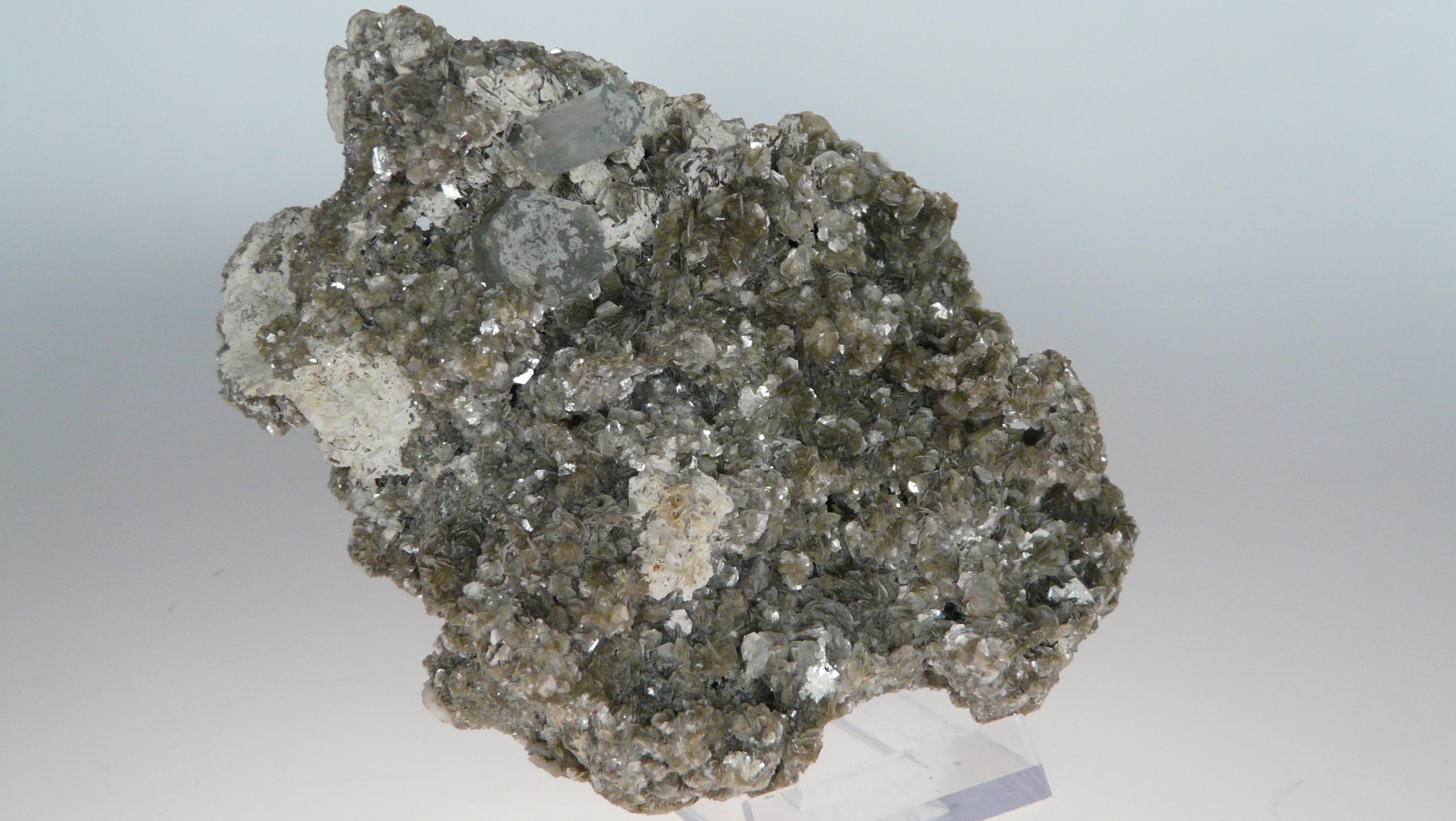
Hambergite, Muscovite and Albite
| ID | 489 | |
|---|---|---|
| Mineral |
Hambergite
Muscovite Albite |
|
| Location | Gilgit-Baltistan - Pakistan | |
| Fluorescence | LW-UV: close SW-UV: close |
|
| Mindat.org |
View Hambergite information at mindat.org View Muscovite information at mindat.org View Albite information at mindat.org |
|
Mindat data
| ID | 1811 |
|---|---|
| Long ID | 1:1:1811:7 |
| Formula |
Be2(BO3)(OH)
|
| IMA Status |
0 1 |
| General Appearance | A single crystal 3.5x1.5 cm. |
| Occurrence | Syenite pegmatite. |
| Other Occurrences | Alkali-rich pegmatites (Madagascar); gem gravels (Kashmir). |
| Discovery Year | 1890 |
| Diapheny | Transparent,Translucent |
| Cleavage | On {010}; on {100} good. |
| Tenacity | brittle |
| Colour | Colourless, greyish, yellowish; colourless in transmitted light |
| Hardness (min) | 7.5 |
| Hardness (max) | 7.5 |
| About the name | Named in 1890 by Waldemar Christofer Brøgger in honor of Axel Hamberg [January 17, 1863 Klara Församling, Stockholm, Sweden - June 28, 1933 Stockholm, Sweden], professor of geography at the University of Uppsala, Sweden, who drew attention to the first specimens. |
| Streak | White |
| Crystal System | Orthorhombic |
| Cleavage Type | Perfect |
| Morphology | Crystals prismatic [001], frequently flattened {100}. {100} striated [001] with dull and etched terminal faces (large crystals). |
| Twinning | Twin and composition plane {110}. |
| Publication Year | 1890 |
| key_elements |
0 1 |
| shortcode_ima | Hb |
| ID | 2815 |
|---|---|
| Long ID | 1:1:2815:4 |
| Formula |
KAl2(Si3Al)O10(OH)2
|
| IMA Status |
0 1 |
| Other Occurrences | Muscovite is common in many different rock types as a primary mineral. |
| Diapheny | Transparent,Translucent |
| Cleavage | Perfect on {001}. |
| Tenacity | elastic |
| Colour | White to colorless, silvery-white, and tinged various colors by impurities. |
| Hardness (min) | 2.5 |
| Hardness (max) | 2.5 |
| About the name | The earliest names attributable to muscovite include Muscovy Glass, Cat Silver, and Lapis Specularis (stone mirror); these names appearing in texts in the seventeenth century and before. The stand-alone name 'Muscovite' was used as early as 1794 by Johann Gottfried Schmeisser in his System of Mineralogy and is derived from the term "Muscovy glass," which was in common use by that time. Muscovy Province in Russia yielded sheet mica for a variety of uses. Muscovite and sometimes similar species were earlier called mica (Phillips and Kersey, 1706), glimmer (Phillips and Kersey, 1706), and isinglass (1747 according to OED) but all of these terms are still in use to some degree. It should be noted that mica, glimmer, and isinglass were also used for a variety of materials before these given dates and in those earlier times did not always indicate what would be a mineral, much less muscovite proper. Isinglass, for example, was originally used for a gelatinous bladder found in sturgeon. |
| Streak | White |
| Crystal System | Monoclinic |
| Cleavage Type | Perfect |
| Fracture type | Micaceous |
| Morphology |
Crystals uncommon, tabular {001} with rhombic to hexagonal outlines, often bound by {221}, |
| Twinning |
Mica law twins common [310] forming six pointed stars, less common with the composition plane perpendicular to {001} (hkl refer to |
| shortcode_ima | Ms |
| Group | Dioctahedral mica |
| ID | 96 |
|---|---|
| Long ID | 1:1:96:9 |
| Formula |
Na(AlSi3O8)
|
| IMA Status |
0 1 |
| Other Occurrences | A major constituent of granites and granite pegmatites, alkalic diorites, basalts, and in hydrothermal and alpine veins. A product of potassium metasomatism and in low-temperature and low-pressure metamorphic facies and in some schists. Detrital and authigenic in sedimentary rocks. |
| Discovery Year | 1815 |
| Diapheny | Transparent,Translucent,Opaque |
| Cleavage | on [001], good on [010], imperfect on {110} |
| Tenacity | brittle |
| Colour | White to gray or colorless, uncommonly blue tinted or rarely green or red tinted, while much included albite may be strongly colored.. |
| Hardness (min) | 6.0 |
| Hardness (max) | 6.5 |
| Lustre | Vitreous, pearly |
| About the name | Named in 1815 by Johan Gottlieb Gahn and Jöns Jacob Berzelius from Latin "albus", white, alluding to its usual color. |
| Streak | White |
| Crystal System | Triclinic |
| Cleavage Type | Perfect |
| Fracture type | Irregular/Uneven,Conchoidal |
| Morphology |
Crystals commonly tabular parallel |
| Twinning |
Common around |
| Comment Luster | Pearly on cleavages |
| shortcode_ima | Ab |
| Group | Plagioclase |
Details
MinID: KTK-PVD
Price: € 75
Dimensions: 120 mm x 90 mm x 50 mm
Weight: Not registered
Visibile in overview:
Notes:
None
| Symbol | Element | |
|---|---|---|
| Al | Aluminium | |
| B | Boron | |
| Be | Beryllium |

|
| H | Hydrogen | |
| K | Potassium | |
| Na | Sodium | |
| O | Oxygen | |
| Si | Silicium |