Titanite, Clinochlore and Quartz
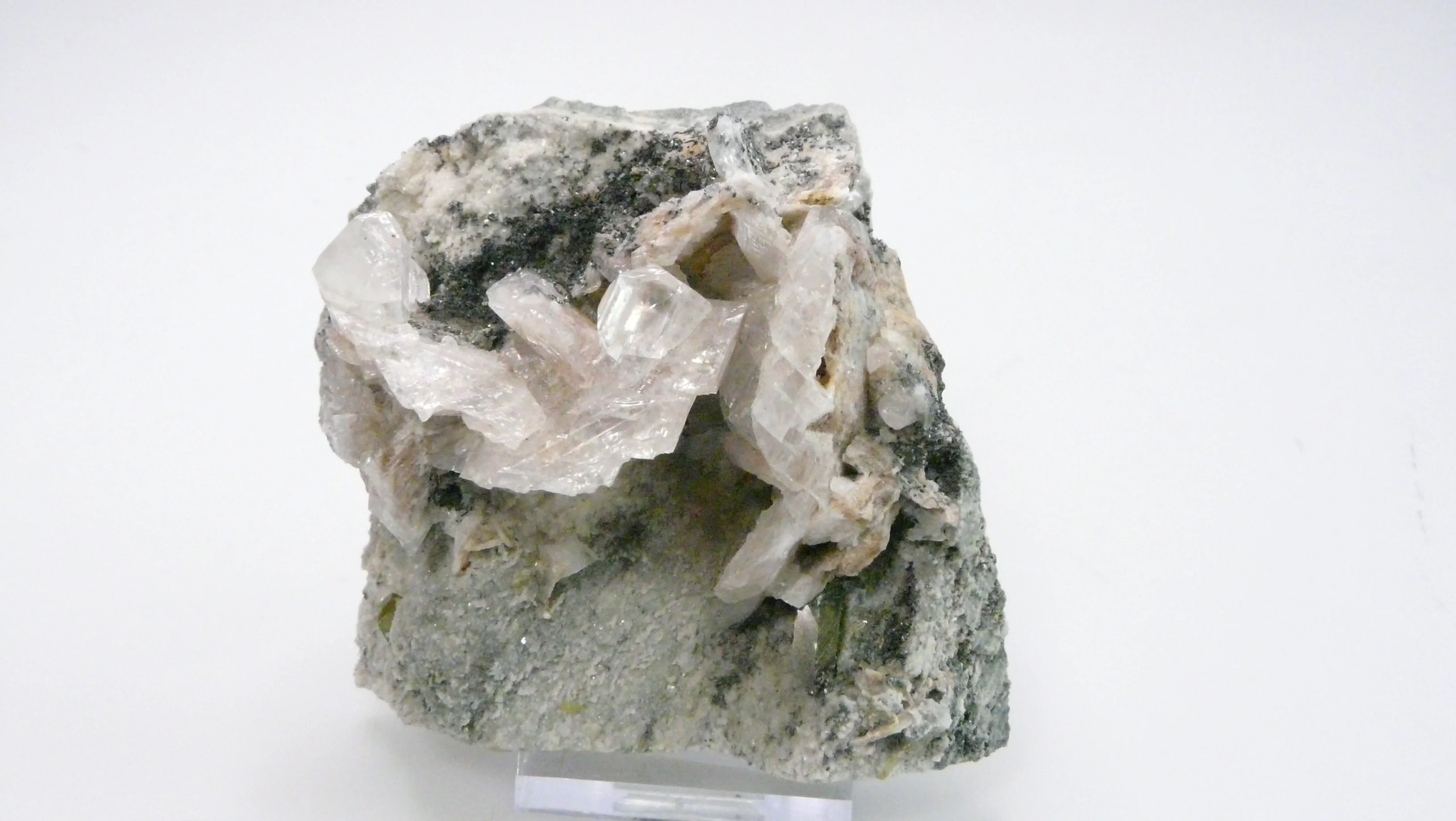
| ID | 475 | |
|---|---|---|
| Mineral |
Titanite
Clinochlore Quartz |
|
| Location | Gilgit-Baltistan - Pakistan | |
| Fluorescence | LW-UV: close SW-UV: close |
|
| Mindat.org |
View Titanite information at mindat.org View Clinochlore information at mindat.org View Quartz information at mindat.org |
|
Mindat data
| ID | 3977 |
|---|---|
| Long ID | 1:1:3977:8 |
| Formula |
CaTi(SiO4)O
|
| IMA Status |
0 1 |
| Other Occurrences | Common accessory mineral in intermediate and felsic plutonic rocks, pegmatites, alpine veins. Also in some gneisses, schists, and skarns. |
| Discovery Year | 1795 |
| Diapheny | Transparent,Translucent |
| Cleavage | Good on {110} |
| Tenacity | brittle |
| Colour | Brown, green, yellow, orange, rose-red, black, beige, grey, colourless, grey-blue, bluish |
| Hardness (min) | 5.0 |
| Hardness (max) | 5.5 |
| Lustre | Adamantine to resinous |
| About the name | First recognized as "nouveau substance minérale" in 1787 by Marc August Pictet, but only described and named in 1795 by Martin Klaproth for its titanium content. A common synonym, sphene (from the Greek sphenos (σφηνώ), meaning wedge, for its common wedge-shaped crystals), was introduced in 1801 by Rene Just Haüy. |
| Streak | White |
| Crystal System | Monoclinic |
| Cleavage Type | Distinct/Good |
| Morphology | Common forms are {111}, {110}, {102}, {100}, {001} and {112}. Crystals equant to wedge-shaped, or flattened with large {001} or {102}, or prismatic by extension along [001], to 65 x 17 x 17 cm, compact, massive. NOTE: The morphological data is based on a choice of unit-cell parameters that differs from the one that is given in Mindat. This 'old' unit cell has a = 6.56, b = 8.72, c = 7.44 Å and β = 119.54° (see the introduction in http://rruff.info/rruff_1.0/uploads/AM61_238.pdf). The 3D drawings of titanite are also based on this old cell. |
| Twinning | On {100}, contact and penetration, less commonly lamellar on {221}. |
| key_elements |
0 |
| shortcode_ima | Ttn |
| Group | Titanite Group |
| ID | 1070 |
|---|---|
| Long ID | 1:1:1070:8 |
| Formula |
Mg5Al(AlSi3O10)(OH)8
|
| IMA Status |
0 1 |
| Other Occurrences | Hydrothermal alteration product of amphibole, pyroxene, and biotite in many igneous rocks. An important rock forming mineral in many sedimentary and metamorphic rocks. |
| Discovery Year | 1851 |
| Diapheny | Transparent,Translucent |
| Cleavage | {001} Perfect |
| Tenacity | flexible |
| Colour | Green, yellowish green, olive green, blackish green, bluish green, white, pink |
| Hardness (min) | 2.0 |
| Hardness (max) | 2.5 |
| Lustre | Vitreous, Pearly |
| About the name | Named in 1851 by William Phipps Blake from the Greek κλινειν "klinein", "to incline", in allusion to the inclined optic axes and the Greek χλωρο "chloros," for "green," its typical color. Clinochlore was originally named chlorite in 1789 by Abraham Gottlob Werner from the Greek χλωρο "chloros," for "green," its typical color. There are many named synonyms or varieties of clinochlore. Many names that have been attributed to minerals now called clinochlore, as well as chamosite, include: baltimorite, berlauite, chlorite, chlorophaeite, chromchlorit, corundophilite, daphnite, delessite, diabantite, euralite, faecherstein, grengesite, grochauite, helminthe, kaemmererite, kotschubeite, leuchtenbergite, lophoite, ogkoite, pattersonite, pennine, penninite, prochlorite, pyknochlorite, rhodochrome, rhodophyllite, ripidolite, rumpfite, seraphinite, sheridanite, specksten, talgsten, and many others. |
| Streak | Greenish white to white |
| Crystal System | Monoclinic |
| Cleavage Type | Perfect |
| Fracture type | Micaceous |
| Morphology | Thin to thick pseudohexagonal platey crystals; rarely fibrous. |
| Twinning | Plane {001}, axis [310], composition plane {001} |
| shortcode_ima | Clc |
| Group | Chlorite Group |
| ID | 3337 |
|---|---|
| Long ID | 1:1:3337:0 |
| Formula |
SiO2
|
| IMA Status |
0 1 |
| Other Occurrences | Most of them... |
| Industrial | Ore for silicon, glassmaking, frequency standards, optical instruments, silica source for concrete setting, filtering agents as sand. A major component of sand. |
| Diapheny | Transparent,Translucent |
| Cleavage |
The rhombohedral cleavage r |
| Tenacity | brittle |
| Colour | Colorless, purple, rose, red, black, yellow, brown, green, blue, orange, etc. |
| Hardness (min) | 7.0 |
| Hardness (max) | 7.0 |
| Luminescence | Triboluminescent |
| Lustre | Vitreous |
| About the name | Quartz has been known and appreciated since pre-historic times. The most ancient name known is recorded by Theophrastus in about 300-325 BCE, κρύσταλλος or kristallos. The varietal names, rock crystal and bergcrystal, preserve the ancient usage. The root words κρύοσ signifying ice cold and στέλλειυ to contract (or solidify) suggest the ancient belief that kristallos was permanently solidified ice. The earliest printed use of "querz" was anonymously published in 1505, but attributed to a physician in Freiberg, Germany, Ulrich Rülein von Kalbe (a.k.a. Rülein von Calw, 1527). Agricola used the spelling "quarzum" (Agricola 1530) as well as "querze", but Agricola also referred to "crystallum", "silicum", "silex", and silice". Tomkeieff (1941) suggested an etymology for quartz: "The Saxon miners called large veins - Gänge, and the small cross veins or stringers - Querklüfte. The name ore (Erz, Ertz) was applied to the metallic minerals, the gangue or to the vein material as a whole. In the Erzgebirge, silver ore is frequently found in small cross veins composed of silica. It may be that this ore was called by the Saxon miners 'Querkluftertz' or the cross-vein-ore. Such a clumsy word as 'Querkluftertz' could easily be condensed to 'Querertz' and then to 'Quertz', and eventually become 'Quarz' in German, 'quarzum' in Latin and 'quartz' in English." Tomkeieff (1941, q.v.) noted that "quarz", in its various spellings, was not used by other noted contemporary authors. "Quarz" was used in later literature referring to the Saxony mining district, but seldom elsewhere. Gradually, there were more references to quartz: E. Brown in 1685 and Johan Gottschalk Wallerius in 1747. In 1669, Nicolaus Steno (Niels Steensen) obliquely formulated the concept of the constancy of interfacial angles in the caption of an illustration of quartz crystals. He referred to them as "cristallus" and "crystallus montium". Tomkeieff (1941) also noted that Erasmus Bartholinus (1669) used the various spellings for "crystal" to signify other species than quartz and that crystal could refer to other "angulata corpora" (bodies with angles): "In any case in the second half of the XVIIIth century quartz became established as a name of a particular mineral and the name crystal became a generic term synonymous with the old term 'corpus angulatum'." |
| Streak | White |
| Crystal System | Trigonal |
| Cleavage Type | Poor/Indistinct |
| Fracture type | Conchoidal |
| Twinning | Dauphiné law. Brazil law. Japan law. Others for beta-quartz... |
| Thermal Behaviour | Transforms to beta-quartz at 573° C and 1 bar (100 kPa) pressure. |
| shortcode_ima | Qz |
Details
Price: € 25
Dimensions: Not registered
Weight: Not registered
Visibile in overview:
Notes:
Ma
| Symbol | Element | |
|---|---|---|
| Al | Aluminium | |
| Ca | Calcium | |
| H | Hydrogen | |
| Mg | Magnesium | |
| O | Oxygen | |
| Si | Silicium | |
| Ti | Titanium |