Albite, Epidote, Grossular and Orthoclase
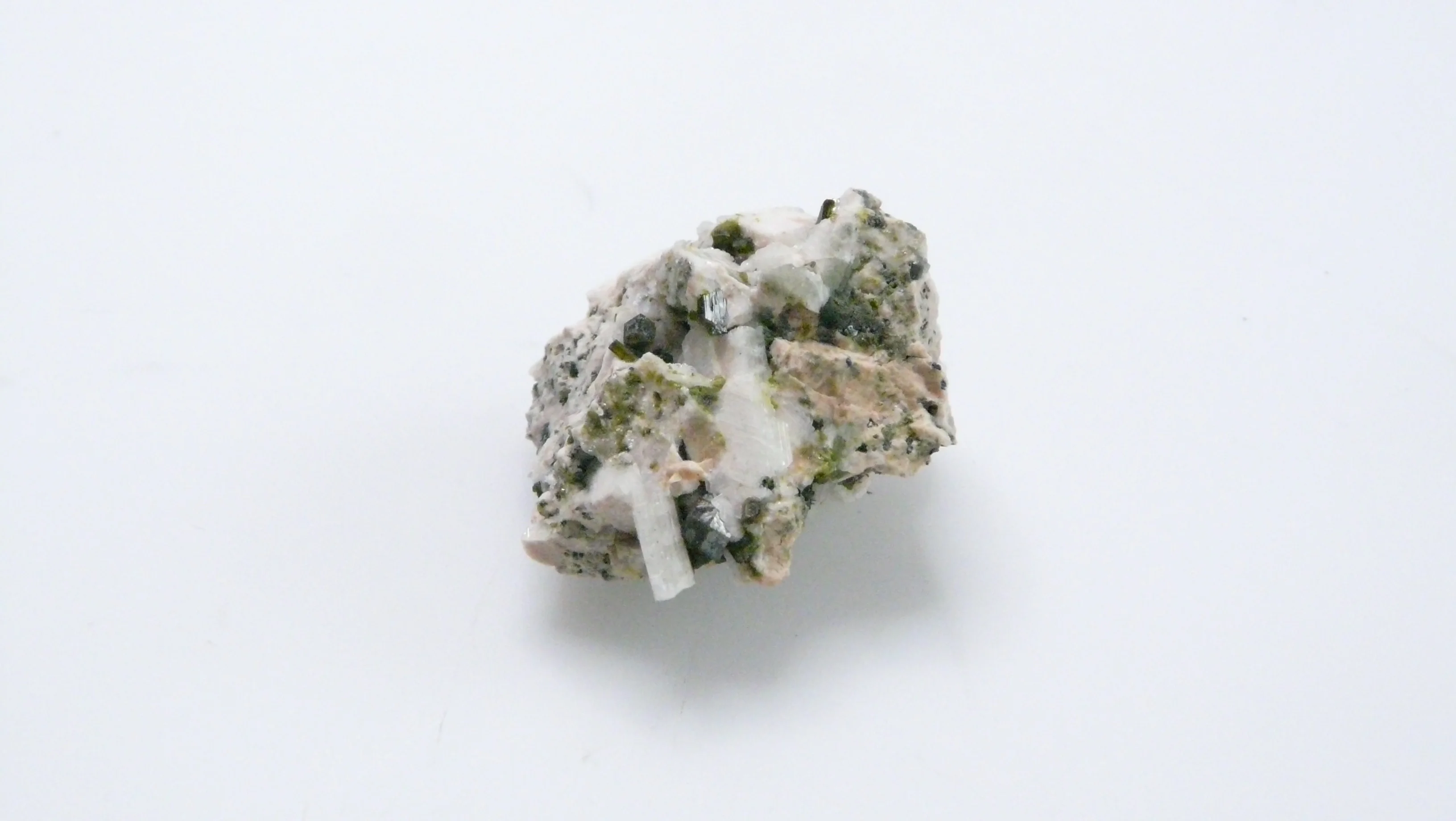
| ID | 465 | |
|---|---|---|
| Mineral |
Albite
Epidote Grossular Orthoclase |
|
| Location | Sandefjord - Vestfold og Telemark - Norway | |
| Fluorescence | LW-UV: close SW-UV: close |
|
| Mindat.org |
View Albite information at mindat.org View Epidote information at mindat.org View Grossular information at mindat.org View Orthoclase information at mindat.org |
|
Mindat data
| ID | 96 |
|---|---|
| Long ID | 1:1:96:9 |
| Formula |
Na(AlSi3O8)
|
| IMA Status |
0 1 |
| Other Occurrences | A major constituent of granites and granite pegmatites, alkalic diorites, basalts, and in hydrothermal and alpine veins. A product of potassium metasomatism and in low-temperature and low-pressure metamorphic facies and in some schists. Detrital and authigenic in sedimentary rocks. |
| Discovery Year | 1815 |
| Diapheny | Transparent,Translucent,Opaque |
| Cleavage | on [001], good on [010], imperfect on {110} |
| Tenacity | brittle |
| Colour | White to gray or colorless, uncommonly blue tinted or rarely green or red tinted, while much included albite may be strongly colored.. |
| Hardness (min) | 6.0 |
| Hardness (max) | 6.5 |
| Lustre | Vitreous, pearly |
| About the name | Named in 1815 by Johan Gottlieb Gahn and Jöns Jacob Berzelius from Latin "albus", white, alluding to its usual color. |
| Streak | White |
| Crystal System | Triclinic |
| Cleavage Type | Perfect |
| Fracture type | Irregular/Uneven,Conchoidal |
| Morphology |
Crystals commonly tabular parallel |
| Twinning |
Common around |
| Comment Luster | Pearly on cleavages |
| shortcode_ima | Ab |
| Group | Plagioclase |
| ID | 1389 |
|---|---|
| Long ID | 1:1:1389:1 |
| Formula |
Ca2(Al2Fe3+)[Si2O7][SiO4]O(OH)
|
| IMA Status |
0 1 |
| Other Occurrences | Regional and contact metamorphic rocks. Saussuritisation (alteration of plagioclase). |
| Discovery Year | 1801 |
| Diapheny | Transparent,Translucent,Opaque |
| Cleavage | Perfect on {001}, imperfect on {100} |
| Tenacity | brittle |
| Colour | Yellowish-green, green, brownish-green, black |
| Hardness (min) | 6.0 |
| Hardness (max) | 6.0 |
| Lustre | Vitreous |
| About the name | Named in 1801 by Rene Just Haüy from the Greek επιδοσιζ ("epidosis"), meaning "increase", in allusion to the crystal characteristic of one longer side at the base of the prism. |
| Streak | Colourless |
| Crystal System | Monoclinic |
| Cleavage Type | Perfect |
| Fracture type | Irregular/Uneven |
| Morphology | Crystals prismatic to 35 cm, also stubby, rarely tabular or pseudo-octahedral. Fibrous, coarse to finely granular, massive. Prismatic crystals may show a pseudo-hexagonal cross-section. |
| Twinning | On {100}, contact, lamellar, common. |
| shortcode_ima | Ep |
| Group | Epidote Group |
| ID | 1755 |
|---|---|
| Long ID | 1:1:1755:4 |
| Formula |
Ca3Al2(SiO4)3
|
| IMA Status |
0 1 |
| Other Occurrences | Contact and regionally metamorphosed calcareous rocks. Rodingites |
| Industrial | Gem |
| Diapheny | Transparent,Translucent |
| Tenacity | brittle |
| Colour | Brown, orange, red, yellow, green, white, colorless, pink |
| Hardness (min) | 6.5 |
| Hardness (max) | 7.0 |
| About the name | Originally named "cinnamon stone" ("Kanelstein" in German) in 1803 by Abraham Gottlob Werner and renamed grossularite by Werner in 1808. Named for the color of gooseberries (Ribes grossularium) as the original specimens were this color. |
| Streak | White to pale Brownish white |
| Crystal System | Isometric |
| Cleavage Type | None Observed |
| Fracture type | Irregular/Uneven,Sub-Conchoidal |
| Morphology | Dodecahedra or trapezohedra, granular, compact, massive. May have hexoctahedral faces. Rarely tetrahexahedral or octahedral. |
| Twinning | Not observed |
| UV | Almost always non-fluorescent; may be a weak golden yellow (LW & SW) Some light green grossular garnets exhibit orange-red luminescence under long-wave and short-wave ultraviolet light. Results imply that chromium and manganese are the luminescence activators in grossular garnets, and vanadium is a powerful quencher. |
| shortcode_ima | Grs |
| Group | Garnet Group |
| ID | 3026 |
|---|---|
| Long ID | 1:1:3026:3 |
| Formula |
K(AlSi3O8)
|
| IMA Status |
0 1 |
| Other Occurrences | Common feldspar of high-temperature granites, syenites, high-grade metamorphic rocks, and some felsic extrusive rocks, eg some rhyolites (although these tend to contain sanidine when fresh). |
| Industrial | Ceramics, abrasives, crushed stone, decorative facing in slabbed rock panels, gem materials |
| Discovery Year | 1823 |
| Diapheny | Transparent,Translucent |
| Cleavage | Perfect on {001}, good on {010} |
| Tenacity | brittle |
| Colour | Colorless to white, Greenish white, Grayish yellow, Pale pink |
| Hardness (min) | 6.0 |
| Hardness (max) | 6.0 |
| About the name | Named "orthose" in 1801 by Rene Just Haüy from the Greek orthos - "right" in allusion to the mineral's right angle of good cleavage. The sense of Haüy's name was that the mineral was a feldspar, but he did not specify a type-locality, nor did Haüy give a chemical analysis. The name was changed in 1823 to orthoklas by Johann Friedrich August Breithaupt. |
| Streak | White |
| Crystal System | Monoclinic |
| Cleavage Type | Perfect |
| Fracture type | Irregular/Uneven,Conchoidal |
| Morphology | Short prismatic |
| Twinning | Common as Carlsbad, Baveno and Manebach. |
| UV | May fluoresce dull white or red in SW UV |
| Comment Luster | Slightly pearly on cleavage |
| shortcode_ima | Or |
| Group | K Feldspar |
Details
Price: € 5
Dimensions: Not registered
Weight: Not registered
Visibile in overview:
Notes:
None
| Symbol | Element | |
|---|---|---|
| Al | Aluminium | |
| Ca | Calcium | |
| Fe | Iron | |
| H | Hydrogen | |
| K | Potassium | |
| Na | Sodium | |
| O | Oxygen | |
| Si | Silicium |