Hematite, Chalcedony, Fluorapatite and Augite
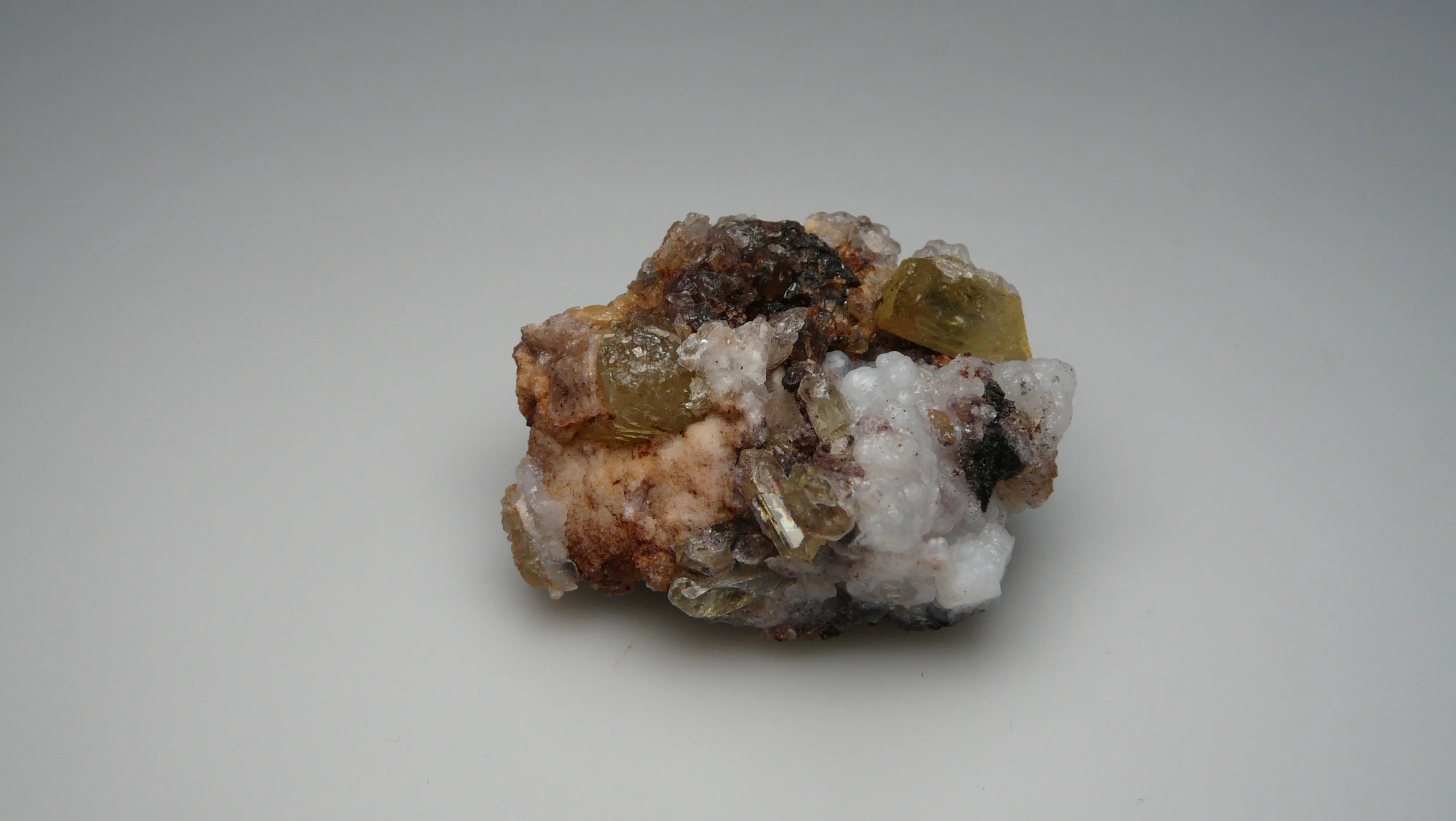
| ID | 460 | |
|---|---|---|
| Mineral |
Hematite
Chalcedony Fluorapatite Augite |
|
| Location | Cerro del Mercado - Durango - Mexico | |
| Fluorescence | LW-UV: close SW-UV: close |
|
| Mindat.org |
View Hematite information at mindat.org View Chalcedony information at mindat.org View Fluorapatite information at mindat.org View Augite information at mindat.org |
|
Mindat data
| ID | 2583 |
|---|---|
| Long ID | 1:1:2583:2 |
| IMA Status |
0 1 |
| Variety of | 1856 |
| Entry type | 2 |
| Description | The name given for hematite pseudomorphs after magnetite, formed under conditions of increasing oxygen fugacity. For pseudomorphs of magnetite after hematite see "mushketovite". Originally described from Itabira, Minas Gerais, Southeast Region... |
| Hardness (min) | 5.0 |
| Hardness (max) | 6.0 |
| Lustre | Metallic |
| Crystal System | Trigonal |
| ID | 960 |
|---|---|
| Long ID | 1:1:960:9 |
| IMA Status |
0 1 |
| Variety of | 3337 |
| Entry type | 2 |
| Description | Depending on the context, the term "chalcedony" has different meanings. 1. A more general term for all varieties of quartz that are made of microscopic or submicroscopic crystals, the so-called microcrystalline varieties of quartz. Examples are the ... |
| Other Occurrences | Very common. As nodules, vein fillings, crusts in volcanic rocks. As sinter-like crusts in low- to medium temperature hydrothermal veins. Main constituent in silica-rich marine sedimentary rocks. As nodular concretions and layers in limestones and marls. As a metasomatic replacement in limestones and marls ("replacement chert"). As cement in sandstones. Replacing other minerals in pseudomorphoses. As a fossilizing material (petrified wood, coral agate). |
| Diapheny | Translucent |
| Tenacity | brittle |
| Colour | colorless, white, gray, blue, any color due to embedded minerals, multicolored specimen not uncommon. |
| Hardness (min) | 7.0 |
| Hardness (max) | 7.0 |
| Lustre | Vitreous |
| About the name | Mentioned by Agricola (1546) of a stone named for the town of Chalcedon, now called Kadıköy, and is a district within the city of Istanbul, Turkey. |
| Streak | White |
| Crystal System | Trigonal |
| Cleavage Type | None Observed |
| Fracture type | Conchoidal,Sub-Conchoidal |
| Twinning | Quartz crystallites in the chalcedony fibers are polysynthetically twinned by the Brazil law (left- and right-handed domains). |
| UV | None in a pure specimen, however, green fluorescence in short-wave UV light is very common at many localities. |
| Comment Luster | vitreous when polished, fractured surfaces have a dull or waxy luster |
| ID | 1572 |
|---|---|
| Long ID | 1:1:1572:7 |
| Formula |
Ca5(PO4)3F
|
| IMA Status |
0 1 |
| Other Occurrences | Most common rock forming phosphate. Accessory mineral in most igneous rocks with important concentrations in carbonatites. Common in marbles and skarns. Major mineral in sedimentary phosphorites. |
| Industrial | Source of phosphorus. |
| Discovery Year | 1823 |
| Diapheny | Transparent,Opaque |
| Cleavage |
Indistinct (0001) and |
| Tenacity | brittle |
| Colour | Colourless to white when pure, also green, blue, pink, yellow, brown, violet, purple. |
| Hardness (min) | 5.0 |
| Hardness (max) | 5.0 |
| Luminescence | Fluorescent & Phosphorescent. |
| Lustre | Vitreous, Resinous |
| About the name |
Renamed in 1860 from the original |
| Streak | White |
| Crystal System | Hexagonal |
| Cleavage Type | Poor/Indistinct |
| Fracture type | Irregular/Uneven,Conchoidal |
| Morphology |
Crystals short to long hexagonal prisms [0001], with |
| Twinning |
Rare contact twins on |
| UV | Often fluorescent bright yellow or blue white and phosphorescent, especially the manganoan varieties. The REEs-doped FAp powders synthesized by hydrothermal methods produce fluorescence of different wavelengths. Er-, Eu-, Pr-, Ho-, and Yb-doped FAps can, respectively, emit blue, orange, red, orange, red, and green light under the excitation of ultraviolet light (250 nm). Compared with the Pr/Sm/Gd/Ho/Yb-doped FAps, Er/Eu-doped FAps exhibit high fluorescence intensity, attributed to their small lattice distortion, big grain size and suitable doping concentration.[[1]] |
| Thermal Behaviour | Strongly thermoluminescent at times. |
| shortcode_ima | Fap |
| Group | Apatite Group |
| ID | 419 |
|---|---|
| Long ID | 1:1:419:0 |
| Formula |
(Ca,Mg,Fe)2Si2O6
|
| IMA Status |
0 1 |
| Other Occurrences | Major rock forming mineral in mafic igneous rocks, ultramafic rocks, and some high-grade metamorphic rocks. |
| Discovery Year | 1792 |
| Diapheny | Translucent,Opaque |
| Cleavage | Good on {110} |
| Tenacity | brittle |
| Colour | Brown-green, black, green-black, brown, purplish brown |
| Hardness (min) | 5.5 |
| Hardness (max) | 6.0 |
| Lustre | Vitreous, resinous |
| About the name | Named by Abraham G. Werner in 1792 from the Greek αυγή ("auge") for "shine" or "luster," in allusion to the appearance of its cleavage surfaces. |
| Streak | Greenish gray, light to dark brown |
| Crystal System | Monoclinic |
| Cleavage Type | Distinct/Good |
| Fracture type | Irregular/Uneven,Sub-Conchoidal |
| Morphology | Stubby prismatic crystals. |
| Twinning | Simple or multiple on {100}, also on {001} |
| UV | Not fluorescent |
| shortcode_ima | Aug |
| Group | Clinopyroxene Subgroup |
Details
Price: € 15
Dimensions: Not registered
Weight: Not registered
Visibile in overview:
Notes:
Ma
| Symbol | Element | |
|---|---|---|
| Ca | Calcium | |
| F | Fluorine |

|
| Fe | Iron | |
| Mg | Magnesium | |
| O | Oxygen | |
| P | Phosphorus |
|
| Si | Silicium |