Strengite, Purpurite and Quartz
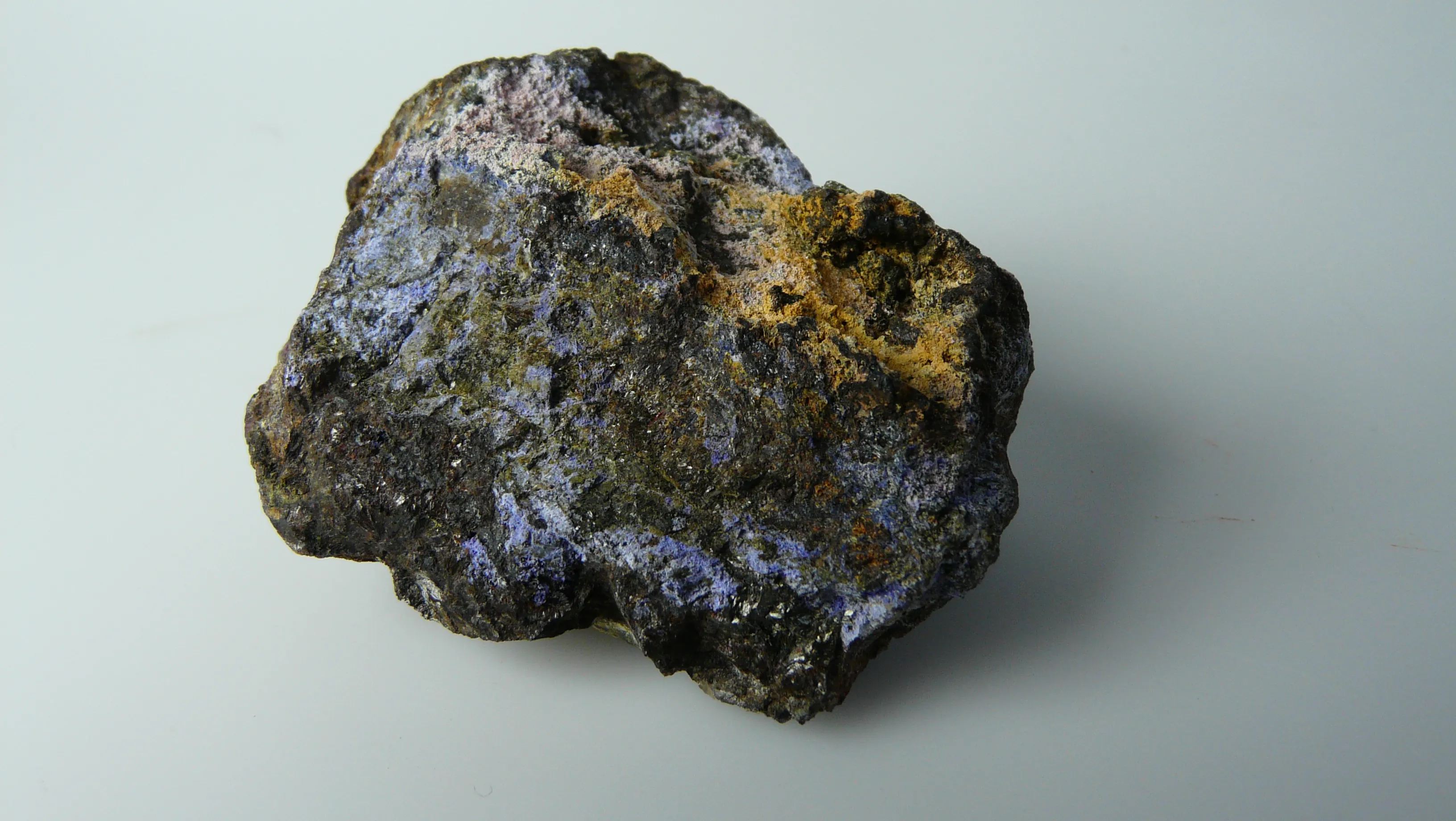
| ID | 434 | |
|---|---|---|
| Mineral |
Strengite
Purpurite Quartz |
|
| Location | Corvaceira Mine - Chãs de Tavares - Viseu - Portugal | |
| Fluorescence | LW-UV: close SW-UV: close |
|
| Mindat.org |
View Strengite information at mindat.org View Purpurite information at mindat.org View Quartz information at mindat.org |
|
Mindat data
| ID | 3801 |
|---|---|
| Long ID | 1:1:3801:6 |
| Formula |
Fe3+(PO4) · 2H2O
|
| IMA Status |
0 1 |
| Occurrence | Phosphate-bearing iron ore deposit |
| Other Occurrences |
Secondary mineral formed under surface or near-surface conditions by the alteration of iron-bearing phosphates, such as |
| Discovery Year | 1877 |
| Diapheny | Transparent,Translucent |
| Cleavage | Good on {010}, poor on {001} |
| Tenacity | brittle |
| Colour | Purple, violet, pink, peach-blossom-red, carmine, greenish white, colorless; Colourless to pale pink in transmitted light. |
| Hardness (min) | 3.5 |
| Hardness (max) | 4.0 |
| About the name | Named after Johann August Streng [February 4, 1830 Frankfurt, Germany - January 7, 1897 Giessen, Germany], Professor of Mineralogy, University of Giessen, Germany. Streng was an assistant to Robert Bunsen at University of Heidelberg and later professor of chemistry at the Clausthal Mining Academy. Streng was an innovator in new methods of chemical titration. |
| Streak | white |
| Crystal System | Orthorhombic |
| Cleavage Type | Distinct/Good |
| Morphology | Crystals rarely octahedral {111}; usually thick to thin tabular {001}; also stout prismatic [100] or [010]. May be lathlike, radial fibrous, botyroidal or spherical aggregates and crusts. |
| Twinning | Rarely on {201} |
| UV | Not fluorescent in UV |
| shortcode_ima | Stg |
| Group | Variscite Group |
| ID | 3311 |
|---|---|
| Long ID | 1:1:3311:0 |
| Formula |
Mn3+(PO4)
|
| IMA Status |
0 1 |
| General Appearance | Small irregular masses. Narrow lenses or veinlets. |
| Occurrence | Oxidized and leached primary lithiophilite pods from a granite pegmatite. |
| Other Occurrences | Primarily an alteration product of lithiophylite in complex granitic pegmatites, rarely from the reaction of bat guano, Fe-Mn deposits and sea water. |
| Discovery Year | 1905 |
| Diapheny | Opaque |
| Cleavage | On {100}, good; on {010}, imperfect. Cleavage surfaces curved or crinkled at times. |
| Tenacity | brittle |
| Colour | Dark purple to purplish red |
| Hardness (min) | 4.0 |
| Hardness (max) | 4.5 |
| Lustre | Vitreous, dull |
| About the name | Named in 1905 by Louis C. Graton and Waldemar T. Schaller from the Latin "purpura" in allusion to its colour. |
| Streak | Light to medium purple, lighter than the colour of the massive mineral. |
| Crystal System | Orthorhombic |
| Cleavage Type | Distinct/Good |
| Fracture type | Irregular/Uneven |
| Morphology | Massive, cleavage fragments to 20 cm. |
| UV | Not fluorescent in UV |
| Comment Luster | Luster of fresh fracture surfaces is satiny; dull on altered surfaces. |
| Publication Year | 1905 |
| shortcode_ima | Pur |
| Group | Triphylite Group |
| ID | 3337 |
|---|---|
| Long ID | 1:1:3337:0 |
| Formula |
SiO2
|
| IMA Status |
0 1 |
| Other Occurrences | Most of them... |
| Industrial | Ore for silicon, glassmaking, frequency standards, optical instruments, silica source for concrete setting, filtering agents as sand. A major component of sand. |
| Diapheny | Transparent,Translucent |
| Cleavage |
The rhombohedral cleavage r |
| Tenacity | brittle |
| Colour | Colorless, purple, rose, red, black, yellow, brown, green, blue, orange, etc. |
| Hardness (min) | 7.0 |
| Hardness (max) | 7.0 |
| Luminescence | Triboluminescent |
| Lustre | Vitreous |
| About the name | Quartz has been known and appreciated since pre-historic times. The most ancient name known is recorded by Theophrastus in about 300-325 BCE, κρύσταλλος or kristallos. The varietal names, rock crystal and bergcrystal, preserve the ancient usage. The root words κρύοσ signifying ice cold and στέλλειυ to contract (or solidify) suggest the ancient belief that kristallos was permanently solidified ice. The earliest printed use of "querz" was anonymously published in 1505, but attributed to a physician in Freiberg, Germany, Ulrich Rülein von Kalbe (a.k.a. Rülein von Calw, 1527). Agricola used the spelling "quarzum" (Agricola 1530) as well as "querze", but Agricola also referred to "crystallum", "silicum", "silex", and silice". Tomkeieff (1941) suggested an etymology for quartz: "The Saxon miners called large veins - Gänge, and the small cross veins or stringers - Querklüfte. The name ore (Erz, Ertz) was applied to the metallic minerals, the gangue or to the vein material as a whole. In the Erzgebirge, silver ore is frequently found in small cross veins composed of silica. It may be that this ore was called by the Saxon miners 'Querkluftertz' or the cross-vein-ore. Such a clumsy word as 'Querkluftertz' could easily be condensed to 'Querertz' and then to 'Quertz', and eventually become 'Quarz' in German, 'quarzum' in Latin and 'quartz' in English." Tomkeieff (1941, q.v.) noted that "quarz", in its various spellings, was not used by other noted contemporary authors. "Quarz" was used in later literature referring to the Saxony mining district, but seldom elsewhere. Gradually, there were more references to quartz: E. Brown in 1685 and Johan Gottschalk Wallerius in 1747. In 1669, Nicolaus Steno (Niels Steensen) obliquely formulated the concept of the constancy of interfacial angles in the caption of an illustration of quartz crystals. He referred to them as "cristallus" and "crystallus montium". Tomkeieff (1941) also noted that Erasmus Bartholinus (1669) used the various spellings for "crystal" to signify other species than quartz and that crystal could refer to other "angulata corpora" (bodies with angles): "In any case in the second half of the XVIIIth century quartz became established as a name of a particular mineral and the name crystal became a generic term synonymous with the old term 'corpus angulatum'." |
| Streak | White |
| Crystal System | Trigonal |
| Cleavage Type | Poor/Indistinct |
| Fracture type | Conchoidal |
| Twinning | Dauphiné law. Brazil law. Japan law. Others for beta-quartz... |
| Thermal Behaviour | Transforms to beta-quartz at 573° C and 1 bar (100 kPa) pressure. |
| shortcode_ima | Qz |
Details
Price: € 10
Dimensions: Not registered
Weight: 168 g
Visibile in overview:
Notes:
| Symbol | Element | |
|---|---|---|
| Fe | Iron | |
| H | Hydrogen | |
| Mn | Manganese | |
| O | Oxygen | |
| P | Phosphorus |

|
| Si | Silicium |