Baryte and Calcite
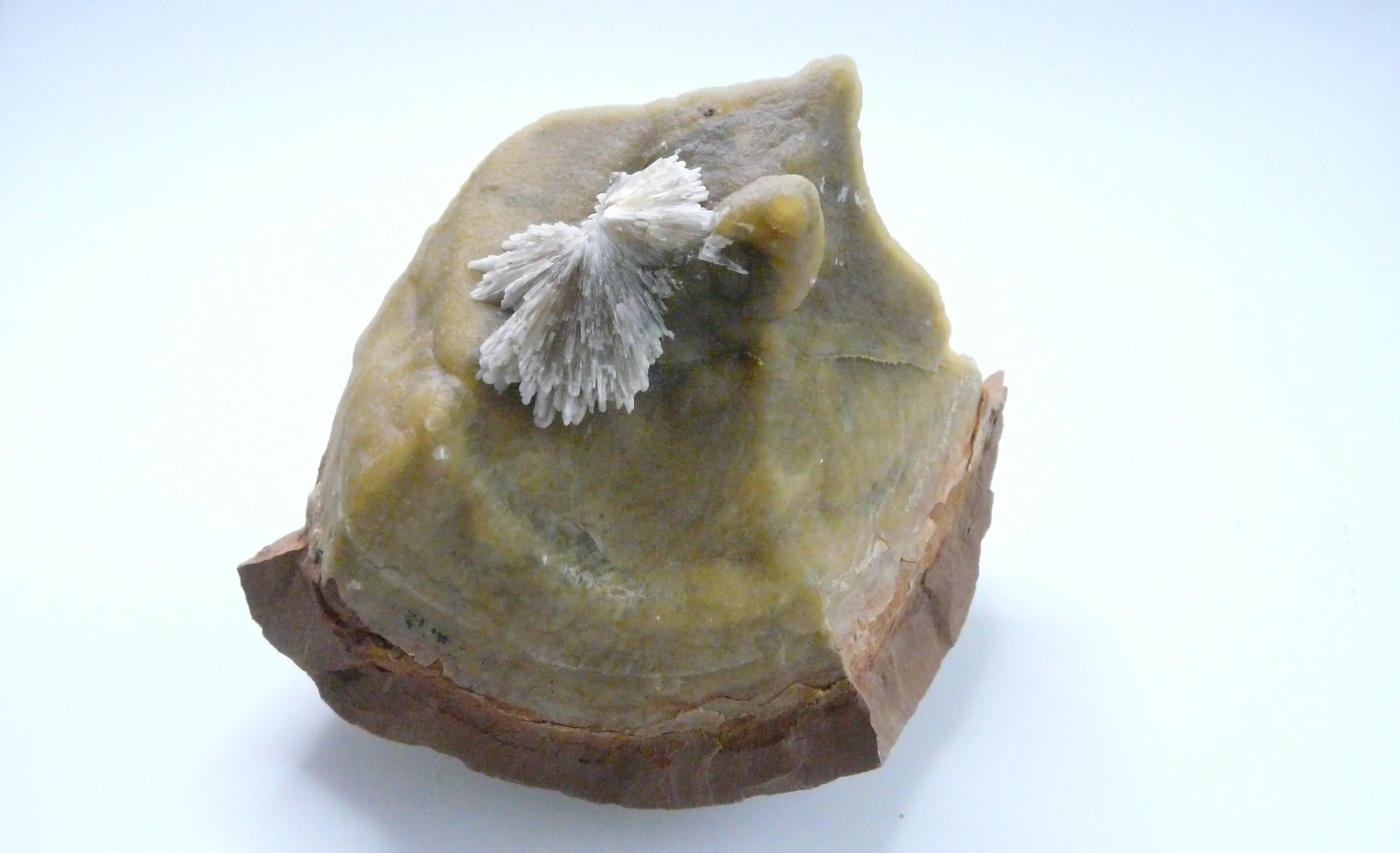
| ID | 430 | |
|---|---|---|
| Mineral |
Baryte
Calcite |
|
| Location | Warden Point - Warden - Isle of Sheppy - United Kingdom | |
| Fluorescence | LW-UV: close SW-UV: close |
|
| Mindat.org |
View Baryte information at mindat.org View Calcite information at mindat.org |
|
Mindat data
| ID | 549 |
|---|---|
| Long ID | 1:1:549:0 |
| Formula |
Ba(SO4)
|
| IMA Status |
0 1 |
| Other Occurrences | Commonly found as a gangue mineral in metallic ore deposits of epithermal or mesothermal origin; but it may also be found as lenses or replacement deposits in sedimentary rocks, both of hypogene and supergene origin. |
| Industrial | Used as an additive in drilling fluids, as a white pigment, e. g. in cosmetic products and in paints, and as a filling material for polymers and papers, high contrast medium for medical X-rays. Also the main source of barium. |
| Diapheny | Transparent,Translucent,Opaque |
| Cleavage | Perfect on {001}; less so on {210}; Imperfect on {010}. |
| Tenacity | brittle |
| Colour | Colourless, white, yellow, brown, grey, blue, etc.; colourless in transmitted light (also tinted yellow, brown, green, blue, etc.) |
| Hardness (min) | 3.0 |
| Hardness (max) | 3.0 |
| Luminescence | Fluoresces yellows, orange, or pink in LW; phophsphoresces strongly greenish-white. |
| Lustre | Vitreous to Resinous, Pearly on cleavage surfaces. |
| About the name | Named in 1800 by Dietrich Ludwig Gustav Karsten from the Greek βαρύς, heavy, due to its unusual heaviness for a non-metallic mineral. |
| Streak | white |
| Crystal System | Orthorhombic |
| Cleavage Type | Perfect |
| Fracture type | Irregular/Uneven |
| Morphology | Usually thin to thick tabular {001}, bounded by {210} alone or in combination with {101}, {011} or other forms. Also flattened {001}, and elongated to prismatic [010] or [100]. More rarely prismatic [001], or equant. Often as aggregates or clusters of tabular crystals with edges projecting into crest-like forms, or as rosettes. Also found as massive material, compact, laminated or concretionary; and in fibrous, stalactic, and earthy masses. |
| UV | Shades of yellow, occasionally orange or pink (LW UV). Shades of yellow, white (Franklin & Sterling Hill, NJ). May phosphoresce strongly greenish-white. |
| Thermal Behaviour | Inverts to another (monoclinic?) polymorph when heated to 1149°C. Above 1400°C decomposition to barium oxide, sulphur dioxide and oxygen. Thermoluminescent at times. |
| Comment Luster | Vitreous to Resinous, Pearly on cleavage surfaces. |
| key_elements |
0 |
| shortcode_ima | Brt |
| Group | Baryte Group |
| ID | 859 |
|---|---|
| Long ID | 1:1:859:4 |
| Formula |
Ca(CO3)
|
| IMA Status |
0 1 |
| Other Occurrences | Found in most geologic settings and as a later forming replacement mineral in most other environments in one form or another, it is most common as massive material in limestones and marbles. It forms as chemical sedimentary deposits as limestone, can be regionally or contact metamorphosed into marbles and rarely forms igneous rocks (carbonatites). Also is a common gangue mineral in hydrothermal deposits. |
| Industrial | Mined extensively for a wide variety of uses ranging from lime (cement) to limestone and marble building stones and aggregates, agricultural supplements and optical calcite. |
| Diapheny | Transparent,Translucent |
| Cleavage |
Perfect on |
| Tenacity | brittle |
| Colour | White, Yellow, Red, Orange, Blue, Green, Brown, Gray etc. |
| Hardness (min) | 3.0 |
| Hardness (max) | 3.0 |
| Luminescence | Fluorescent |
| Lustre | Vitreous |
| About the name | Ancient name. Named as a mineral by Gaius Plinius Secundus (Pliny the elder) in 79 from Calx, Latin for Lime. |
| Streak | White |
| Crystal System | Trigonal |
| Cleavage Type | Perfect |
| Fracture type | Conchoidal |
| Morphology | Over 800 different forms have been described. Most commonly as acute rhombohedrons or prismatic with scalenohedral terminations, or combinations of the two. |
| Twinning |
At least four twin laws have been described, the most common being when the twin plane and the composition plane are |
| UV | May be fluorescent under LW UV, mid-range UV or SW UV as well as under X-rays, cathode rays and even sunlight, in a number of colors and shades, commonly an intense red under SW with Mn as an activator (such as at Franklin, New Jersey, USA, and Långban in Sweden. |
| Comment Luster | Pearly on cleavage and {0001}. Can be dull or earthy in chalk variety. |
| shortcode_ima | Cal |
| Group | Calcite Group |
Details
Price: € 25
Dimensions: Not registered
Weight: 723 g
Visibile in overview:
Notes:
Septaria
| Symbol | Element | |
|---|---|---|
| Ba | Barium | |
| C | Carbon | |
| Ca | Calcium | |
| O | Oxygen | |
| S | Sulfur |