Calcite, Schorl and Phlogopite
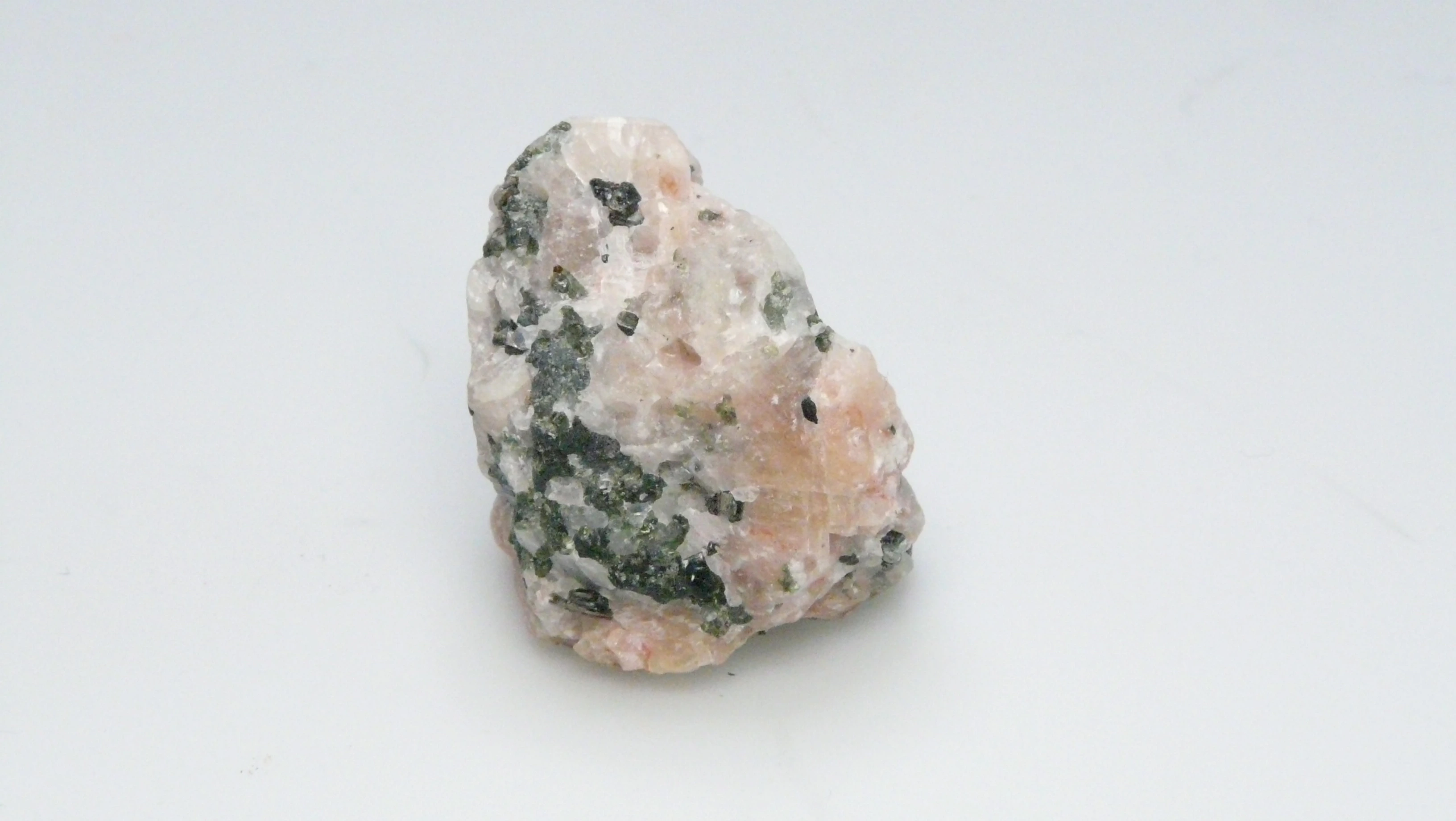
| ID | 419 | |
|---|---|---|
| Mineral |
Calcite
Schorl Phlogopite |
|
| Location | Mica Pits - North Burgess Township - Ontario - Canada | |
| Fluorescence | LW-UV: close SW-UV: close |
|
| Mindat.org |
View Calcite information at mindat.org View Schorl information at mindat.org View Phlogopite information at mindat.org |
|
Mindat data
| ID | 859 |
|---|---|
| Long ID | 1:1:859:4 |
| Formula |
Ca(CO3)
|
| IMA Status |
0 1 |
| Other Occurrences | Found in most geologic settings and as a later forming replacement mineral in most other environments in one form or another, it is most common as massive material in limestones and marbles. It forms as chemical sedimentary deposits as limestone, can be regionally or contact metamorphosed into marbles and rarely forms igneous rocks (carbonatites). Also is a common gangue mineral in hydrothermal deposits. |
| Industrial | Mined extensively for a wide variety of uses ranging from lime (cement) to limestone and marble building stones and aggregates, agricultural supplements and optical calcite. |
| Diapheny | Transparent,Translucent |
| Cleavage |
Perfect on |
| Tenacity | brittle |
| Colour | White, Yellow, Red, Orange, Blue, Green, Brown, Gray etc. |
| Hardness (min) | 3.0 |
| Hardness (max) | 3.0 |
| Luminescence | Fluorescent |
| Lustre | Vitreous |
| About the name | Ancient name. Named as a mineral by Gaius Plinius Secundus (Pliny the elder) in 79 from Calx, Latin for Lime. |
| Streak | White |
| Crystal System | Trigonal |
| Cleavage Type | Perfect |
| Fracture type | Conchoidal |
| Morphology | Over 800 different forms have been described. Most commonly as acute rhombohedrons or prismatic with scalenohedral terminations, or combinations of the two. |
| Twinning |
At least four twin laws have been described, the most common being when the twin plane and the composition plane are |
| UV | May be fluorescent under LW UV, mid-range UV or SW UV as well as under X-rays, cathode rays and even sunlight, in a number of colors and shades, commonly an intense red under SW with Mn as an activator (such as at Franklin, New Jersey, USA, and Långban in Sweden. |
| Comment Luster | Pearly on cleavage and {0001}. Can be dull or earthy in chalk variety. |
| shortcode_ima | Cal |
| Group | Calcite Group |
| ID | 3578 |
|---|---|
| Long ID | 1:1:3578:7 |
| Formula |
NaFe2+3Al6(Si6O18)(BO3)3(OH)3(OH)
|
| IMA Status |
0 1 |
| Occurrence | In placers. |
| Other Occurrences | In granites and granitic pegmatites, high temperature hydrothermal veins, metamorphic rocks. |
| Discovery Year | 1505 |
| Diapheny | Translucent,Opaque |
| Cleavage |
Very poor on |
| Tenacity | brittle |
| Colour | Bluish-black to black, sometimes brownish-black, rarely greenish-black. |
| Hardness (min) | 7.0 |
| Hardness (max) | 7.0 |
| Luminescence | Nonfluorescent. |
| Lustre | Vitreous to oily, dull. |
| About the name | The early history of the mineral schorl shows that the name "Schorl" was in use prior to the year 1400 (AD) because a village known today as Zschorlau (in Saxony, Germany) was then named "Schorl" (or minor variants of this name). This village had a nearby tin mine where, in addition to cassiterite, a lot of black tourmaline was found. First mentioned by Ulrich Rülein von Calw 1505. The first relatively detailed description of schorl with the name "schürl" and its occurrence (various tin mines in the Saxony Ore Mountains) was written by Johannes Mathesius (1504-1565) in 1562 under the title "Sarepta oder Bergpostill". Up to about 1600, additional names used in the German language were "Schurel", "Schörle", and "Schurl". From the 18th century on, the name "Schörl" was mainly used in the German-speaking area. In English, the names "shorl" and "shirl" were used in the 18th century for schorl. In the 19th century the names "common schorl", "schörl", "schorl" and "iron tourmaline" were used in the Anglo-Saxon area (Ertl, 2006). |
| Streak | Greyish-white to bluish-white. |
| Crystal System | Trigonal |
| Cleavage Type | Poor/Indistinct |
| Fracture type | Irregular/Uneven,Sub-Conchoidal |
| Morphology | Prismatic to acicular. |
| Twinning |
|
| Publication Year | 1524 |
| key_elements |
0 |
| shortcode_ima | Srl |
| Group | Tourmaline |
| ID | 3193 |
|---|---|
| Long ID | 1:1:3193:2 |
| Formula |
KMg3(AlSi3O10)(OH)2
|
| IMA Status |
0 1 |
| Other Occurrences | Contact and regional metamorphic limestones and dolomites, ultramafic rocks. |
| Discovery Year | 1841 |
| Diapheny | Transparent,Translucent |
| Cleavage | on {0001} |
| Tenacity | flexible |
| Colour | Brown, gray, green, yellow, or reddish brown |
| Hardness (min) | 2.0 |
| Hardness (max) | 3.0 |
| Luminescence | None |
| Lustre | Vitreous - Pearly |
| About the name | Named in 1841 by Johann Friedrich August Breithaupt from the Greek φλογωποζ "phlogopos" for "resembling fire", in allusion to the red tint of the original specimens. |
| Streak | White |
| Crystal System | Monoclinic |
| Cleavage Type | Perfect |
| Fracture type | Micaceous |
| Morphology | Six sided crystals, thick tabular to prismatic, commonly tapered. |
| Twinning | Composition plane {001}, twin axis [310] |
| Comment Luster | sub-metallic on cleavage |
| shortcode_ima | Phl |
| Group | Biotite |
Details
Price: € 2
Dimensions: Not registered
Weight: Not registered
Visibile in overview:
Notes:
| Symbol | Element | |
|---|---|---|
| Al | Aluminium | |
| B | Boron | |
| C | Carbon | |
| Ca | Calcium | |
| Fe | Iron | |
| H | Hydrogen | |
| K | Potassium | |
| Mg | Magnesium | |
| Na | Sodium | |
| O | Oxygen | |
| Si | Silicium |