Goethite, Limonite and Cerussite
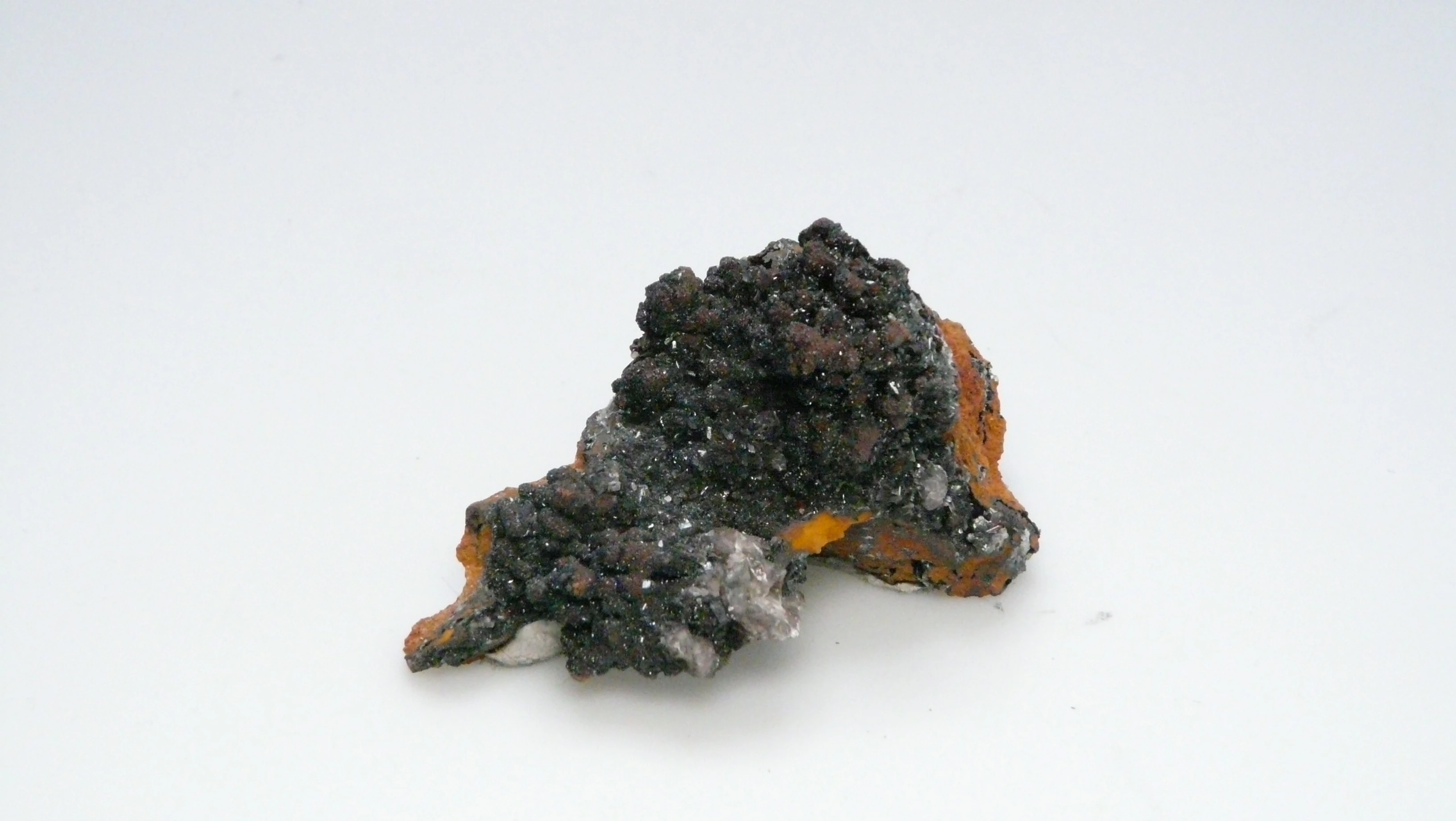
| ID | 415 | |
|---|---|---|
| Mineral |
Goethite
Limonite Cerussite |
|
| Location | Chihuahua - Mexico | |
| Fluorescence | LW-UV: close SW-UV: close |
|
| Mindat.org |
View Goethite information at mindat.org View Limonite information at mindat.org View Cerussite information at mindat.org |
|
Mindat data
| ID | 1719 |
|---|---|
| Long ID | 1:1:1719:6 |
| Formula |
FeO(OH)
|
| IMA Status |
0 1 |
| Other Occurrences | Common weathering product, primary hydrothermal mineral, bog and marine environments. |
| Industrial | Iron ore |
| Discovery Year | 1806 |
| Diapheny | Opaque |
| Cleavage | {010}; {100} less perfect. |
| Tenacity | brittle |
| Colour | Brownish black, yellow-brown, reddish brown |
| Hardness (min) | 5.0 |
| Hardness (max) | 5.5 |
| About the name | Named in 1806 by Johann Georg Lenz in honor of the German poet, novelist, playwrighter, philosopher, politician, and geoscientist Johann Wolfgang von Goethe [August 28, 1749, Frankfurt, Germany – March 22, 1832, Weimar, Germany]. Goethe was Chief Minister of State of Weimar. (Portions of the Goethe mineral collection are reputedly held by the Goethe Society in New York, New York, USA.) |
| Streak | Yellowish brown, orange-yellow, ocher-yellow |
| Crystal System | Orthorhombic |
| Cleavage Type | Perfect |
| Fracture type | Irregular/Uneven |
| Morphology | Prismatic [001] and striated [001]; also flattened into tablets or scales on {010}. Velvety aggregates of capillary crystals to acicular [001] and long prismatic forms often radially grouped. Massive, reniform, botryoidal, stalactitic. Bladed or columnar. Compact or fibrous concretionary nodules. Oolitic. |
| Twinning |
Apparently none reported, but see https://www.mindat.org/mesg-631125.html and compare twinning in isostructural |
| Thermal Behaviour | Heated in a closed tube, gives off water. |
| shortcode_ima | Gth |
| Group | Diaspore Group |
| ID | 2402 |
|---|---|
| Long ID | 1:1:2402:6 |
| Description | Currently used as a field-term for unidentified massive hydroxides and oxides of iron, with no visible crystals, and a yellow-brown streak. 'Limonite' is most commonly the mineral species goethite, but can also consist of varying proportions of lepidoc... |
| Diapheny | Opaque |
| About the name | Named in 1813 by Johann Friedrich Ludwig Hausmann from the Greek λειμών for meadow alluding to its common occurrences in bogs. |
| ID | 934 |
|---|---|
| Long ID | 1:1:934:4 |
| Formula |
Pb(CO3)
|
| IMA Status |
0 1 |
| Other Occurrences | Commonly occurs in the upper oxidized zones of base metal deposits, especially lead-silver deposits. |
| Industrial | Ore of lead, and often also of silver. |
| Diapheny | Transparent,Translucent |
| Cleavage | On {110} and {021} distinct; on {010} and {012} in traces. |
| Tenacity | very brittle |
| Colour | Colourless, white, gray, blue, or green; colourless in transmitted light |
| Hardness (min) | 3.0 |
| Hardness (max) | 3.5 |
| Luminescence | None |
| Lustre | Adamantine |
| About the name | Named in 1845 by Wilhelm Karl von Haidinger from the Latin, cerussa, meaning "white lead." |
| Streak | White |
| Crystal System | Orthorhombic |
| Cleavage Type | Distinct/Good |
| Fracture type | Conchoidal |
| Morphology |
Crystal morphology extremely varied. Simple crystals often tabular {010} and elongated [001] or [100]. Also equant or dipyramidal and then pseudo-hexagonal. Rarely acicular [001] or very thin tabular {001}. {010} and {0kl} usually striated [100]; {111} often striated |
| Twinning | Almost universal. Most commonly on {110}, as twin lamellae or as contact twin types producing stellate pseudo-hexagonal groups or reticulated aggregates. On {130} less common, mainly as contact twins with a heart-shaped outline. Both laws may occur simultaneously. |
| UV | Occasionally fluorescent under SW and MW UV lights showing a yellow color. Yellow/white under SW UV light, but less intense. |
| Thermal Behaviour | Breaks down to a basic carbonate at about 300°, which, in turn, decomposes to PbO at about 500° (?). According to Grisafe & White (1964) cerussite decomposes: - at ca. 204 °C, according to reaction: 3PbCO3 ⇌ 2Pb2O(CO3) + CO2 Further reactions: - at ca. 283 °C: 2Pb3O(CO3)2 ⇌ 3Pb2O(CO3) + CO2 - at 373 °C: 3Pb2O(CO3)⇌ 2Pb3O2(CO3) + CO2 - at 435 °C: Pb3O2(CO3) ⇌ 3PbO + CO2 |
| key_elements |
0 |
| shortcode_ima | Cer |
| Group | Aragonite Group |
Details
Price: € 35
Dimensions: Not registered
Weight: 70 g
Visibile in overview:
Notes:
| Symbol | Element | |
|---|---|---|
| C | Carbon | |
| Fe | Iron | |
| H | Hydrogen | |
| O | Oxygen | |
| Pb | Lead |

|