Smithsonite and Adamite
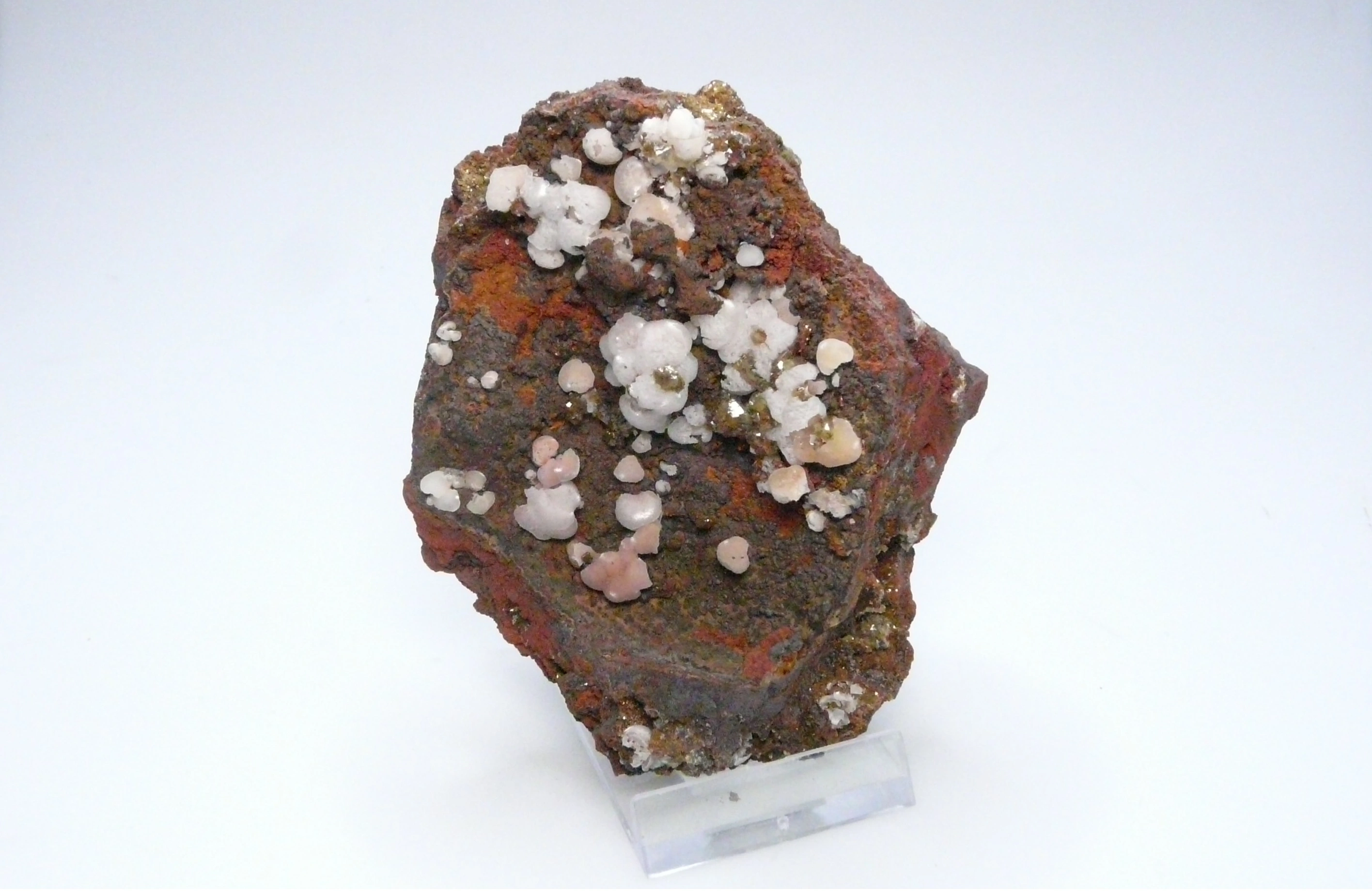
| ID | 413 | |
|---|---|---|
| Mineral |
Smithsonite
Adamite |
|
| Location | Ojuela Mine - Mapimi - Durango - Mexico | |
| Fluorescence | LW-UV: close SW-UV: close |
|
| Mindat.org |
View Smithsonite information at mindat.org View Adamite information at mindat.org |
|
Mindat data
| ID | 3688 |
|---|---|
| Long ID | 1:1:3688:3 |
| Formula |
Zn(CO3)
|
| IMA Status |
0 1 |
| Other Occurrences | Oxidised zones of zinc ore deposits. |
| Industrial | Ore of zinc. |
| Discovery Year | 1832 |
| Diapheny | Translucent |
| Cleavage |
On |
| Tenacity | brittle |
| Colour | White, grey, yellow, green to apple-green, blue, pink, purple, bluish grey, and brown; colourless or faintly tinted in transmitted light. |
| Hardness (min) | 4.0 |
| Hardness (max) | 4.5 |
| Lustre | Vitreous to Pearly |
| About the name | Lapis calaminaris was a name used by Agricola in 1546. In 1747, Johan Gottschalk Wallerius (Vallerius) used the simplified form calamine for the zinc carbonate. In 1780, Torbern Bergmann analyzed calamines and found they were mixed ores of zinc carbonates and silicates. In 1803, James Smithson made a systematic investigation of calamines and showed that ores identified as calamine consisted of several different minerals: a carbonate and a silicate. The carbonate "calamine" was re-named smithsonite in 1832 by François Sulpice Beudant in honor of James Smithson [1754-1829], British chemist, mineralogist, and benefactor of the Smithsonian Institution (Washington, DC, USA). |
| Streak | White |
| Crystal System | Trigonal |
| Cleavage Type | Very Good |
| Fracture type | Irregular/Uneven,Sub-Conchoidal |
| Morphology |
Crystals rhombohedral |
| Twinning | None observed. |
| UV | May fluoresce pale green or pale blue. |
| key_elements |
0 |
| shortcode_ima | Smt |
| Group | Calcite Group |
| ID | 21 |
|---|---|
| Long ID | 1:1:21:1 |
| Formula |
Zn2(AsO4)(OH)
|
| IMA Status |
0 1 |
| Other Occurrences | A secondary mineral in the oxidised zone of zinc- and arsenic-bearing hydrothermal mineral deposits. |
| Discovery Year | 1866 |
| Diapheny | Transparent,Translucent |
| Cleavage | on {101}, good; on {010}, poor. |
| Tenacity | very brittle |
| Colour | Ideally white, colourless, frequently pale yellow, honey-yellow, brownish yellow, rose red; blue, pale green to green, may be zoned; bright green (Cu-bearing); bright pink, purple (Co-bearing) |
| Hardness (min) | 3.5 |
| Hardness (max) | 3.5 |
| Luminescence | None? |
| Lustre | Vitreous |
| About the name | Named by Charles Friedel in 1866 for Gilbert Joseph Adam (7 April 1795 Seine-et-Marne, Fontainbleau, France - 8 June 1881 Paris, France), Inspector (Auditor) of Finance for the French Government, who supplied the first specimens of his mineral. Adam was a wealthy mineral collector and his mineral collection was described in Annales des Mines in 1869 and later in a published catalog (1869). Adam was also the discoverer of aerugite, chenevixite, corkite, cuprotungstite, scacchite, and xanthiosite. Adam's mineral collection was acquired by the École des Mines, Paris, France. Adam was a member of Société géologique de France and received the honor of Commandeur de la Légion d'Honneur. |
| Streak | white |
| Crystal System | Orthorhombic |
| Cleavage Type | Distinct/Good |
| Fracture type | Irregular/Uneven,Conchoidal |
| Morphology | Crystals of variable morphology. Often elongated [010], also elongated [001], rarely elongated [100]. Tabular at times {101} or equant. Commonly forms radial aggregates, fanlike rosettes or crystalline crusts. |
| UV | May fluoresce or phosphoresce lemon-yellow under SW and LW UV. |
| Thermal Behaviour | Heated in a closed tube, it decrepitates feebly, and gives a little water, becoming white and porcelanous. On charcoal, it fuses, producing a coating of zinc oxide, and a faint odor of arsenic. In a closed tube with soda and charcoal, it gives a ring of arsenic. |
| Publication Year | 1866 |
| key_elements |
0 1 |
| shortcode_ima | Ad |
| Group | Olivenite Group |
Details
Price: € 20
Dimensions: Not registered
Weight: 254 g
Visibile in overview:
Notes:
| Symbol | Element | |
|---|---|---|
| As | Arsenic |

|
| C | Carbon | |
| H | Hydrogen | |
| O | Oxygen | |
| Zn | Zinc |