Azurite, Malachite and Goethite
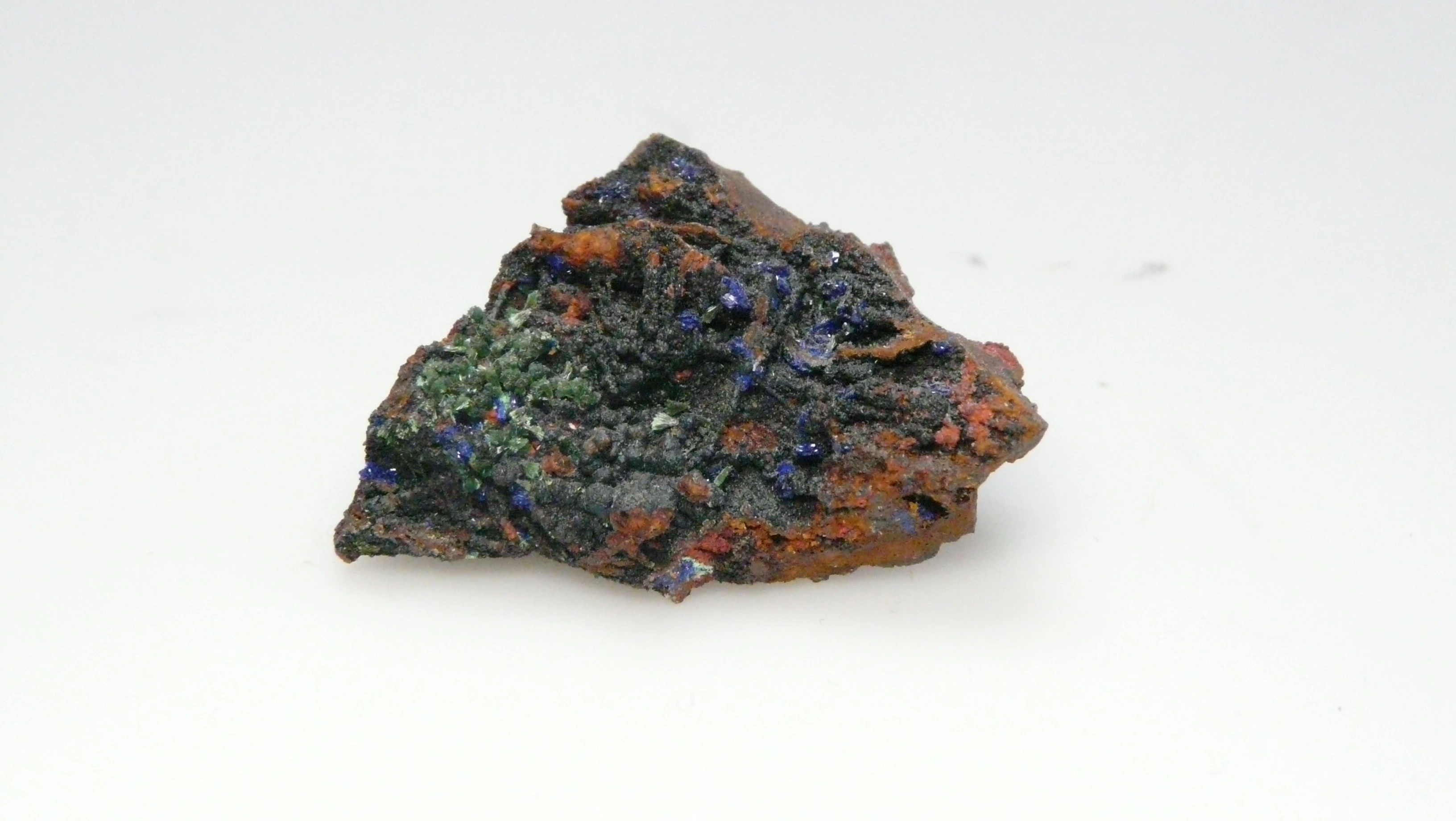
| ID | 391 | |
|---|---|---|
| Mineral |
Azurite
Malachite Goethite |
|
| Location | New South Wales - Australia | |
| Fluorescence | LW-UV: close SW-UV: close |
|
| Mindat.org |
View Azurite information at mindat.org View Malachite information at mindat.org View Goethite information at mindat.org |
|
Mindat data
| ID | 447 |
|---|---|
| Long ID | 1:1:447:3 |
| Formula |
Cu3(CO3)2(OH)2
|
| IMA Status |
0 1 |
| Other Occurrences | Found largely in the oxidized portions of copper deposits, it is a secondary mineral formed by the action of carbonated water acting on copper-containing minerals, or from Cu-containing solutions, such as CuSO^4 or CuCl^2 reacting with limestones. |
| Industrial | A very minor ore of copper. |
| Discovery Year | 1824 |
| Diapheny | Transparent,Translucent |
| Cleavage | Perfect on {011}; on {100} fair; on {110} in traces. |
| Tenacity | brittle |
| Colour | Azure blue, blue, light blue, or dark blue; light blue in transmitted light |
| Hardness (min) | 3.5 |
| Hardness (max) | 4.0 |
| Luminescence | None |
| Lustre | Vitreous |
| About the name | From the ancient Persian lazhward, meaning "blue", in allusion to the color. Name changed to azurite in 1824 by François Sulpice Beudant. |
| Streak | Light blue |
| Crystal System | Monoclinic |
| Cleavage Type | Perfect |
| Fracture type | Conchoidal |
| Morphology |
Tabular {001}, less common {102} or |
| Twinning |
Rare, across |
| UV | None. |
| key_elements |
0 |
| shortcode_ima | Azu |
| ID | 2550 |
|---|---|
| Long ID | 1:1:2550:4 |
| Formula |
Cu2(CO3)(OH)2
|
| IMA Status |
0 1 |
| Other Occurrences | It is the most common secondary mineral found in the oxidized zones of copper deposits. |
| Industrial | A minor ore of copper when abundant enough in a copper deposit. |
| Discovery Year | Unno |
| Diapheny | Opaque |
| Cleavage |
Perfect on |
| Tenacity | brittle |
| Colour | Bright green, with crystals deeper shades of green, even very dark to nearly black; green to yellowish green in transmitted light. |
| Hardness (min) | 3.5 |
| Hardness (max) | 4.0 |
| About the name | Named in antiquity (see Pliny the Elder, 79 CE) molochitus after the Greek μαλαχή, "mallows," in allusion to the green color of the leaves. Known in the new spelling, malachites, at least by 1661. |
| Streak | Light green |
| Crystal System | Monoclinic |
| Cleavage Type | Perfect |
| Fracture type | Splintery |
| Morphology | Crystals uncommon, usually short or long prismatic or acicular, parallel to [001]; often grouped in rosettes, sprays, or tufts. Botryoidal to mammillary aggregates of radiating fibrous crystals more common. It may also be massive, compact, and stalactitic. |
| Twinning | Untwinned crystals are extremely rare. Typically twinned on {100}, sometimes as penetration or polysynthetic twinning with the axis parallel to [201]. |
| Thermal Behaviour | Loses water at about 315°, leaving tenorite. |
| key_elements |
0 |
| shortcode_ima | Mlc |
| Group | Rosasite Group |
| ID | 1719 |
|---|---|
| Long ID | 1:1:1719:6 |
| Formula |
FeO(OH)
|
| IMA Status |
0 1 |
| Other Occurrences | Common weathering product, primary hydrothermal mineral, bog and marine environments. |
| Industrial | Iron ore |
| Discovery Year | 1806 |
| Diapheny | Opaque |
| Cleavage | {010}; {100} less perfect. |
| Tenacity | brittle |
| Colour | Brownish black, yellow-brown, reddish brown |
| Hardness (min) | 5.0 |
| Hardness (max) | 5.5 |
| About the name | Named in 1806 by Johann Georg Lenz in honor of the German poet, novelist, playwrighter, philosopher, politician, and geoscientist Johann Wolfgang von Goethe [August 28, 1749, Frankfurt, Germany – March 22, 1832, Weimar, Germany]. Goethe was Chief Minister of State of Weimar. (Portions of the Goethe mineral collection are reputedly held by the Goethe Society in New York, New York, USA.) |
| Streak | Yellowish brown, orange-yellow, ocher-yellow |
| Crystal System | Orthorhombic |
| Cleavage Type | Perfect |
| Fracture type | Irregular/Uneven |
| Morphology | Prismatic [001] and striated [001]; also flattened into tablets or scales on {010}. Velvety aggregates of capillary crystals to acicular [001] and long prismatic forms often radially grouped. Massive, reniform, botryoidal, stalactitic. Bladed or columnar. Compact or fibrous concretionary nodules. Oolitic. |
| Twinning |
Apparently none reported, but see https://www.mindat.org/mesg-631125.html and compare twinning in isostructural |
| Thermal Behaviour | Heated in a closed tube, gives off water. |
| shortcode_ima | Gth |
| Group | Diaspore Group |
Details
Price: € 2
Dimensions: Not registered
Weight: Not registered
Visibile in overview:
Notes:
| Symbol | Element | |
|---|---|---|
| C | Carbon | |
| Cu | Copper | |
| Fe | Iron | |
| H | Hydrogen | |
| O | Oxygen |