Baryte and Sulphur
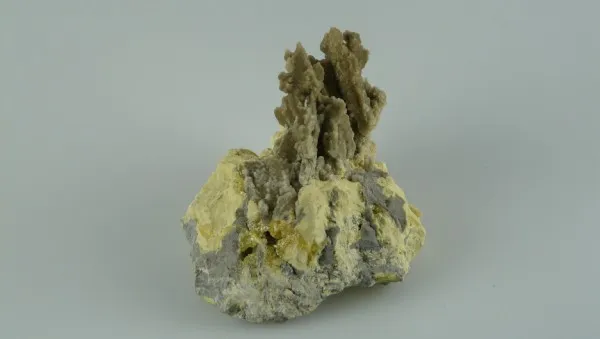
| ID | 363 | |
|---|---|---|
| Mineral |
Baryte
Sulphur |
|
| Location | Machow mine - Tarnobrzeg - Subcarpathian Voivodeship - Poland | |
| Fluorescence | LW-UV: close SW-UV: close |
|
| Mindat.org |
View Baryte information at mindat.org View Sulphur information at mindat.org |
|
Mindat data
| ID | 549 |
|---|---|
| Long ID | 1:1:549:0 |
| Formula |
Ba(SO4)
|
| IMA Status |
0 1 |
| Other Occurrences | Commonly found as a gangue mineral in metallic ore deposits of epithermal or mesothermal origin; but it may also be found as lenses or replacement deposits in sedimentary rocks, both of hypogene and supergene origin. |
| Industrial | Used as an additive in drilling fluids, as a white pigment, e. g. in cosmetic products and in paints, and as a filling material for polymers and papers, high contrast medium for medical X-rays. Also the main source of barium. |
| Diapheny | Transparent,Translucent,Opaque |
| Cleavage | Perfect on {001}; less so on {210}; Imperfect on {010}. |
| Tenacity | brittle |
| Colour | Colourless, white, yellow, brown, grey, blue, etc.; colourless in transmitted light (also tinted yellow, brown, green, blue, etc.) |
| Hardness (min) | 3.0 |
| Hardness (max) | 3.0 |
| Luminescence | Fluoresces yellows, orange, or pink in LW; phophsphoresces strongly greenish-white. |
| Lustre | Vitreous to Resinous, Pearly on cleavage surfaces. |
| About the name | Named in 1800 by Dietrich Ludwig Gustav Karsten from the Greek βαρύς, heavy, due to its unusual heaviness for a non-metallic mineral. |
| Streak | white |
| Crystal System | Orthorhombic |
| Cleavage Type | Perfect |
| Fracture type | Irregular/Uneven |
| Morphology | Usually thin to thick tabular {001}, bounded by {210} alone or in combination with {101}, {011} or other forms. Also flattened {001}, and elongated to prismatic [010] or [100]. More rarely prismatic [001], or equant. Often as aggregates or clusters of tabular crystals with edges projecting into crest-like forms, or as rosettes. Also found as massive material, compact, laminated or concretionary; and in fibrous, stalactic, and earthy masses. |
| UV | Shades of yellow, occasionally orange or pink (LW UV). Shades of yellow, white (Franklin & Sterling Hill, NJ). May phosphoresce strongly greenish-white. |
| Thermal Behaviour | Inverts to another (monoclinic?) polymorph when heated to 1149°C. Above 1400°C decomposition to barium oxide, sulphur dioxide and oxygen. Thermoluminescent at times. |
| Comment Luster | Vitreous to Resinous, Pearly on cleavage surfaces. |
| key_elements |
0 |
| shortcode_ima | Brt |
| Group | Baryte Group |
| ID | 3826 |
|---|---|
| Long ID | 1:1:3826:9 |
| Formula |
S
|
| IMA Status |
0 1 |
| Other Occurrences | Usually formed from volcanic action - as a deposition product from volcanic gasses associated with realgar, cinnabar and other minerals. It is also found in some vein deposits and as an alteration product of sulphide minerals. It can also be formed biogenically - a major source being salt domes, where it has formed by the bacterial decomposition of calcium sulfate. |
| Industrial | Used in a great many applications, ranging from matches and fireworks to rubber. |
| Discovery Year | Know |
| Diapheny | Transparent,Translucent |
| Cleavage | Imperfect on {001}, {110} and {111}. |
| Tenacity | brittle |
| Colour | Yellow, sulphur-yellow, brownish or greenish yellow, orange, white |
| Hardness (min) | 1.5 |
| Hardness (max) | 2.5 |
| Luminescence | None |
| Lustre | Resinous |
| About the name | A name in Middle English, introduced at least as early as 1390. Also known as brimstone. Theophrastus (~300 BCE) wrote μαλώδης (an otherwise unknown word) for what may be sulfur impregnated pumice, but Caley and Richards (1956) in their analysis and translation of Περι Λιθον ("Peri Lithon") suggest that the actual word should have been μηλώδης meaning quince-yellow. Other interpretations have been given. |
| Streak | Colourless |
| Crystal System | Orthorhombic |
| Cleavage Type | Imperfect/Fair |
| Fracture type | Irregular/Uneven,Conchoidal |
| Morphology | Over 50 forms have been noted, blocky dipyramidal ones most common, also tabular and sphenoidal; also found as powdery coatings, massive material, and in reniform and stalactic forms. |
| Twinning | On {101}{011}{110} rare. |
| Thermal Behaviour | With a low melting point of 113°C, sulphur burns readily in air, with a low blue flame, and gives off choking fumes of sulphur-dioxide - acrid odor (forms sulphurous and eventually sulphuric acid in air). |
| shortcode_ima | S |
| Group | Sulphur Group |
Details
Price: € 40
Dimensions: Not registered
Weight: Not registered
Visibile in overview:
Notes:
| Symbol | Element | |
|---|---|---|
| Ba | Barium | |
| O | Oxygen | |
| S | Sulfur |