Rosasite, Gypsum and Dolomite
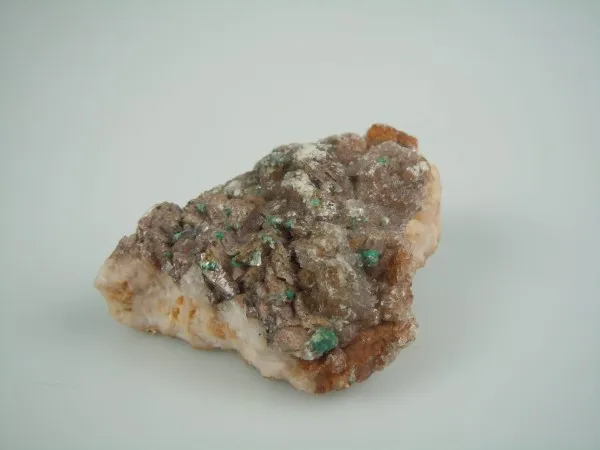
| ID | 355 | |
|---|---|---|
| Mineral |
Rosasite
Gypsum Dolomite |
|
| Location | Bou Beker - Jerada - Morocco | |
| Fluorescence | LW-UV: close SW-UV: close |
|
| Mindat.org |
View Rosasite information at mindat.org View Gypsum information at mindat.org View Dolomite information at mindat.org |
|
Mindat data
| ID | 3447 |
|---|---|
| Long ID | 1:1:3447:6 |
| Formula |
CuZn(CO3)(OH)2
|
| IMA Status |
0 1 |
| Occurrence | In the oxidised zone of a Zn-Cu deposit. |
| Discovery Year | 1908 |
| Diapheny | Translucent |
| Cleavage | In two directions at right angles. |
| Tenacity | brittle |
| Colour | Blue, blue-green to green, sky-blue; colourless to light blue in transmitted light. |
| Hardness (min) | 4.5 |
| Hardness (max) | 4.5 |
| About the name | Named in 1908 by Domenico Lovisato after its discovery locality, the Rosas Mine, Sulcis, Sardinia, Italy. |
| Streak | Light blue |
| Crystal System | Monoclinic |
| Cleavage Type | Distinct/Good |
| Morphology |
Occurs as mammilary, botryoidal or |
| Twinning | On {100}. |
| key_elements |
0 |
| shortcode_ima | Rss |
| Group | Rosasite Group |
| ID | 5527 |
|---|---|
| Long ID | 1:1:5527:3 |
| IMA Status |
0 1 |
| Variety of | 1784 |
| Entry type | 2 |
| Description | The name 'selenite' is mostly synonymous with gypsum but has been used historically to describe the transparent variety, as opposed to satin spar gypsum for the fibrous variety and alabaster for the fine-grained massive form. The original name was ... |
| Diapheny | Transparent |
| Colour | Colourless, light tints due to included matter |
| Hardness (min) | 2.0 |
| Hardness (max) | 2.0 |
| About the name | From the Greek σελήυη, for "moon," in allusion to the moon-like white reflections of the mineral or to the quality of the light transmitted by translucent gypsum slabs of cleavages used as windows. |
| Crystal System | Monoclinic |
| Fracture type | Micaceous |
| ID | 1304 |
|---|---|
| Long ID | 1:1:1304:4 |
| Formula |
CaMg(CO3)2
|
| IMA Status |
0 1 |
| Other Occurrences | An important sedimentary and metamorphic mineral found as the principal mineral in dolostones and metadolostones, and as an important mineral in limestones and marbles where calcite is the principal mineral present. Also found as a hydrothermal vein mineral, forming crystals in cavities; and found in serpentinites and similar rocks. |
| Industrial | A major source of magnesium, particularly for agricultural and pharmaceutical applications. |
| Discovery Year | 1791 |
| Diapheny | Transparent,Translucent |
| Cleavage |
On |
| Tenacity | brittle |
| Colour | Colourless, white, gray, reddish-white, brownish-white, or pink; colourless in transmitted light |
| Hardness (min) | 3.5 |
| Hardness (max) | 4.0 |
| Luminescence | None |
| Lustre | Vitreous |
| About the name | Named in 1791 by Nicolas Théodore de Saussure in honor of the French mineralogist and geologist, Déodat (Dieudonné) Guy Silvain Tancrède Gratet de Dolomieu [June 24, 1750, Dolomieu, near Tour-du-Pin, Isère, France - November 26, 1801, Château-Neuf, Sâone-et-Loire, France]. de Dolomieu wrote numerous books on observations on geology, notably about the Alps and Pyrenees, in addition to theoretical books about the internal structure of the Earth. He discovered a specimen of what would eventually be called dolomite during his participation in Napoleon Bonaparte's expedition into Egypt in 1798. |
| Streak | White |
| Crystal System | Trigonal |
| Cleavage Type | Perfect |
| Fracture type | Sub-Conchoidal |
| Morphology |
Crystals typically rhombohedral with |
| Twinning |
On {0001}, common with re-entrant angles around the middle edges; on |
| UV | Some types fluoresce white, blue white, creamy yellow, etc. in either SW or LW UV. Manganoan varieties may fluoresce pale pink through intense red, but weaker in long wave. |
| Comment Luster | Usually not vitreous or sub-vitreous |
| shortcode_ima | Dol |
| Group | Dolomite Group |
Details
Price: € 10
Dimensions: Not registered
Weight: 72 g
Visibile in overview:
Notes:
| Symbol | Element | |
|---|---|---|
| C | Carbon | |
| Ca | Calcium | |
| Cu | Copper | |
| H | Hydrogen | |
| Mg | Magnesium | |
| O | Oxygen | |
| S | Sulfur | |
| Zn | Zinc |