Strontianite and Chalcopyrite
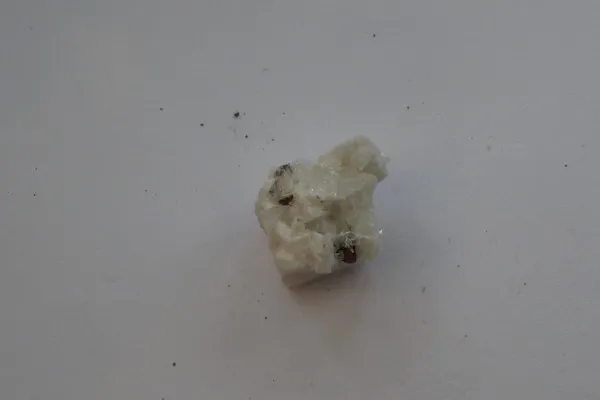
| ID | 346 | |
|---|---|---|
| Mineral |
Strontianite
Chalcopyrite |
|
| Location | Dreislar - Nordrhein-Westfalen - Germany | |
| Fluorescence | LW-UV: close SW-UV: close |
|
| Mindat.org |
View Strontianite information at mindat.org View Chalcopyrite information at mindat.org |
|
Mindat data
| ID | 3805 |
|---|---|
| Long ID | 1:1:3805:4 |
| Formula |
Sr(CO3)
|
| IMA Status |
0 1 |
| Occurrence | In veins in gneiss. |
| Other Occurrences | Forms in low-temperature hydrothermal deposits in limestone and marl or as a gangue mineral in sulfide veins; as geodes or concretionary masses in limestone or clay. |
| Discovery Year | 1790 |
| Diapheny | Transparent,Translucent |
| Cleavage | On {110} nearly perfect; on {021} poor; on {010} in traces. |
| Tenacity | brittle |
| Colour | Colourless, white, gray, light yellow, green, brown; colourless in transmitted light |
| Hardness (min) | 3.5 |
| Hardness (max) | 3.5 |
| About the name | Named in 1791 by Friedrich Gabriel Sulzer after its discovery locality, Strontian, Scotland. |
| Streak | White |
| Crystal System | Orthorhombic |
| Cleavage Type | Very Good |
| Fracture type | Irregular/Uneven,Sub-Conchoidal |
| Morphology | Crystals short to long prismatic [001], often acicular. Often pseudohexagonal in aspect due to equal development of {110} and {010} or of {hhl} and {0.2h.l}. {110} and {010} are striated horizontally, the steep {hhl} and {0kl} forms are rounded at times. Massive, columnar to fibrous; granular; rounded masses. |
| Twinning | Very common. Twin plane {110}, usually as contact twins, rarely as penetration twins; also repeated, as trillings, fourlings, or polysynthetic, yielding enclosed twin lamellae. |
| UV | Fluorescent and phosphorescent in UV, X-rays, and electron beams. Bluish white (SW, MW, and LW), also white, pink or greenish white. |
| Thermal Behaviour | Inverts to a hexagonal modification upon heating. Thermoluminescent at times. |
| Comment Luster | resinous on breaks |
| key_elements |
0 |
| shortcode_ima | Str |
| Group | Aragonite Group |
| ID | 955 |
|---|---|
| Long ID | 1:1:955:7 |
| Formula |
CuFeS2
|
| IMA Status |
0 1 |
| Other Occurrences | It is the most abundant copper-bearing mineral and is widespread. It is a primary mineral in hydrothermal veins, disseminations, and massive replacements; the principal copper mineral of porphyry copper deposits. |
| Industrial | It is the principal ore of copper. |
| Discovery Year | 1725 |
| Diapheny | Opaque |
| Cleavage | Indistinct on {011}, sometimes distinct. |
| Tenacity | brittle |
| Colour | Brass yellow, often with an iridescent tarnish. |
| Hardness (min) | 3.5 |
| Hardness (max) | 4.0 |
| Luminescence | None |
| Lustre | Metallic |
| About the name | Named in 1725 by Johann Friedrich Henckel from the Greek "chalkos", copper, and "pyrites", strike fire. |
| Streak | Greenish black |
| Crystal System | Tetragonal |
| Cleavage Type | Poor/Indistinct |
| Fracture type | Irregular/Uneven |
| Morphology | Typically found as equant to wedge-shaped pseudo-tetrahedral dispenoidal crystals, often modified by tetragonal scalenohedral faces. Mostly found massive or in disseminated grains and major deposits of such material are known. |
| Twinning | Twinned on {112} and {012}, penetration or cyclic. |
| key_elements |
0 |
| shortcode_ima | Ccp |
| Group | Chalcopyrite Group |
Details
Price: € 1
Dimensions: Not registered
Weight: 7 g
Visibile in overview:
Notes:
| Symbol | Element | |
|---|---|---|
| C | Carbon | |
| Cu | Copper | |
| Fe | Iron | |
| O | Oxygen | |
| S | Sulfur | |
| Sr | Strontium |