Antimony
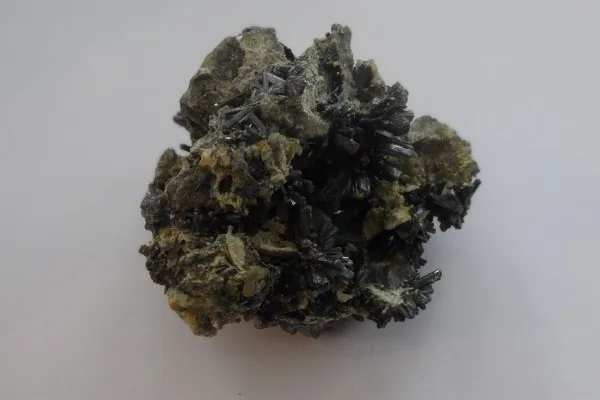
| ID | 331 | |
|---|---|---|
| Mineral | Antimony | |
| Location | Baia Sprie - Maramures - Romania | |
| Fluorescence | LW-UV: close SW-UV: close |
|
| Mindat.org |
View Antimony information at mindat.org |
|
Mindat data
| ID | 3782 |
|---|---|
| Long ID | 1:1:3782:8 |
| Formula |
Sb2S3
|
| IMA Status |
0 1 |
| Diapheny | Opaque |
| Cleavage | Perfect on {010}, imperfect on {100}{110} |
| Tenacity | flexible |
| Colour | Lead-gray with pale blue tint |
| Hardness (min) | 2.0 |
| Hardness (max) | 2.0 |
| About the name | Renamed in 1832 by François Sulpice Beudant. According to Dioscorides, the original Greek names for the mineral were Στιβι "stibi", Στιμμι "stimmi", and Πλατνόπθαλμου. The former name became the Latin "stibium" and the old name for the element antimony (Sb). Named spiessglas in 1430 by Basil Valentine who showed the mineral contained sulphur. Also known as antimony glance, antimonite, and stibine. |
| Streak | Lead grey |
| Crystal System | Orthorhombic |
| Cleavage Type | Perfect |
| Fracture type | Sub-Conchoidal |
| Morphology | Slender to stout crystals |
| Twinning | Rare {130}{120}{310} |
| Thermal Behaviour | Melts at 546°C. Fuses very easily, at 1, coloring the flame greenish blue. Heated in an open tube gives sulphurous and antimonial fumes. The latter condenses as a white sublimate. |
| key_elements |
0 |
| shortcode_ima | Sbn |
| Group | Stibnite Group |
Details
Price: € 20
Dimensions: Not registered
Weight: 98 g
Visibile in overview:
Notes:
| Symbol | Element | |
|---|---|---|
| S | Sulfur | |
| Sb | Antimony |

|