Indicolite, Clevelandite and Quartz
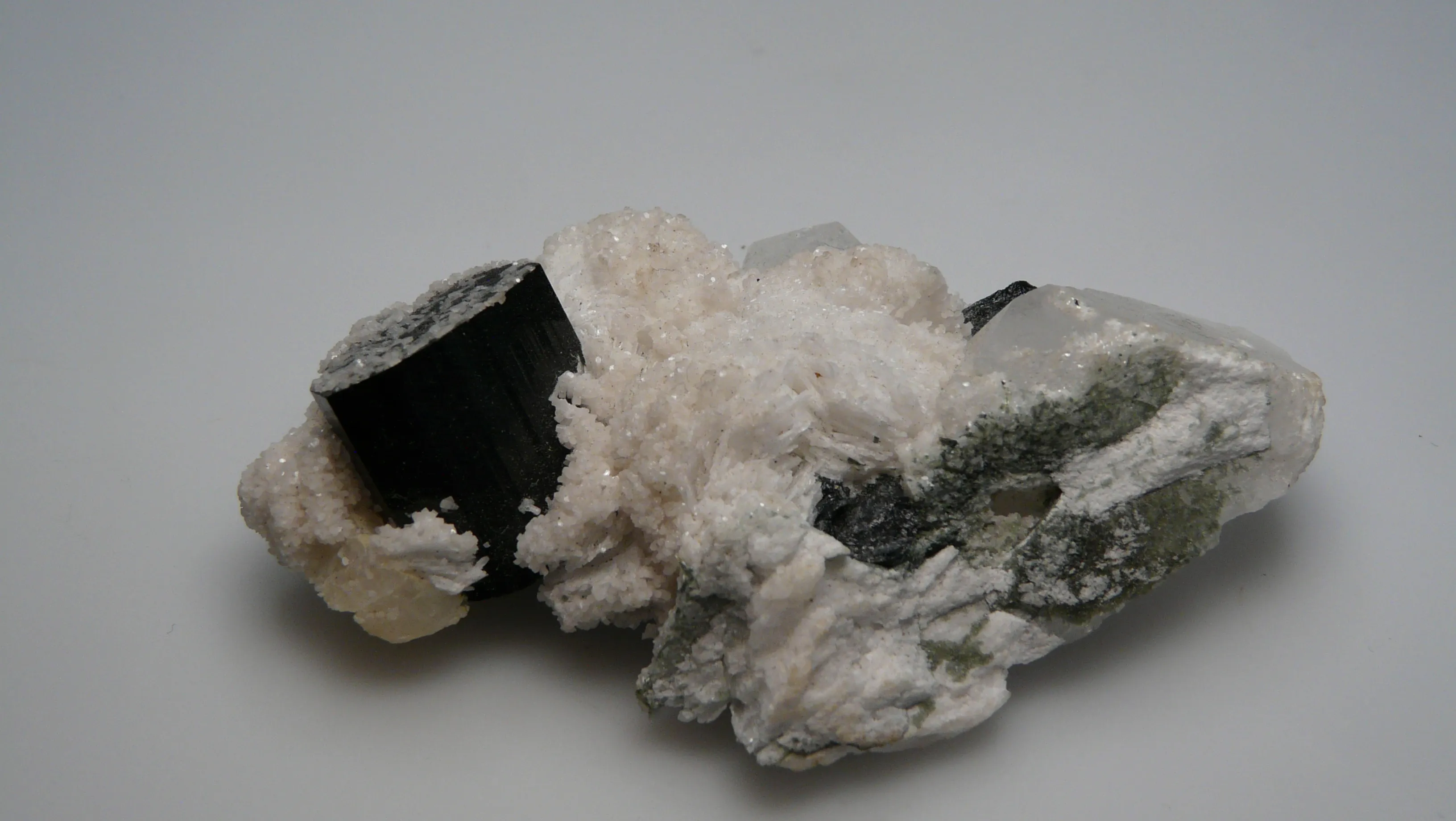
| ID | 322 | |
|---|---|---|
| Mineral |
Indicolite
Clevelandite Quartz |
|
| Location | Gilgit-Baltistan - Pakistan | |
| Fluorescence | LW-UV: close SW-UV: close |
|
| Mindat.org |
View Indicolite information at mindat.org View Clevelandite information at mindat.org View Quartz information at mindat.org |
|
Mindat data
| ID | 2027 |
|---|---|
| Long ID | 1:1:2027:1 |
| Description | A blue gemmy variety of tourmaline (usually, but not always, elbaite or fluor-elbaite). |
| ID | 7688 |
|---|---|
| Long ID | 1:1:7688:9 |
| IMA Status |
0 1 |
| Variety of | 96 |
| Entry type | 2 |
| Description | Platy milky-white lamellae, generally found in granite pegmatites often in large masses ranging from centimeters to meters. The defining feature of cleavelandite is an abundance of parallel platy and/or aggregates or curved curved masses. The crystals ... |
| Occurrence | Granite pegmatites, Late-stage vugs in granite |
| Discovery Year | 1817 |
| Diapheny | Translucent,Opaque |
| Tenacity | brittle |
| Colour | White, Tan, Blue |
| Hardness (min) | 6.0 |
| Hardness (max) | 6.5 |
| Lustre | Vitreous, pearly |
| About the name | Named in 1823 by Henry J. Brooke in honor of Parker Cleaveland [January 15, 1780 Rowley (Byfield), Massachusetts, USA - August 15, 1758, in Brunswick, Maine, USA], professor of geology and mineralogy at Bowdoin College in Maine 1805-1858. In 1816 Cleaveland wrote the first mineralogy textbook authored by a citizen of the USA. Despite the title page date, the textbook was actually released in January 1817. The textbook was noted for its unification of European schools of thought and was also popular in its second edition of 1822. Cleavelandite had been described earlier in 1817 by Johann Friedrich Ludwig Hausmann with the name "kieselspath". In 1815, Hans Peter Eggertz named granular and radiated albite, probably identical to cleavelandite of Brooke. In 1936, Harold Lattimore Alling defined cleavelandite as a triclinic mineral, suggesting a difference from true albite as well as "analbite". Fisher (1968) studied cleavelandite from Chesterfield, Massachusetts, USA, the type locality, but did not study type specimens, and proposed that true cleavelandite should be restricted to warped platy masses of mineral with lamellae parallel to (010) and "lack other well-defined crystal faces, and may be twinned on the albite law". This definition would not include most specimens called "cleavelandite", especially those cleavelandites grown into open cavities, although such "cleavelandite" is also known from the type locality. The current use of the varietal name generally includes cavity hosted crystal aggregates. The original annoncement of Cleavelandite was published in Annals of Philosophy, May 1823, p. 381-382: Article XII. A Description of the Crystalline Form of some new Minerals. By H. J. Brooke, Esq. FRS. FLS. &c. (To the Editor of the Annals of Philosophy.) Dear SIR, April 19, 1822. Having lately been engaged in an examination of the crystalline forms of minerals, and in a few instances of their chemical characters, preparatory to a list I have proposed to add to an elementary production to crystallography, I have observed a few new results, which form the substance of the following brief notices: ... Cleavelandite. - The albite, and siliceous spar of Haussman [sic], which accompanies the green and red tourmaline from Chesterfield, in Massachusetts, are varieties of the same mineral. Two different names having been given to this substance, it becomes necessary either to adopt one of these to the exclusion of the other, or to assign a new one to the species. As albite is generally blue, and sometimes red,* its name is consequently bad, and siliceous spar might be applied with equal propriety to the other substances; I have therefore, preferred adopting the term Cleavelandite to denote the species, out of respect to the Professor of Natural Philosophy in Bowdoin College. United States. This species has cleavages in three directions, parallel to the planes of a doubly oblique prism. * The specimen which first enabled me to determine the form is bright blue. It came from Labrador, and was given to me by the Rev. C. I. Latrobe. M. Nordenskiold has favored me with a specimen which is red. |
| Crystal System | Triclinic |
| Cleavage Type | Perfect |
| Morphology | Platy |
| UV | Frequent fluoresces red SWUV |
| ID | 3337 |
|---|---|
| Long ID | 1:1:3337:0 |
| Formula |
SiO2
|
| IMA Status |
0 1 |
| Other Occurrences | Most of them... |
| Industrial | Ore for silicon, glassmaking, frequency standards, optical instruments, silica source for concrete setting, filtering agents as sand. A major component of sand. |
| Diapheny | Transparent,Translucent |
| Cleavage |
The rhombohedral cleavage r |
| Tenacity | brittle |
| Colour | Colorless, purple, rose, red, black, yellow, brown, green, blue, orange, etc. |
| Hardness (min) | 7.0 |
| Hardness (max) | 7.0 |
| Luminescence | Triboluminescent |
| Lustre | Vitreous |
| About the name | Quartz has been known and appreciated since pre-historic times. The most ancient name known is recorded by Theophrastus in about 300-325 BCE, κρύσταλλος or kristallos. The varietal names, rock crystal and bergcrystal, preserve the ancient usage. The root words κρύοσ signifying ice cold and στέλλειυ to contract (or solidify) suggest the ancient belief that kristallos was permanently solidified ice. The earliest printed use of "querz" was anonymously published in 1505, but attributed to a physician in Freiberg, Germany, Ulrich Rülein von Kalbe (a.k.a. Rülein von Calw, 1527). Agricola used the spelling "quarzum" (Agricola 1530) as well as "querze", but Agricola also referred to "crystallum", "silicum", "silex", and silice". Tomkeieff (1941) suggested an etymology for quartz: "The Saxon miners called large veins - Gänge, and the small cross veins or stringers - Querklüfte. The name ore (Erz, Ertz) was applied to the metallic minerals, the gangue or to the vein material as a whole. In the Erzgebirge, silver ore is frequently found in small cross veins composed of silica. It may be that this ore was called by the Saxon miners 'Querkluftertz' or the cross-vein-ore. Such a clumsy word as 'Querkluftertz' could easily be condensed to 'Querertz' and then to 'Quertz', and eventually become 'Quarz' in German, 'quarzum' in Latin and 'quartz' in English." Tomkeieff (1941, q.v.) noted that "quarz", in its various spellings, was not used by other noted contemporary authors. "Quarz" was used in later literature referring to the Saxony mining district, but seldom elsewhere. Gradually, there were more references to quartz: E. Brown in 1685 and Johan Gottschalk Wallerius in 1747. In 1669, Nicolaus Steno (Niels Steensen) obliquely formulated the concept of the constancy of interfacial angles in the caption of an illustration of quartz crystals. He referred to them as "cristallus" and "crystallus montium". Tomkeieff (1941) also noted that Erasmus Bartholinus (1669) used the various spellings for "crystal" to signify other species than quartz and that crystal could refer to other "angulata corpora" (bodies with angles): "In any case in the second half of the XVIIIth century quartz became established as a name of a particular mineral and the name crystal became a generic term synonymous with the old term 'corpus angulatum'." |
| Streak | White |
| Crystal System | Trigonal |
| Cleavage Type | Poor/Indistinct |
| Fracture type | Conchoidal |
| Twinning | Dauphiné law. Brazil law. Japan law. Others for beta-quartz... |
| Thermal Behaviour | Transforms to beta-quartz at 573° C and 1 bar (100 kPa) pressure. |
| shortcode_ima | Qz |
Details
Price: € 75
Dimensions: Not registered
Weight: 62 g
Visibile in overview:
Notes:
| Symbol | Element | |
|---|---|---|
| Al | Aluminium | |
| B | Boron | |
| Na | Sodium | |
| O | Oxygen | |
| Si | Silicium |