Smithsonite
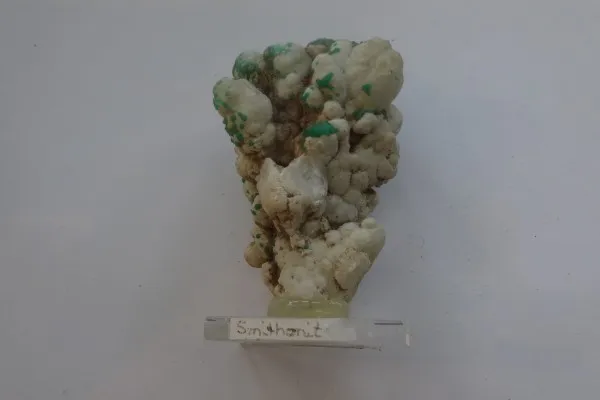
| ID | 309 | |
|---|---|---|
| Mineral | Smithsonite | |
| Location | Carnaiba - Bahia - Brazil | |
| Fluorescence | LW-UV: close SW-UV: close |
|
| Mindat.org |
View Smithsonite information at mindat.org |
|
Mindat data
| ID | 3688 |
|---|---|
| Long ID | 1:1:3688:3 |
| Formula |
Zn(CO3)
|
| IMA Status |
0 1 |
| Other Occurrences | Oxidised zones of zinc ore deposits. |
| Industrial | Ore of zinc. |
| Discovery Year | 1832 |
| Diapheny | Translucent |
| Cleavage |
On |
| Tenacity | brittle |
| Colour | White, grey, yellow, green to apple-green, blue, pink, purple, bluish grey, and brown; colourless or faintly tinted in transmitted light. |
| Hardness (min) | 4.0 |
| Hardness (max) | 4.5 |
| Lustre | Vitreous to Pearly |
| About the name | Lapis calaminaris was a name used by Agricola in 1546. In 1747, Johan Gottschalk Wallerius (Vallerius) used the simplified form calamine for the zinc carbonate. In 1780, Torbern Bergmann analyzed calamines and found they were mixed ores of zinc carbonates and silicates. In 1803, James Smithson made a systematic investigation of calamines and showed that ores identified as calamine consisted of several different minerals: a carbonate and a silicate. The carbonate "calamine" was re-named smithsonite in 1832 by François Sulpice Beudant in honor of James Smithson [1754-1829], British chemist, mineralogist, and benefactor of the Smithsonian Institution (Washington, DC, USA). |
| Streak | White |
| Crystal System | Trigonal |
| Cleavage Type | Very Good |
| Fracture type | Irregular/Uneven,Sub-Conchoidal |
| Morphology |
Crystals rhombohedral |
| Twinning | None observed. |
| UV | May fluoresce pale green or pale blue. |
| key_elements |
0 |
| shortcode_ima | Smt |
| Group | Calcite Group |
Details
Price: € 15
Dimensions: Not registered
Weight: 84 g
Visibile in overview:
Notes:
| Symbol | Element | |
|---|---|---|
| C | Carbon | |
| O | Oxygen | |
| Zn | Zinc |