Chalcopyrite and Baryte
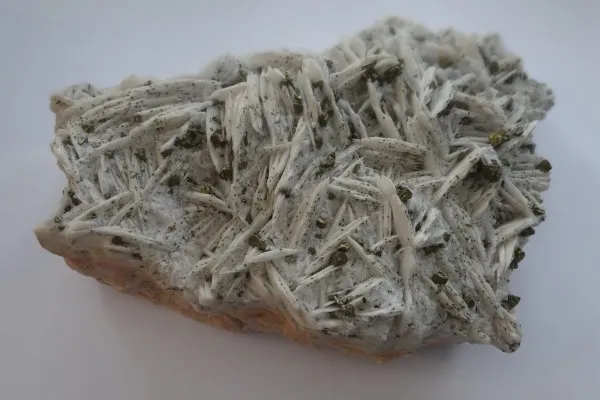
| ID | 252 | |
|---|---|---|
| Mineral |
Chalcopyrite
Baryte |
|
| Location | Dreislar - Nordrhein-Westfalen - Germany | |
| Fluorescence | LW-UV: close SW-UV: close |
|
| Mindat.org |
View Chalcopyrite information at mindat.org View Baryte information at mindat.org |
|
Mindat data
| ID | 955 |
|---|---|
| Long ID | 1:1:955:7 |
| Formula |
CuFeS2
|
| IMA Status |
0 1 |
| Other Occurrences | It is the most abundant copper-bearing mineral and is widespread. It is a primary mineral in hydrothermal veins, disseminations, and massive replacements; the principal copper mineral of porphyry copper deposits. |
| Industrial | It is the principal ore of copper. |
| Discovery Year | 1725 |
| Diapheny | Opaque |
| Cleavage | Indistinct on {011}, sometimes distinct. |
| Tenacity | brittle |
| Colour | Brass yellow, often with an iridescent tarnish. |
| Hardness (min) | 3.5 |
| Hardness (max) | 4.0 |
| Luminescence | None |
| Lustre | Metallic |
| About the name | Named in 1725 by Johann Friedrich Henckel from the Greek "chalkos", copper, and "pyrites", strike fire. |
| Streak | Greenish black |
| Crystal System | Tetragonal |
| Cleavage Type | Poor/Indistinct |
| Fracture type | Irregular/Uneven |
| Morphology | Typically found as equant to wedge-shaped pseudo-tetrahedral dispenoidal crystals, often modified by tetragonal scalenohedral faces. Mostly found massive or in disseminated grains and major deposits of such material are known. |
| Twinning | Twinned on {112} and {012}, penetration or cyclic. |
| key_elements |
0 |
| shortcode_ima | Ccp |
| Group | Chalcopyrite Group |
| ID | 549 |
|---|---|
| Long ID | 1:1:549:0 |
| Formula |
Ba(SO4)
|
| IMA Status |
0 1 |
| Other Occurrences | Commonly found as a gangue mineral in metallic ore deposits of epithermal or mesothermal origin; but it may also be found as lenses or replacement deposits in sedimentary rocks, both of hypogene and supergene origin. |
| Industrial | Used as an additive in drilling fluids, as a white pigment, e. g. in cosmetic products and in paints, and as a filling material for polymers and papers, high contrast medium for medical X-rays. Also the main source of barium. |
| Diapheny | Transparent,Translucent,Opaque |
| Cleavage | Perfect on {001}; less so on {210}; Imperfect on {010}. |
| Tenacity | brittle |
| Colour | Colourless, white, yellow, brown, grey, blue, etc.; colourless in transmitted light (also tinted yellow, brown, green, blue, etc.) |
| Hardness (min) | 3.0 |
| Hardness (max) | 3.0 |
| Luminescence | Fluoresces yellows, orange, or pink in LW; phophsphoresces strongly greenish-white. |
| Lustre | Vitreous to Resinous, Pearly on cleavage surfaces. |
| About the name | Named in 1800 by Dietrich Ludwig Gustav Karsten from the Greek βαρύς, heavy, due to its unusual heaviness for a non-metallic mineral. |
| Streak | white |
| Crystal System | Orthorhombic |
| Cleavage Type | Perfect |
| Fracture type | Irregular/Uneven |
| Morphology | Usually thin to thick tabular {001}, bounded by {210} alone or in combination with {101}, {011} or other forms. Also flattened {001}, and elongated to prismatic [010] or [100]. More rarely prismatic [001], or equant. Often as aggregates or clusters of tabular crystals with edges projecting into crest-like forms, or as rosettes. Also found as massive material, compact, laminated or concretionary; and in fibrous, stalactic, and earthy masses. |
| UV | Shades of yellow, occasionally orange or pink (LW UV). Shades of yellow, white (Franklin & Sterling Hill, NJ). May phosphoresce strongly greenish-white. |
| Thermal Behaviour | Inverts to another (monoclinic?) polymorph when heated to 1149°C. Above 1400°C decomposition to barium oxide, sulphur dioxide and oxygen. Thermoluminescent at times. |
| Comment Luster | Vitreous to Resinous, Pearly on cleavage surfaces. |
| key_elements |
0 |
| shortcode_ima | Brt |
| Group | Baryte Group |
Details
Price: € 15
Dimensions: Not registered
Weight: 1471 g
Visibile in overview:
Notes:
| Symbol | Element | |
|---|---|---|
| Ba | Barium | |
| Cu | Copper | |
| Fe | Iron | |
| O | Oxygen | |
| S | Sulfur |