Sphalerite, Marcasite and Siderite
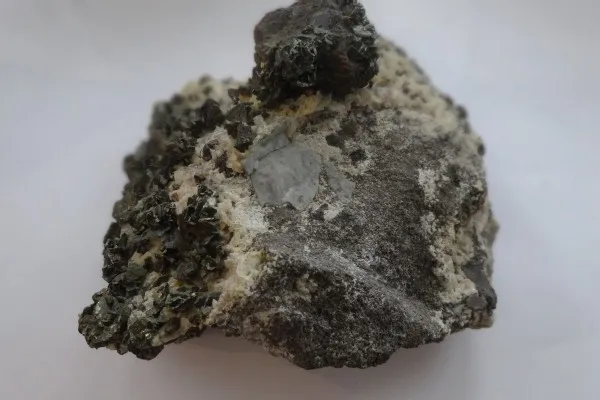
| ID | 233 | |
|---|---|---|
| Mineral |
Sphalerite
Marcasite Siderite |
|
| Location | Negresti-Oas - Satu Mare - Romania | |
| Fluorescence | LW-UV: close SW-UV: close |
|
| Mindat.org |
View Sphalerite information at mindat.org View Marcasite information at mindat.org View Siderite information at mindat.org |
|
Mindat data
| ID | 3727 |
|---|---|
| Long ID | 1:1:3727:9 |
| Formula |
ZnS
|
| IMA Status |
0 1 |
| Discovery Year | 1847 |
| Diapheny | Transparent,Translucent |
| Cleavage | Perfect {011} |
| Tenacity | brittle |
| Colour | Yellow, light to dark brown, black, red-brown, colourless, light blue. green |
| Hardness (min) | 3.5 |
| Hardness (max) | 4.0 |
| Luminescence | Fluorescent and triboluminescent |
| Lustre | Resinous |
| About the name | Originally called blende in 1546 by Georgius Agricola (Georg Bauer). Known by a variety of chemical-based names subsequent to Agricola and before Glocker, including "zincum". Named Sphalerite in 1847 by Ernst Friedrich Glocker from the Greek σφαλεροζ "sphaleros" = treacherous, in allusion to the ease with which dark varieties were mistaken for galena, but yielded no lead. |
| Streak | Pale yellow to brown. |
| Crystal System | Isometric |
| Cleavage Type | Perfect |
| Fracture type | Conchoidal |
| Twinning | {111} |
| UV | Light colored sphalerite may fluoresce in blue or orange in LW. Fluoresces less strongly, sometimes not at all, in SW or MW. |
| key_elements |
0 |
| shortcode_ima | Sp |
| Group | Sphalerite Group |
| ID | 2571 |
|---|---|
| Long ID | 1:1:2571:9 |
| Formula |
FeS2
|
| IMA Status |
0 1 |
| Other Occurrences | Most frequently found in sedimentary rocks and coal beds, as a replacement mineral forming fossils, it is a mineral of low-temperature, near-surface, environments, forming from acid solutions. Pyrite, the more stable form of FeS^2, forms under conditions of higher temperatures and lower acidity or alkaline environments. |
| Discovery Year | 1845 |
| Diapheny | Opaque |
| Cleavage | Distinct on {101}. {110} in traces. |
| Tenacity | brittle |
| Colour | Pale brass-yellow, tin-white on fresh exposures. |
| Hardness (min) | 6.0 |
| Hardness (max) | 6.5 |
| Lustre | Metallic |
| About the name | Early use of the word marcasite seems to have been unspecific. The word is Arabic or Moorish and was applied to pyrite and similar metallic bronze colored minerals. Walter Pope (1665) mentioned marcasite occurring in the mercury ores of the Idria Mine, Cividale del Friuli in the Julian Alps of Slovenia: "There are also several Marcasites and stones, which seem to have specks of Gold in them, but upon trial they say, they find none in them. These round stones are some of them very ponderous, and well impregnated with Mercury; others light, having little or none in them." The mercury ore at Idria does contain metallic golden specks of what is now called marcasite, but it also has metallic golden pyrite. Johnathan Hill used the name marcasite in 1771, but his usage was also indiscriminate and was a term for any massive "pyrites" or "mundic". In 1845, Wilhelm Karl von Haidinger defined marcasite as the mineral is known today. |
| Streak | Dark-gray to black. |
| Crystal System | Orthorhombic |
| Cleavage Type | Distinct/Good |
| Fracture type | Conchoidal,Sub-Conchoidal |
| Morphology | Crystals usually tabular on {010}, also pyramidal, faces often curved, frequently twinned; also stalactic, globular, or reniform with radiating internal structure. |
| Twinning | Common on {101}, forming "swallowtail" contact twins; this may be repeated to form stellate fivelings. Less common on {011}. |
| UV | Not fluorescent in ultraviolet light |
| Comment Luster | Frequently iridescence obscures the luster and color |
| shortcode_ima | Mrc |
| Group | Marcasite Group |
| ID | 3647 |
|---|---|
| Long ID | 1:1:3647:0 |
| Formula |
Fe(CO3)
|
| IMA Status |
0 1 |
| Other Occurrences | Most often found in bedded sedimentary deposits with a biological component, with shales, clays and coal beds - suggesting that the siderite is biogenically created under low-oxygen and low-Ph conditions. It is also found in metamorphosed sedimentary rocks as more massively crystalline material, as a primary gangue mineral in hydrothermal deposits, and in pegmatites, including nepheline syenite pegmatites; as bog deposits. |
| Industrial | An ore of iron when found in sufficient volumes to be economically recoverable. |
| Diapheny | Translucent |
| Cleavage |
Perfect on |
| Tenacity | brittle |
| Colour | Yellowish-brown to greyish-brown, pale yellow to tannish, grey, brown, green, red, black and, rarely, colourless; tarnished iridescent at times; colourless to yellow and yellow-brown in transmitted light. |
| Hardness (min) | 3.5 |
| Hardness (max) | 4.5 |
| Lustre | Vitreous |
| About the name | Named in 1845 by Wilhelm Karl von Haidinger from the Greek "σίδηρος" (sideros), "iron", in allusion to its composition. |
| Streak | White |
| Crystal System | Trigonal |
| Cleavage Type | Perfect |
| Fracture type | Irregular/Uneven,Conchoidal |
| Morphology |
Crystals usually rhombohedral |
| Twinning |
On |
| shortcode_ima | Sd |
| Group | Calcite Group |
Details
Price: € 15
Dimensions: Not registered
Weight: 537 g
Visibile in overview:
Notes:
| Symbol | Element | |
|---|---|---|
| C | Carbon | |
| Fe | Iron | |
| O | Oxygen | |
| S | Sulfur | |
| Zn | Zinc |