Dolomite, Marcasite and Quartz
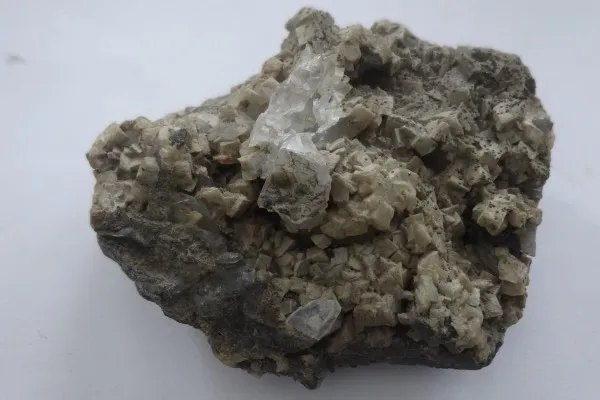
| ID | 199 | |
|---|---|---|
| Mineral |
Dolomite
Marcasite Quartz |
|
| Location | St. Johnsville - New York - United States of America | |
| Fluorescence | LW-UV: close SW-UV: close |
|
| Mindat.org |
View Dolomite information at mindat.org View Marcasite information at mindat.org View Quartz information at mindat.org |
|
Mindat data
| ID | 1304 |
|---|---|
| Long ID | 1:1:1304:4 |
| Formula |
CaMg(CO3)2
|
| IMA Status |
0 1 |
| Other Occurrences | An important sedimentary and metamorphic mineral found as the principal mineral in dolostones and metadolostones, and as an important mineral in limestones and marbles where calcite is the principal mineral present. Also found as a hydrothermal vein mineral, forming crystals in cavities; and found in serpentinites and similar rocks. |
| Industrial | A major source of magnesium, particularly for agricultural and pharmaceutical applications. |
| Discovery Year | 1791 |
| Diapheny | Transparent,Translucent |
| Cleavage |
On |
| Tenacity | brittle |
| Colour | Colourless, white, gray, reddish-white, brownish-white, or pink; colourless in transmitted light |
| Hardness (min) | 3.5 |
| Hardness (max) | 4.0 |
| Luminescence | None |
| Lustre | Vitreous |
| About the name | Named in 1791 by Nicolas Théodore de Saussure in honor of the French mineralogist and geologist, Déodat (Dieudonné) Guy Silvain Tancrède Gratet de Dolomieu [June 24, 1750, Dolomieu, near Tour-du-Pin, Isère, France - November 26, 1801, Château-Neuf, Sâone-et-Loire, France]. de Dolomieu wrote numerous books on observations on geology, notably about the Alps and Pyrenees, in addition to theoretical books about the internal structure of the Earth. He discovered a specimen of what would eventually be called dolomite during his participation in Napoleon Bonaparte's expedition into Egypt in 1798. |
| Streak | White |
| Crystal System | Trigonal |
| Cleavage Type | Perfect |
| Fracture type | Sub-Conchoidal |
| Morphology |
Crystals typically rhombohedral with |
| Twinning |
On {0001}, common with re-entrant angles around the middle edges; on |
| UV | Some types fluoresce white, blue white, creamy yellow, etc. in either SW or LW UV. Manganoan varieties may fluoresce pale pink through intense red, but weaker in long wave. |
| Comment Luster | Usually not vitreous or sub-vitreous |
| shortcode_ima | Dol |
| Group | Dolomite Group |
| ID | 2571 |
|---|---|
| Long ID | 1:1:2571:9 |
| Formula |
FeS2
|
| IMA Status |
0 1 |
| Other Occurrences | Most frequently found in sedimentary rocks and coal beds, as a replacement mineral forming fossils, it is a mineral of low-temperature, near-surface, environments, forming from acid solutions. Pyrite, the more stable form of FeS^2, forms under conditions of higher temperatures and lower acidity or alkaline environments. |
| Discovery Year | 1845 |
| Diapheny | Opaque |
| Cleavage | Distinct on {101}. {110} in traces. |
| Tenacity | brittle |
| Colour | Pale brass-yellow, tin-white on fresh exposures. |
| Hardness (min) | 6.0 |
| Hardness (max) | 6.5 |
| Lustre | Metallic |
| About the name | Early use of the word marcasite seems to have been unspecific. The word is Arabic or Moorish and was applied to pyrite and similar metallic bronze colored minerals. Walter Pope (1665) mentioned marcasite occurring in the mercury ores of the Idria Mine, Cividale del Friuli in the Julian Alps of Slovenia: "There are also several Marcasites and stones, which seem to have specks of Gold in them, but upon trial they say, they find none in them. These round stones are some of them very ponderous, and well impregnated with Mercury; others light, having little or none in them." The mercury ore at Idria does contain metallic golden specks of what is now called marcasite, but it also has metallic golden pyrite. Johnathan Hill used the name marcasite in 1771, but his usage was also indiscriminate and was a term for any massive "pyrites" or "mundic". In 1845, Wilhelm Karl von Haidinger defined marcasite as the mineral is known today. |
| Streak | Dark-gray to black. |
| Crystal System | Orthorhombic |
| Cleavage Type | Distinct/Good |
| Fracture type | Conchoidal,Sub-Conchoidal |
| Morphology | Crystals usually tabular on {010}, also pyramidal, faces often curved, frequently twinned; also stalactic, globular, or reniform with radiating internal structure. |
| Twinning | Common on {101}, forming "swallowtail" contact twins; this may be repeated to form stellate fivelings. Less common on {011}. |
| UV | Not fluorescent in ultraviolet light |
| Comment Luster | Frequently iridescence obscures the luster and color |
| shortcode_ima | Mrc |
| Group | Marcasite Group |
| ID | 3337 |
|---|---|
| Long ID | 1:1:3337:0 |
| Formula |
SiO2
|
| IMA Status |
0 1 |
| Other Occurrences | Most of them... |
| Industrial | Ore for silicon, glassmaking, frequency standards, optical instruments, silica source for concrete setting, filtering agents as sand. A major component of sand. |
| Diapheny | Transparent,Translucent |
| Cleavage |
The rhombohedral cleavage r |
| Tenacity | brittle |
| Colour | Colorless, purple, rose, red, black, yellow, brown, green, blue, orange, etc. |
| Hardness (min) | 7.0 |
| Hardness (max) | 7.0 |
| Luminescence | Triboluminescent |
| Lustre | Vitreous |
| About the name | Quartz has been known and appreciated since pre-historic times. The most ancient name known is recorded by Theophrastus in about 300-325 BCE, κρύσταλλος or kristallos. The varietal names, rock crystal and bergcrystal, preserve the ancient usage. The root words κρύοσ signifying ice cold and στέλλειυ to contract (or solidify) suggest the ancient belief that kristallos was permanently solidified ice. The earliest printed use of "querz" was anonymously published in 1505, but attributed to a physician in Freiberg, Germany, Ulrich Rülein von Kalbe (a.k.a. Rülein von Calw, 1527). Agricola used the spelling "quarzum" (Agricola 1530) as well as "querze", but Agricola also referred to "crystallum", "silicum", "silex", and silice". Tomkeieff (1941) suggested an etymology for quartz: "The Saxon miners called large veins - Gänge, and the small cross veins or stringers - Querklüfte. The name ore (Erz, Ertz) was applied to the metallic minerals, the gangue or to the vein material as a whole. In the Erzgebirge, silver ore is frequently found in small cross veins composed of silica. It may be that this ore was called by the Saxon miners 'Querkluftertz' or the cross-vein-ore. Such a clumsy word as 'Querkluftertz' could easily be condensed to 'Querertz' and then to 'Quertz', and eventually become 'Quarz' in German, 'quarzum' in Latin and 'quartz' in English." Tomkeieff (1941, q.v.) noted that "quarz", in its various spellings, was not used by other noted contemporary authors. "Quarz" was used in later literature referring to the Saxony mining district, but seldom elsewhere. Gradually, there were more references to quartz: E. Brown in 1685 and Johan Gottschalk Wallerius in 1747. In 1669, Nicolaus Steno (Niels Steensen) obliquely formulated the concept of the constancy of interfacial angles in the caption of an illustration of quartz crystals. He referred to them as "cristallus" and "crystallus montium". Tomkeieff (1941) also noted that Erasmus Bartholinus (1669) used the various spellings for "crystal" to signify other species than quartz and that crystal could refer to other "angulata corpora" (bodies with angles): "In any case in the second half of the XVIIIth century quartz became established as a name of a particular mineral and the name crystal became a generic term synonymous with the old term 'corpus angulatum'." |
| Streak | White |
| Crystal System | Trigonal |
| Cleavage Type | Poor/Indistinct |
| Fracture type | Conchoidal |
| Twinning | Dauphiné law. Brazil law. Japan law. Others for beta-quartz... |
| Thermal Behaviour | Transforms to beta-quartz at 573° C and 1 bar (100 kPa) pressure. |
| shortcode_ima | Qz |
Details
Price: € 20
Dimensions: Not registered
Weight: 315 g
Visibile in overview:
Notes:
| Symbol | Element | |
|---|---|---|
| C | Carbon | |
| Ca | Calcium | |
| Fe | Iron | |
| Mg | Magnesium | |
| O | Oxygen | |
| S | Sulfur | |
| Si | Silicium |