Celestine
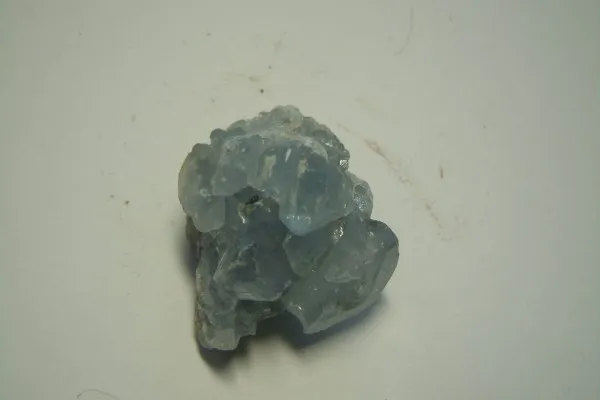
| ID | 176 | |
|---|---|---|
| Mineral | Celestine | |
| Location | Mahajanga - Madagascar | |
| Fluorescence | LW-UV: close SW-UV: close |
|
| Mindat.org |
View Celestine information at mindat.org |
|
Mindat data
| ID | 927 |
|---|---|
| Long ID | 1:1:927:4 |
| Formula |
Sr(SO4)
|
| IMA Status |
0 1 |
| General Appearance | Fibrous veinlets. |
| Occurrence | Sedimentary rocks. |
| Other Occurrences | Occurs mainly in sedimentary rocks such as bedded deposits of gypsum and halite; also in bedded limestone and dolomite, in cavities. |
| Industrial | Major ore for strontium. |
| Discovery Year | 1791 |
| Diapheny | Transparent,Translucent |
| Cleavage | On {001} perfect; on {210} good; on {010} poor. Also reported on {011}. |
| Tenacity | brittle |
| Colour | Colourless, shades of light blue, white, reddish, greenish, brownish, greyish; colourless or lightly tinted in transmitted light |
| Hardness (min) | 3.0 |
| Hardness (max) | 3.5 |
| About the name | Originally named fasriger schwerspath by Andreas Gotthelf Schütz in 1791. Renamed schwefelsaurer strontianite aus Pennsylvania by Martin Klaproth in 1797. Renamed by Abraham Gottlieb Werner in 1798 in German zoelestin from the Greek cœlestis for celestial, in allusion to the faint blue color of the original specimen. Renamed Schützit by Dietrich Ludwig Gustav Karsten in 1800. Although far superior celestine crystals were previously known from Sicily, they were thought to be barium-rich as the element strontium was not discovered until the late 1780s and not formally described until 1792. |
| Streak | White |
| Crystal System | Orthorhombic |
| Cleavage Type | Perfect |
| Fracture type | Irregular/Uneven |
| Morphology | Crystals commonly thin to thick tabular {001}, usually with large {210}; tabular {001} and elongated [100] yielding lath-like forms; or elongated [100] with equant cross section. Equant by development of {001}, {011}, {101} of otherwise, less common. Pyramidal {122}; elongated [010] or [001]; tabular {100}, {100} commonly striated [001]. Fibrous veinlets or nodules with parallel or radiated fiber structure; massive granular; lamellar, earthy, rare. |
| Twinning | Reported on {210}, {101}, and other planes (doubtful). |
| Thermal Behaviour | Inverts at about 1152°C to a hexagonal polymorph. Melting Point = ~1605°C. |
| key_elements |
0 |
| shortcode_ima | Clt |
| Group | Baryte Group |
Details
Price: € 5
Dimensions: Not registered
Weight: Not registered
Visibile in overview:
Notes:
| Symbol | Element | |
|---|---|---|
| O | Oxygen | |
| S | Sulfur | |
| Sr | Strontium |