Spessartine and Muscovite
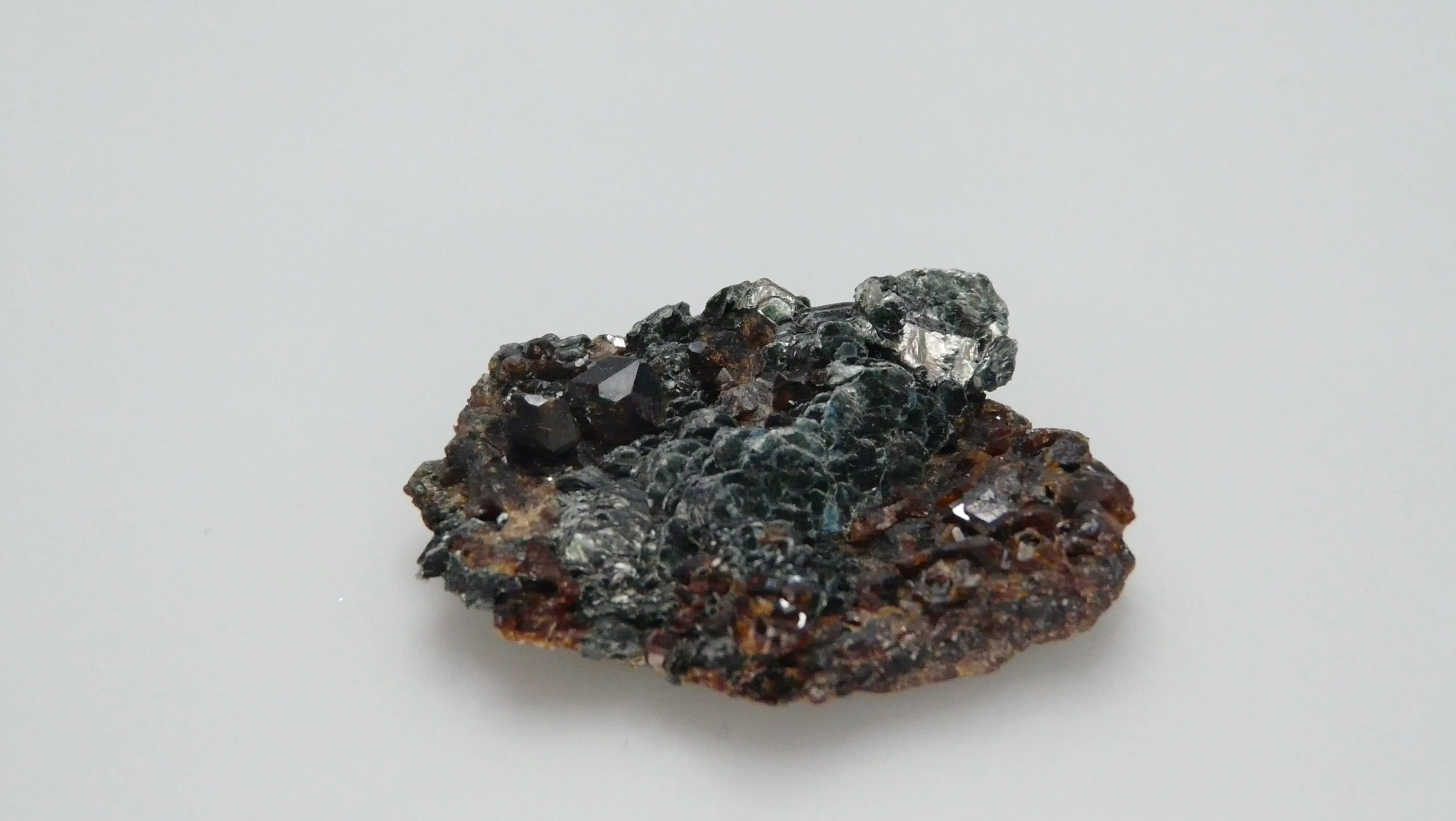
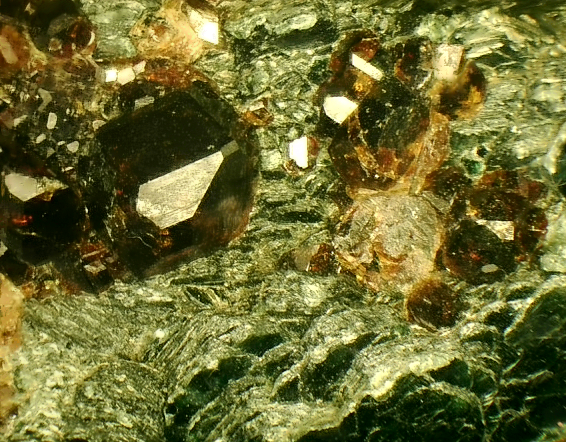
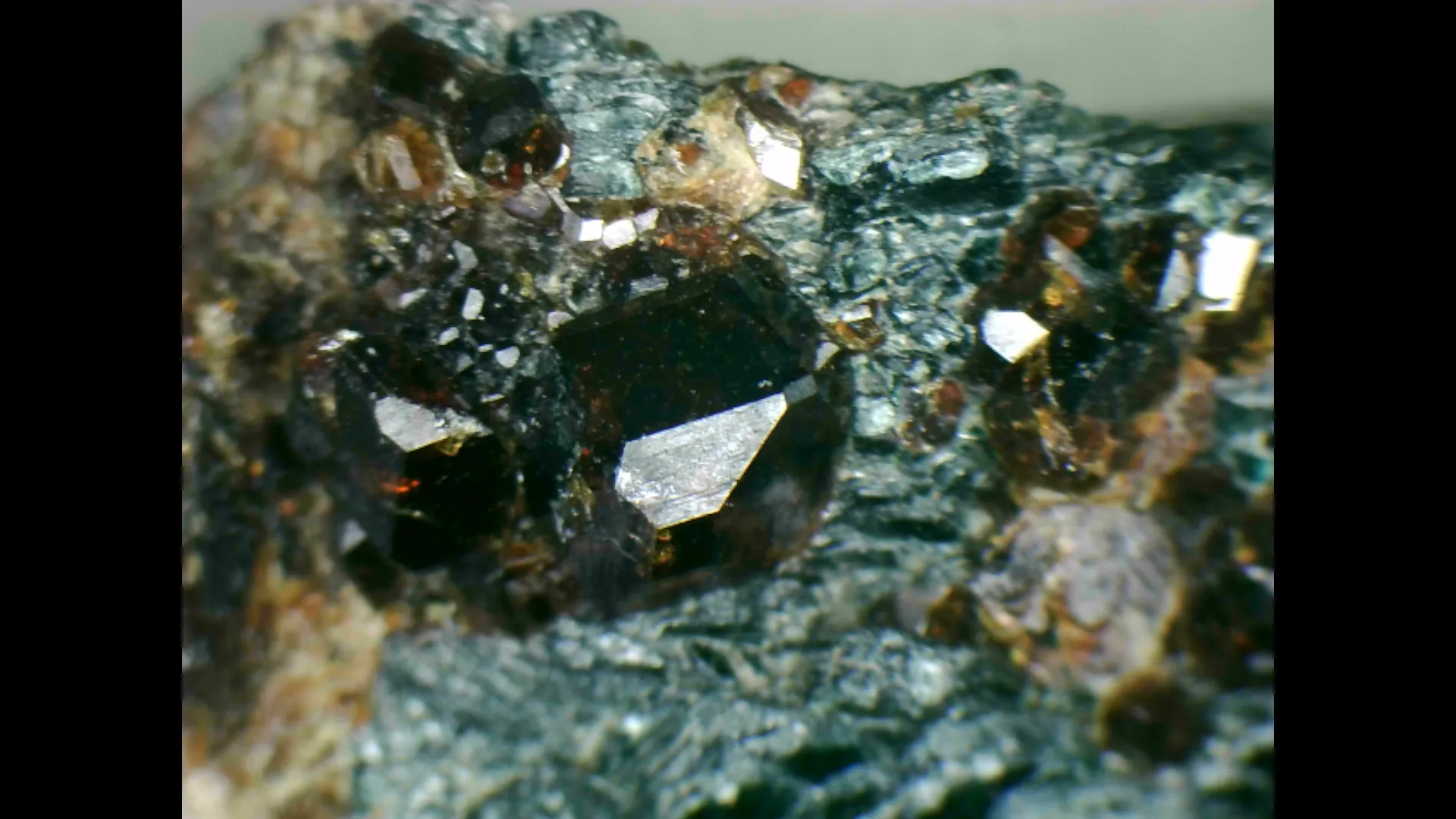
| ID | 140 | |
|---|---|---|
| Mineral |
Spessartine
Muscovite |
|
| Location | Wushan Spessartine Mine - Tongbei - Zhangzhou - China | |
| Fluorescence | LW-UV: close SW-UV: close |
|
| Mindat.org |
View Spessartine information at mindat.org View Muscovite information at mindat.org |
|
Mindat data
| ID | 3725 |
|---|---|
| Long ID | 1:1:3725:5 |
| Formula |
Mn2+3Al2(SiO4)3
|
| IMA Status |
0 1 |
| Discovery Year | 1832 |
| Diapheny | Transparent,Translucent |
| Cleavage | Distinct |
| Tenacity | brittle |
| Colour | Red, reddish orange, yellowish brown, reddish brown, or brown |
| Hardness (min) | 6.5 |
| Hardness (max) | 7.5 |
| Luminescence | Non-fluorescent |
| Lustre | Vitreous - Resinous |
| About the name | Re-named in 1832 by François Sulpice Beudant after its type locality in the Spessart Mountains, Germany. Previously distinguished as a "manganesian" garnet by Henry Seybert in 1823 using mineral from Haddam, Connecticut, USA. Originally, this mineral, from Spessart Mountains, was called "granatförmiges Braunsteinerz" in 1797 by Martin Klaproth. |
| Streak | White |
| Crystal System | Isometric |
| Fracture type | Sub-Conchoidal |
| Morphology | euhedral crystals, dodecahedra or trapezohedra, or in combination with other cubic forms, to 10 cm. |
| shortcode_ima | Sps |
| Group | Garnet Group |
| ID | 2815 |
|---|---|
| Long ID | 1:1:2815:4 |
| Formula |
KAl2(Si3Al)O10(OH)2
|
| IMA Status |
0 1 |
| Other Occurrences | Muscovite is common in many different rock types as a primary mineral. |
| Diapheny | Transparent,Translucent |
| Cleavage | Perfect on {001}. |
| Tenacity | elastic |
| Colour | White to colorless, silvery-white, and tinged various colors by impurities. |
| Hardness (min) | 2.5 |
| Hardness (max) | 2.5 |
| About the name | The earliest names attributable to muscovite include Muscovy Glass, Cat Silver, and Lapis Specularis (stone mirror); these names appearing in texts in the seventeenth century and before. The stand-alone name 'Muscovite' was used as early as 1794 by Johann Gottfried Schmeisser in his System of Mineralogy and is derived from the term "Muscovy glass," which was in common use by that time. Muscovy Province in Russia yielded sheet mica for a variety of uses. Muscovite and sometimes similar species were earlier called mica (Phillips and Kersey, 1706), glimmer (Phillips and Kersey, 1706), and isinglass (1747 according to OED) but all of these terms are still in use to some degree. It should be noted that mica, glimmer, and isinglass were also used for a variety of materials before these given dates and in those earlier times did not always indicate what would be a mineral, much less muscovite proper. Isinglass, for example, was originally used for a gelatinous bladder found in sturgeon. |
| Streak | White |
| Crystal System | Monoclinic |
| Cleavage Type | Perfect |
| Fracture type | Micaceous |
| Morphology |
Crystals uncommon, tabular {001} with rhombic to hexagonal outlines, often bound by {221}, |
| Twinning |
Mica law twins common [310] forming six pointed stars, less common with the composition plane perpendicular to {001} (hkl refer to |
| shortcode_ima | Ms |
| Group | Dioctahedral mica |
Details
Price: € 10
Dimensions: Not registered
Weight: 8 g
Visibile in overview:
Notes:
| Symbol | Element | |
|---|---|---|
| Al | Aluminium | |
| H | Hydrogen | |
| K | Potassium | |
| Mn | Manganese | |
| O | Oxygen | |
| Si | Silicium |