Lazurite and Pyrite
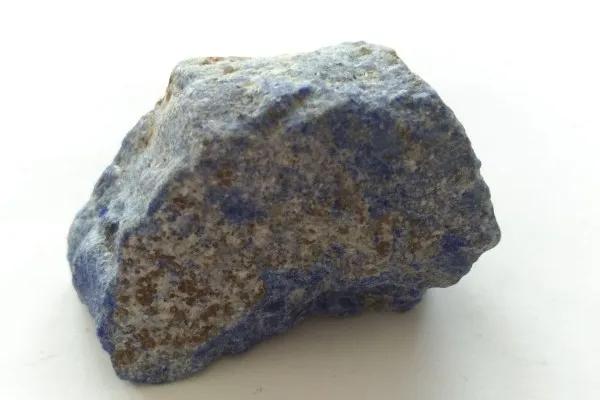
| ID | 111 | |
|---|---|---|
| Mineral |
Lazurite
Pyrite |
|
| Location | Slyudyanka - Tounkinskaya valley - Russia | |
| Fluorescence | LW-UV: close SW-UV: close |
|
| Mindat.org |
View Lazurite information at mindat.org View Pyrite information at mindat.org |
|
Mindat data
| ID | 2357 |
|---|---|
| Long ID | 1:1:2357:9 |
| Formula |
Na7Ca(Al6Si6O24)(SO4)(S3)1- · H2O
|
| IMA Status |
0 |
| General Appearance | Velvet Lazurite of Sapozhnikov et al (2021) |
| Occurrence | The Malo-Bystrinskoe lazurite gem deposit, Baikal Lake area, Eastern Siberian region, Russia. |
| Other Occurrences | Contact metamorphic mineral in marble and skarns. Also in some syenites and alkaline volcanics. |
| Industrial | The blue mineral in Lapis Lazuli, an ornamental stone |
| Discovery Year | 1890 |
| Diapheny | Opaque |
| Cleavage | Imperfect on {110} |
| Tenacity | brittle |
| Colour | Ultramarine, midnight blue, bluish green, green |
| Hardness (min) | 5.0 |
| Hardness (max) | 5.5 |
| About the name | From the Persian "Lazhward" for "blue." Also for its dark blue color resemblance to "azurite." Both Lazurite and azurite derive from "Lazhward". Dana (System of Mineralogy, 1868) considered lapis-lazuli to be the dark blue mineral in the lazulite-calcite rock of the same name, but these were renamed lazurite in 1891 [[1| Brögger W C, Bäckström H 1891]]. |
| Streak | Bright blue for lazurite, white for the small cell hauynes. |
| Crystal System | Isometric |
| Cleavage Type | Imperfect/Fair |
| Fracture type | Sub-Conchoidal |
| Morphology | Dodecahedrons, cubes, granular, disseminated, massive. |
| Twinning | None observed |
| UV | The opaque ultramarine and midnight blue Lazurites are not fluorescent. The translucent green and blue hauynes have an orange brown fluorescence under Long Wave UV. |
| shortcode_ima | Lzr |
| Group | Sodalite Group |
| ID | 3314 |
|---|---|
| Long ID | 1:1:3314:1 |
| Formula |
FeS2
|
| IMA Status |
0 1 |
| Other Occurrences | Common in many rock types, igneous, metamorphic and sedimentary. |
| Diapheny | Opaque |
| Cleavage | Indistinct on {001}. |
| Tenacity | brittle |
| Colour | Pale brass-yellow |
| Hardness (min) | 6.0 |
| Hardness (max) | 6.5 |
| About the name | Named in antiquity from the Greek "pyr" for "fire", because sparks flew from it when struck with another mineral or metal. Known to Dioscorides (~50 CE) under the name "περι υληζ ιατρικηζ" which included both pyrite and chalcopyrite. |
| Streak | Greenish-black |
| Crystal System | Isometric |
| Cleavage Type | Poor/Indistinct |
| Fracture type | Irregular/Uneven,Conchoidal |
| Morphology | Typically cubic or pyritohedral (pentagonal dodecahedral), sometimes octahedral and combinations are common, resulting in striated faces. Less frequently octahedral, most commonly massive, granular, and sometimes radiating, reniform, discoidal or globular. |
| Twinning | On [110], interpenetrating ('Iron Cross Law'). Twin axis [001] and twin plane {011}, penetration and contact twins. Twinning on (111) was described by Nicol (1904), Goldschmidt and Nicol (1904) and Gaubert (1928), all of whom considered it rare. |
| UV | Not fluorescent in UV |
| Thermal Behaviour | Heated in a closed tube gives a sublimate of sulfur and a magnetic residue. |
| shortcode_ima | Py |
| Group | Pyrite Group |
Details
Price: € 5
Dimensions: Not registered
Weight: Not registered
Visibile in overview:
Notes:
| Symbol | Element | |
|---|---|---|
| Al | Aluminium | |
| Ca | Calcium | |
| Fe | Iron | |
| H | Hydrogen | |
| Na | Sodium | |
| O | Oxygen | |
| S | Sulfur | |
| Si | Silicium |