Turquoise and Pyrite
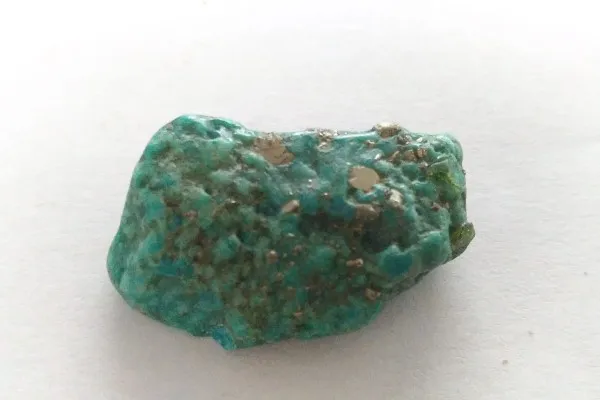
| ID | 107 | |
|---|---|---|
| Mineral |
Turquoise
Pyrite |
|
| Location | Sonora - Mexico | |
| Fluorescence | LW-UV: close SW-UV: close |
|
| Mindat.org |
View Turquoise information at mindat.org View Pyrite information at mindat.org |
|
Mindat data
| ID | 4060 |
|---|---|
| Long ID | 1:1:4060:6 |
| Formula |
CuAl6(PO4)4(OH)8 · 4H2O
|
| IMA Status |
0 1 |
| Other Occurrences | Secondary mineral in potassic alteration zone of porphyry copper deposits. Vein fillings in volcanic rocks and phosphate-rich sediments. |
| Industrial | Jewelry stone. |
| Discovery Year | 1678 |
| Diapheny | Transparent,Translucent,Opaque |
| Cleavage | on {001}, good on {010} |
| Tenacity | brittle |
| Colour | bright blue, sky-blue, pale green, blue-green, turquoise-blue, apple-green, green-gray |
| Hardness (min) | 5.0 |
| Hardness (max) | 6.0 |
| About the name | Named from French "turques" or "turquois" meaning "Turkish" the original material found on the south slopes of the Al-Mirsah-Kuh Mountains (Iran), but which found its way to Europe via Turkey. The name was known at least as early as the 17th century C.E. Turquoise and members of its group were redefined by Foord and Taggert in 1998, with turquoise reserved for an end-member composition. Foord and Taggert (1998) also noted that most of the gem material labeled "turquoise" is inhomogeneous and that planerite is the most common constituent in commercial "turquoise". |
| Streak | Pale greenish blue to white |
| Crystal System | Triclinic |
| Cleavage Type | Perfect |
| Fracture type | Irregular/Uneven,Sub-Conchoidal |
| Morphology |
Crystals rare. Steep pinacoidal crystals exhibiting {010}, |
| UV | Not fluorescent in UV |
| Comment Luster | Dull to waxy in massive varieties, subvitreous in crystals. |
| key_elements |
0 |
| shortcode_ima | Tqu |
| Group | Turquoise Group |
| ID | 3314 |
|---|---|
| Long ID | 1:1:3314:1 |
| Formula |
FeS2
|
| IMA Status |
0 1 |
| Other Occurrences | Common in many rock types, igneous, metamorphic and sedimentary. |
| Diapheny | Opaque |
| Cleavage | Indistinct on {001}. |
| Tenacity | brittle |
| Colour | Pale brass-yellow |
| Hardness (min) | 6.0 |
| Hardness (max) | 6.5 |
| About the name | Named in antiquity from the Greek "pyr" for "fire", because sparks flew from it when struck with another mineral or metal. Known to Dioscorides (~50 CE) under the name "περι υληζ ιατρικηζ" which included both pyrite and chalcopyrite. |
| Streak | Greenish-black |
| Crystal System | Isometric |
| Cleavage Type | Poor/Indistinct |
| Fracture type | Irregular/Uneven,Conchoidal |
| Morphology | Typically cubic or pyritohedral (pentagonal dodecahedral), sometimes octahedral and combinations are common, resulting in striated faces. Less frequently octahedral, most commonly massive, granular, and sometimes radiating, reniform, discoidal or globular. |
| Twinning | On [110], interpenetrating ('Iron Cross Law'). Twin axis [001] and twin plane {011}, penetration and contact twins. Twinning on (111) was described by Nicol (1904), Goldschmidt and Nicol (1904) and Gaubert (1928), all of whom considered it rare. |
| UV | Not fluorescent in UV |
| Thermal Behaviour | Heated in a closed tube gives a sublimate of sulfur and a magnetic residue. |
| shortcode_ima | Py |
| Group | Pyrite Group |
Details
Price: € 5
Dimensions: Not registered
Weight: Not registered
Visibile in overview:
Notes:
Voorraad zolder doos 1
| Symbol | Element | |
|---|---|---|
| Al | Aluminium | |
| Cu | Copper | |
| Fe | Iron | |
| H | Hydrogen | |
| O | Oxygen | |
| P | Phosphorus |

|
| S | Sulfur |