Titanite and Epidote
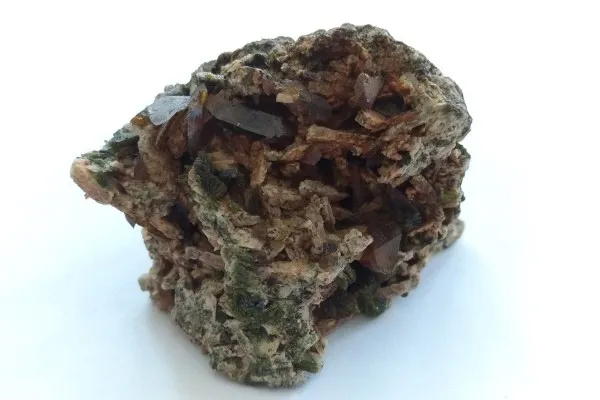
| ID | 50 | |
|---|---|---|
| Mineral |
Titanite
Epidote |
|
| Location | Imilchil - Draa-Tafilalet - Morocco | |
| Fluorescence | LW-UV: close SW-UV: close |
|
| Mindat.org |
View Titanite information at mindat.org View Epidote information at mindat.org |
|
Mindat data
| ID | 3977 |
|---|---|
| Long ID | 1:1:3977:8 |
| Formula |
CaTi(SiO4)O
|
| IMA Status |
0 1 |
| Other Occurrences | Common accessory mineral in intermediate and felsic plutonic rocks, pegmatites, alpine veins. Also in some gneisses, schists, and skarns. |
| Discovery Year | 1795 |
| Diapheny | Transparent,Translucent |
| Cleavage | Good on {110} |
| Tenacity | brittle |
| Colour | Brown, green, yellow, orange, rose-red, black, beige, grey, colourless, grey-blue, bluish |
| Hardness (min) | 5.0 |
| Hardness (max) | 5.5 |
| Lustre | Adamantine to resinous |
| About the name | First recognized as "nouveau substance minérale" in 1787 by Marc August Pictet, but only described and named in 1795 by Martin Klaproth for its titanium content. A common synonym, sphene (from the Greek sphenos (σφηνώ), meaning wedge, for its common wedge-shaped crystals), was introduced in 1801 by Rene Just Haüy. |
| Streak | White |
| Crystal System | Monoclinic |
| Cleavage Type | Distinct/Good |
| Morphology | Common forms are {111}, {110}, {102}, {100}, {001} and {112}. Crystals equant to wedge-shaped, or flattened with large {001} or {102}, or prismatic by extension along [001], to 65 x 17 x 17 cm, compact, massive. NOTE: The morphological data is based on a choice of unit-cell parameters that differs from the one that is given in Mindat. This 'old' unit cell has a = 6.56, b = 8.72, c = 7.44 Å and β = 119.54° (see the introduction in http://rruff.info/rruff_1.0/uploads/AM61_238.pdf). The 3D drawings of titanite are also based on this old cell. |
| Twinning | On {100}, contact and penetration, less commonly lamellar on {221}. |
| key_elements |
0 |
| shortcode_ima | Ttn |
| Group | Titanite Group |
| ID | 1389 |
|---|---|
| Long ID | 1:1:1389:1 |
| Formula |
Ca2(Al2Fe3+)[Si2O7][SiO4]O(OH)
|
| IMA Status |
0 1 |
| Other Occurrences | Regional and contact metamorphic rocks. Saussuritisation (alteration of plagioclase). |
| Discovery Year | 1801 |
| Diapheny | Transparent,Translucent,Opaque |
| Cleavage | Perfect on {001}, imperfect on {100} |
| Tenacity | brittle |
| Colour | Yellowish-green, green, brownish-green, black |
| Hardness (min) | 6.0 |
| Hardness (max) | 6.0 |
| Lustre | Vitreous |
| About the name | Named in 1801 by Rene Just Haüy from the Greek επιδοσιζ ("epidosis"), meaning "increase", in allusion to the crystal characteristic of one longer side at the base of the prism. |
| Streak | Colourless |
| Crystal System | Monoclinic |
| Cleavage Type | Perfect |
| Fracture type | Irregular/Uneven |
| Morphology | Crystals prismatic to 35 cm, also stubby, rarely tabular or pseudo-octahedral. Fibrous, coarse to finely granular, massive. Prismatic crystals may show a pseudo-hexagonal cross-section. |
| Twinning | On {100}, contact, lamellar, common. |
| shortcode_ima | Ep |
| Group | Epidote Group |
Details
Price: € 15
Dimensions: Not registered
Weight: 55 g
Visibile in overview:
Notes:
| Symbol | Element | |
|---|---|---|
| Al | Aluminium | |
| Ca | Calcium | |
| Fe | Iron | |
| H | Hydrogen | |
| O | Oxygen | |
| Si | Silicium | |
| Ti | Titanium |