Okenite
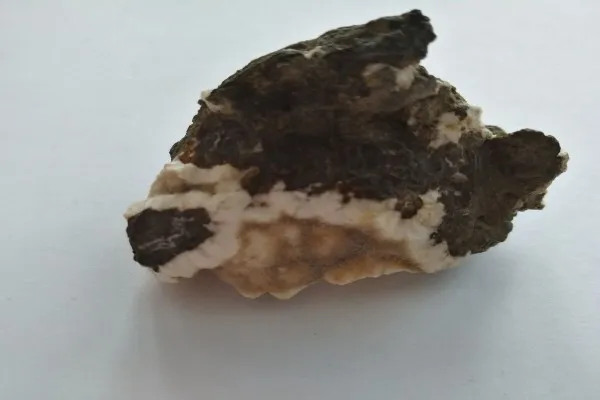
| ID | 30 | |
|---|---|---|
| Mineral | Okenite | |
| Location | Mumbai - Maharashtra - India | |
| Fluorescence | LW-UV: close SW-UV: close |
|
| Mindat.org |
View Okenite information at mindat.org |
|
Mindat data
| ID | 2967 |
|---|---|
| Long ID | 1:1:2967:0 |
| Formula |
Ca10Si18O46 · 18H2O
|
| IMA Status |
0 1 |
| Other Occurrences | Amygdules in basalts |
| Discovery Year | 1828 |
| Diapheny | Transparent,Translucent |
| Cleavage | on {001} |
| Tenacity | elastic |
| Colour | White to slightly yellow, blue |
| Hardness (min) | 4.5 |
| Hardness (max) | 5.0 |
| About the name | Named in 1828 in honor of the German biologist Lorenz Oken (Lorenz Ocken) (August 1, 1779, Bohlsbach (now part of Offenburg), Ortenau, Baden, Germany - August 11, 1851, Zurich, Switzerland), professor at University of Munich, Germany and later professor at University of Zürich, Switzerland. The original name, ockenite, was later shortened to okenite. On September 11, 1802, "Lorenz Oken came up with a new system of animal classification that demonstrated the path of evolution." (From Cell Theory Timeline, http://www.timetoast.com/timelines/71438) In 1805, Oken was the first to recognize the significance of biological cell structure: "All living organisms originate from and consist of cells" (Lefalophodon: Welcome to NCEAS | NCEAS. Web. 04 Oct. 2011.) His full birth-name was Lorenz Okenfuss. |
| Streak | White |
| Crystal System | Triclinic |
| Cleavage Type | Perfect |
| Morphology | Bladed crystals to laths. Commonly as fibers. |
| Twinning | About [010], composition plane {102}, lamellar |
| Thermal Behaviour | Heated in a closed tube, yields water. Before the blowpipe, becomes opaque and white and fuses to a glass. |
| Publication Year | 1828 |
| shortcode_ima | Oke |
Details
Price: € 5
Dimensions: Not registered
Weight: Not registered
Visibile in overview:
Notes:
| Symbol | Element | |
|---|---|---|
| Ca | Calcium | |
| H | Hydrogen | |
| O | Oxygen | |
| Si | Silicium |